

For decades, retirement savers have received the same basic advice: contribute to a 401(k), take the tax deduction, invest consistently, and let compound growth do the work.
That advice has helped millions of Americans build meaningful wealth. It can also create a major tax problem later in life.
Someone who retires with $1 million to $3 million in traditional tax-deferred accounts may discover that retirement does not bring the lower tax bill they expected. This problem does not come from poor planning. It often happens because the saver followed the traditional retirement playbook for 30 or 40 years and placed nearly every retirement dollar into the same taxable bucket.
The Three Ingredients of the Retirement Tax Trap
This problem usually develops when three things happen.
First, someone earns enough income to save consistently. Second, that person contributes to retirement accounts for many years. Third, most or all of those contributions go into tax-deferred accounts.
Traditional 401(k)s and IRAs provide a valuable current-year tax benefit. Contributions may reduce taxable income, and the investments can grow without annual taxation. However, the government eventually collects its share when the account owner withdraws the money.
That tradeoff can work well when someone deducts contributions at a high tax rate and withdraws the money later at a lower rate. The problem begins when future withdrawals push the retiree into the same tax bracket or a higher effective tax rate.
Tax Deferral Is Not Tax Elimination
A traditional retirement account does not permanently eliminate income taxes. It postpones them.
During your working years, you receive a deduction or exclude contributions from taxable income. The account then grows tax-deferred. When you withdraw the money, the taxable portion generally enters your tax return as ordinary income.
Many people assume retirement will automatically place them in a lower tax bracket. That assumption can fail when a retiree has several income sources, including Social Security, a pension, rental income, business income, and retirement-account distributions.
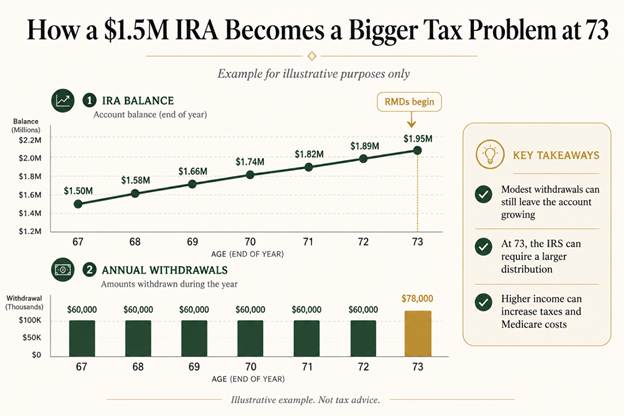
The IRA balance may also keep growing during the early retirement years. A retiree might withdraw 4 percent annually and still see the account increase because investment returns exceed the withdrawals.
The larger that balance becomes, the larger the future tax exposure may become.
Required Minimum Distributions Change the Equation
Before required minimum distributions begin, retirees generally control how much they withdraw from traditional IRAs. Required minimum distributions, commonly called RMDs, eventually remove part of that flexibility.
Under current rules, many account owners begin RMDs at age 73. The applicable age rises to 75 for people born in 1960 or later. The IRS calculates each annual RMD using the prior year-end account balance and a life-expectancy factor. Roth IRAs and designated Roth plan accounts do not require lifetime RMDs for the original owner.
Consider a couple who retires at age 67 with $1.5 million in a traditional IRA. They withdraw about $60,000 each year for living expenses while the remaining balance stays invested.
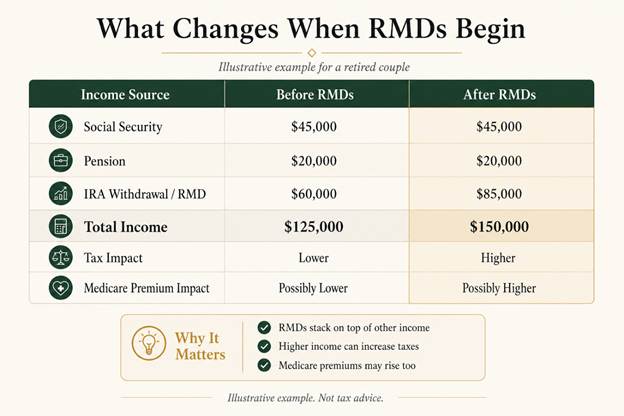
If the account grows to $2 million by age 73, the first RMD could exceed $75,000 based on the IRS life-expectancy table. That mandatory distribution would stack on top of Social Security, pensions, rental income, interest, dividends, and other taxable income.
The couple may not need the entire distribution for spending, but the tax law still requires them to withdraw it and report the taxable amount as income.
Why RMDs Can Keep Growing
RMDs depend on the previous year-end account balance and the distribution period assigned to the owner’s age.
As the retiree grows older, the distribution period generally gets smaller. A smaller divisor produces a larger required withdrawal percentage. If the account also grows, both parts of the formula can push the RMD higher.
The RMD can even increase when the account balance remains flat or declines modestly because the required percentage rises with age.
The Hidden Tax Torpedo
Retirement income does not operate in separate silos. One additional dollar of IRA income can trigger costs elsewhere.
Traditional IRA distributions can cause a larger portion of Social Security benefits to become taxable. The IRS determines Social Security taxability by considering one-half of the benefits plus other income, including tax-exempt interest.
Higher income can also trigger Medicare’s income-related monthly adjustment amount, commonly called IRMAA. IRMAA adds surcharges to Medicare Part B and Part D premiums.
For 2026, IRMAA begins when modified adjusted gross income from the relevant prior tax return exceeds $109,000 for an individual or $218,000 for a married couple filing jointly. Medicare generally uses tax information from two years earlier, so income recognized today can affect premiums later.
This creates a compounding effect. A larger RMD can increase taxable income, make more Social Security taxable, move the retiree into a higher marginal bracket, and increase Medicare premiums.
The retiree may pay thousands of dollars in additional taxes and premiums on a distribution that the government required but the household did not need for current spending.
The Planning Window Many Retirees Miss
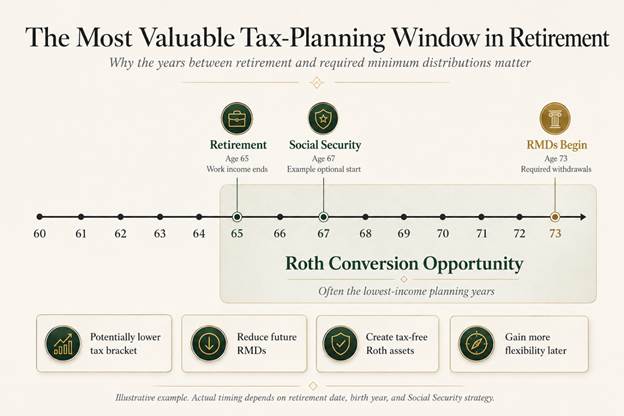
The years immediately after retirement often create one of the best tax-planning opportunities of a person’s life.
A retiree may no longer receive a salary, may not have started Social Security, and may still have several years before RMDs begin. During this period, taxable income can fall to its lowest level in decades.
This window may last five, ten, or even fifteen years depending on the retirement date, Social Security strategy, pension start date, and RMD age.
Without proactive planning, the retiree may spend only from taxable savings while allowing the traditional IRA to keep growing. That approach can produce a low tax bill today but much larger RMDs later.
Good retirement tax planning does not focus only on minimizing this year’s tax return. It focuses on managing taxes across the retiree’s lifetime.
How Roth Conversions Can Help
A Roth conversion moves money from a traditional IRA or eligible retirement plan into a Roth account. The account owner generally recognizes the converted taxable amount as income in the year of the conversion.
The conversion creates a tax cost today, but it can reduce the traditional IRA balance that will generate future RMDs. The Roth account can then grow tax-free, and qualified distributions generally remain tax-free. Original Roth IRA owners also avoid lifetime RMDs.
Suppose the hypothetical couple converts $30,000 each year between retirement and RMD age. Each conversion creates current taxable income, but it also gradually shifts money out of the future RMD calculation.
Over several years, that strategy may reduce future required distributions, create a source of tax-free retirement income, improve control over taxable income, reduce Social Security taxation, and lower the risk of crossing an IRMAA threshold.
The goal does not always involve converting the entire traditional IRA. A full conversion could generate an unnecessarily large tax bill. The better objective often involves creating tax diversification.
Tax Diversification Creates Choices
Retirement wealth can sit in three broad tax buckets: tax-deferred accounts, taxable brokerage and cash accounts, and tax-free Roth accounts.
A retiree with all assets inside a traditional IRA has limited flexibility because every withdrawal may create ordinary taxable income. A retiree with all three buckets can choose where to source cash and manage taxable income more deliberately.
During a high-income year, that person may use Roth or taxable assets. During a low-income year, the retiree may intentionally recognize IRA income or complete a Roth conversion.
This flexibility becomes especially valuable after a business sale, during a market downturn, after the death of a spouse, or when a major purchase creates an unusual cash need.
Roth Conversions Require Careful Coordination
Roth conversions can create significant value, but they do not work in isolation.
A conversion can affect federal income taxes, Medicare premiums, Social Security taxation, capital-gain rates, estimated tax payments, and the taxation of heirs.
The right amount depends on current income, future RMDs, expected tax rates, spending needs, estate goals, and available cash to pay the tax. A good analysis should compare the current plan with one or more conversion strategies across many years.
The lowest tax bill this year does not always produce the lowest lifetime tax bill.
My Final Thoughts
Disciplined retirement savers should feel proud of the wealth they built. However, a large traditional IRA or 401(k) represents both an asset and a future tax obligation.
The greatest risk often comes from waiting too long. Once RMDs begin, retirees lose some control over when taxable income appears. The planning window between retirement and RMD age may provide the best opportunity to reduce that exposure.
The solution does not require abandoning tax-deferred accounts or converting every dollar to Roth. It requires a deliberate strategy that balances current taxes against future taxes and creates more than one source of retirement income.
At Mills Wealth Advisors, we help business owners and successful families map their tax exposure before and during retirement. We evaluate RMDs, Roth conversions, Social Security, Medicare premiums, investment withdrawals, and estate-planning goals as one coordinated strategy.
The earlier you begin that analysis, the more options you may have. Do not wait for the first required minimum distribution to discover that your retirement account has been quietly building a tax problem.
If you are within ten years of retirement or already retired and have not mapped your RMD exposure, schedule a 15-minute intro call and we’ll show you what the next decade looks like.
This article provides general educational information and does not constitute individualized tax, legal, or investment advice. Consult your financial advisor and tax professional before implementing a Roth conversion or retirement distribution strategy.