

Most owners who ask “what’s my business worth” have already answered themselves with a rule of thumb. Someone at a networking event said businesses sell for two times revenue. A competitor sold for four times earnings, so that must be the number. The math feels solid because it’s simple. It’s also the fastest way to walk into a buyer conversation with a price nobody on the other side of the table will accept.
Buyers don’t value your business off a multiple you heard once. They value it off a specific earnings number, calculated a specific way, then apply a multiple that reflects your industry, your size, and how much of the business depends on you personally. Getting the earnings number right is most of the work. Getting it wrong is how deals fall apart in due diligence, months after everyone thought they’d agreed on a price.
SDE and EBITDA Are Not the Same Number
Both are ways of measuring what a business actually earns. Buyers pick which one to use based on size, and using the wrong one will skew your price in a direction you won’t like.
Seller’s Discretionary Earnings (SDE) starts with net income and adds back the owner’s salary, personal expenses run through the business, interest, taxes, depreciation, and amortization, then adds one-time or non-operating items. The idea is to show what the business would generate for a single owner-operator who runs it themselves and takes no other salary. This is the standard for businesses where the owner is still doing meaningful work in the company, roughly under $5 million in revenue.
EBITDA (earnings before interest, taxes, depreciation, and amortization) does not add back an owner’s salary, because the assumption is that a manager would need to be paid to run the business in the owner’s absence. This is the standard once a business is large enough, or has enough of a management layer, that a buyer expects to install a manager rather than work in the business themselves.
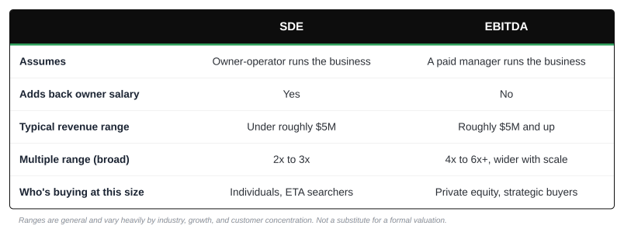
Sellers sometimes present SDE with an EBITDA-sized multiple, or the reverse, whichever makes the number bigger. A buyer’s advisor will catch this in the first conversation, and it costs you credibility before negotiation even starts.
Add-Backs Are Where Deals Get Won and Lost
Add-backs are the adjustments that turn your tax-return net income into SDE or EBITDA. Done honestly, they show a buyer the real cash the business throws off. Done aggressively, they’re the first thing a buyer’s CPA strips back out, usually taking your asking price down with them.
Legitimate add-backs typically include:
- Your salary and benefits, plus family members on payroll who don’t do the work
- Personal vehicle, travel, or meals run through the business
- One-time legal fees, moving costs, or a bad debt that won’t recur
- Above-market rent paid to yourself if you own the building
- Interest, taxes, depreciation, and amortization
Add-backs that raise flags with experienced buyers:
- “Lost” or unrecorded cash revenue you can’t substantiate
- Marketing or hiring you skipped that the business actually needs to run
- Normal repairs and maintenance reclassified as one-time
A buyer’s team will ask for documentation on every add-back over a few thousand dollars. If you can’t produce it, that add-back gets removed, and your earnings number, and your price, drop with it.
If you own the real estate your business operates from, a sale can trigger its own separate tax question. We covered that in Depreciation Recapture on Real Estate.
A DFW Example: HVAC Business, Two Ways
A Grapevine HVAC company generates $2.1 million in revenue. The owner works in the business full time and, like most companies this size, gets valued on SDE.
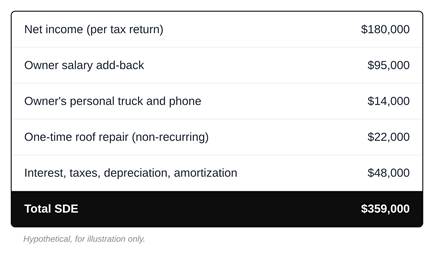
At a 2.5x SDE multiple, common for a residential HVAC business with steady recurring service revenue, this business is worth roughly $900,000. At 2x, closer to $720,000. That half-turn of multiple is a $180,000 swing, and it’s usually decided by things buyers actually care about: how concentrated the customer base is, whether revenue depends on the owner’s personal relationships, and how well documented the books are.
Who’s Actually Buying in DFW Right Now
The buyer pool for a business this size has shifted. BizBuySell’s most recent national market report found nearly half of small business buyers describe themselves as corporate refugees, people who left a corporate job to buy and run a business rather than start one from scratch. Roughly eight in ten expect to use SBA financing to fund the purchase, which means your business needs financials clean enough for a bank, not just a handshake buyer.
The same report points to a gap worth knowing about before you’re in a negotiation. About nine in ten buyers expect the seller to carry some financing, a note for part of the purchase price. Fewer than three in ten sellers actually plan to offer it. If you go into a sale assuming an all-cash close and the buyer pool assumes otherwise, that mismatch either kills your deal or forces a worse structure than you’d have accepted if you’d planned for it. DFW-specific buyer data isn’t publicly reported at this level of detail, so treat these as national benchmarks until we can compare them against what MWA is seeing in local deals.
Buyers today are also underwriting more carefully than they were a few years ago. Earnings need to be durable, not a good year that won’t repeat. A business with one dominant customer, or one owner nobody else knows how to replace, gets discounted for that risk regardless of how clean the SDE number is.
When a Back-of-Envelope Number Isn’t Enough
The math above is a starting point, not a number to put in front of a buyer. A formal valuation matters most when you’re within two or three years of a real exit, when partners or family members need a defensible number for a buyout, or when you’re using the valuation for estate or gifting purposes where the IRS will look closely at how you got there.
Exit planning is broader than the valuation itself. It’s making sure the business can run without you, that the number you need lines up with the number the business can actually produce, and that you’re not finding out any of this the year you’d planned to sell.
If you employ staff and are still funding your own retirement plan through the business, it’s worth revisiting how that plan is structured too. See Outgrowing Your SEP or Solo 401(k).
Frequently Asked Questions
How do I know if my business should be valued on SDE or EBITDA?
Revenue is the rough guide, under about $5 million typically means SDE, but the real driver is whether a buyer expects to run the business themselves or hire a manager. A business the owner has already stepped back from may use EBITDA even at a smaller revenue size.
What add-backs do buyers almost always accept?
Owner salary and benefits, interest, taxes, depreciation, amortization, and one-time expenses with paper trails. The further an add-back gets from documented and non-recurring, the more likely it gets challenged.
Can I estimate my business’s value myself, or do I need a professional?
You can build a reasonable range yourself using the approach above. A formal valuation matters once real money or a real timeline is involved: a pending sale, a partner buyout, or estate planning.
How much does a customer relying on me personally hurt the multiple?
Meaningfully. Buyers pay for cash flow that survives a change in ownership. If revenue is tied to relationships only you have, expect that reflected in a lower multiple, not just a note in the report.
The Bottom Line
The multiple you heard at a networking event isn’t wrong because multiples don’t matter. It’s wrong because it was never attached to your actual SDE or EBITDA, calculated with your actual add-backs, for a buyer pool that actually exists in DFW today. Before you put a number in your head, or in front of a buyer, run the calculation properly.
Stephen Nelson, CEPA, works with DFW business owners on exit readiness well before a sale is on the calendar. If you want a real look at what your business would show a buyer today, we’re glad to walk through it with you.
This article is educational and is not individualized tax, legal, or investment advice. Business valuations depend on industry, financial documentation, customer concentration, and other facts specific to your company.