

Real estate can be one of the most effective ways for business owners and investors to build long-term wealth. You can collect income, benefit from appreciation, use leverage, and deduct depreciation along the way.
The problem often shows up when it is time to sell.
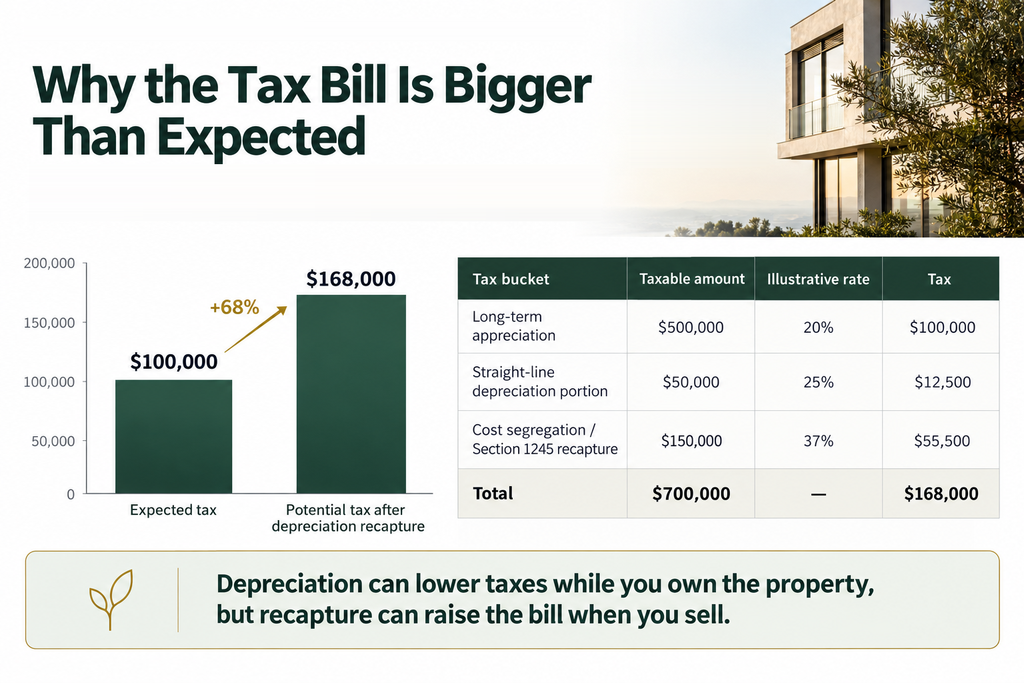
An investor may look at a property purchased for $1 million and sold for $1.5 million and assume there is a $500,000 long-term capital gain. If that investor expects a 20% federal capital gains rate, the anticipated federal tax bill might look like roughly $100,000.
That math can be incomplete.
Years of depreciation can reduce the property’s adjusted tax basis. Cost segregation can make the calculation even more complicated. By the time the property sells, one transaction can contain multiple categories of gain taxed under different rules.
For owners who wait until closing to understand those rules, the tax bill can come as a surprise.
Depreciation Saves Taxes While You Own the Property
Depreciation is one of the major tax benefits of owning investment real estate.
The tax code generally allows an owner to deduct a portion of a depreciable building’s cost over its applicable recovery period. Those deductions can reduce taxable income during the years the property is owned.
But depreciation also reduces the property’s adjusted tax basis.
Assume John, a business owner, buys a commercial property for $1 million. Over eight years, he claims $200,000 of depreciation. Ignoring other basis adjustments for simplicity, his adjusted basis falls to $800,000.
If John later sells the property for $1.5 million, his taxable gain is not simply the $500,000 increase from his original purchase price.
He now has a $700,000 gain because his adjusted basis is $800,000.
That is where many real estate owners get caught off guard.
The Gain Can Fall Into Different Tax Buckets
A real estate sale does not always produce one uniform bucket of long-term capital gain.
For depreciable real property, the portion of gain attributable to prior depreciation may fall into the unrecaptured Section 1250 gain rules and face a maximum federal rate of 25%. The remaining long-term gain may qualify for normal long-term capital gains rates. Depending on the taxpayer, the 3.8% Net Investment Income Tax may also apply.
Texas has no state income tax, so for a DFW owner the federal buckets are the whole story. An investor selling the same property from California could owe state tax on top of all of it.
Using John’s simplified example, assume $200,000 of the $700,000 gain relates to depreciation and the remaining $500,000 represents appreciation above his original $1 million purchase price.
If the $200,000 depreciation-related portion were taxed at 25% and the $500,000 appreciation were taxed at 20%, the simplified federal tax calculation would look like this:
$200,000 × 25% = $50,000
$500,000 × 20% = $100,000
Total = $150,000
John may have mentally budgeted $100,000 for taxes. Instead, the simplified calculation produces $150,000.
That is a meaningful difference, especially if he has already decided how to use the proceeds.
Cost Segregation Can Increase the Surprise
Cost segregation can make this more complicated.
A cost segregation study separates certain components of a building into shorter-lived asset classes. Instead of depreciating every eligible cost over the building’s long recovery period, portions may qualify for 5-year, 7-year, or 15-year treatment.
That can accelerate deductions dramatically. For a business owner in a high tax bracket, receiving those deductions earlier can create substantial value.
The tradeoff appears when the property sells.
Certain components identified through a cost segregation study may be Section 1245 property. Gain attributable to prior depreciation on Section 1245 property can be recaptured as ordinary income, up to the amount of depreciation allowed or allowable.
That ordinary income rate can be higher than the 25% maximum rate that applies to unrecaptured Section 1250 gain.
Suppose $150,000 of John’s $200,000 of depreciation came from Section 1245 components identified through cost segregation, while the remaining $50,000 relates to depreciation on the real property itself.
Using a 37% ordinary income rate for the Section 1245 recapture, a 25% rate for the $50,000 depreciation-related real property gain, and a 20% long-term capital gains rate on the $500,000 of appreciation, the simplified calculation becomes:
$150,000 × 37% = $55,500
$50,000 × 25% = $12,500
$500,000 × 20% = $100,000
Total = $168,000
These simplified figures leave out the 3.8 percent Net Investment Income Tax. For many investors in the top bracket it applies to the entire gain, which on John’s $700,000 would add roughly $26,600. Whether it applies depends on how the property is used and held, including whether it is rented to a business the owner actively runs.
That is a far cry from the $100,000 John may have initially expected. It also matches the problem I see with looking at a real estate sale strictly through the lens of the property’s purchase price and sale price.
The point is not that cost segregation was a bad strategy. John benefited from receiving deductions earlier.
The point is that the exit needs to be modeled when the strategy is implemented, not discovered when the property sells.
A 1031 Exchange Can Defer Tax on Qualifying Real Estate
Section 1031 provides one of the best-known ways to defer gain on investment or business real estate.
In a properly structured like-kind exchange, an investor disposes of qualifying real property and acquires qualifying replacement real property. The investor generally defers recognition of gain rather than paying all of the tax immediately.
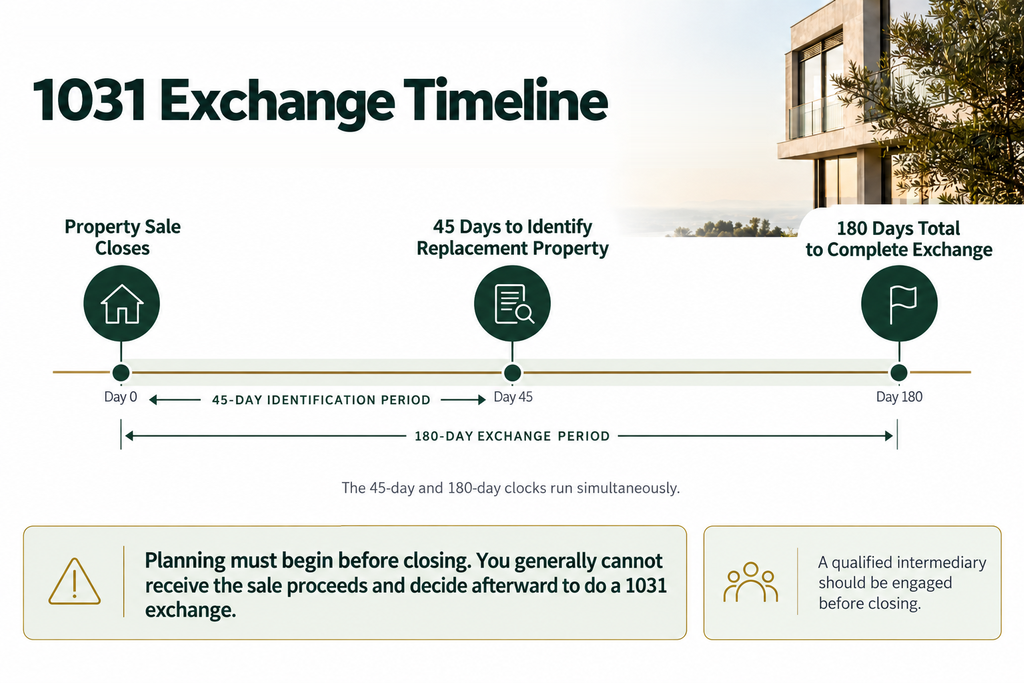
The investor generally has 45 days after transferring the relinquished property to identify replacement property. The investor then must receive the replacement property within 180 days of the original transfer, or by the applicable tax-return due date if that comes first.
The two clocks run at the same time. The investor does not get 45 days plus another 180 days.
A qualified intermediary commonly holds the proceeds during a deferred exchange so the seller does not take actual or constructive receipt of the money.
This is where advance planning becomes critical.
If the seller receives the proceeds and only afterward decides that a 1031 exchange would have been helpful, the opportunity may already be gone.
A successful exchange generally carries the deferred gain into the basis of the replacement property rather than erasing it. Many real estate investors continue exchanging into new properties over time, which can extend the deferral for years.
Cost segregation creates another layer of complexity. Section 1031 applies to real property, and Section 1245 components can require separate analysis. An owner should not assume that every dollar of depreciation recapture will automatically disappear inside a 1031 exchange.
The transaction needs to be modeled before closing with the CPA, tax attorney, qualified intermediary, and wealth advisor working from the same numbers.
Qualified Opportunity Funds Offer a Different Type of Deferral
Qualified Opportunity Funds can provide another planning path for eligible gains.
Unlike a 1031 exchange, an investor generally does not need to reinvest the entire sale proceeds. The investor can elect to invest an amount corresponding to eligible gain into a Qualified Opportunity Fund.
For eligible gains, the investment generally must occur within the applicable 180-day period.
The Opportunity Zone rules are also changing.
For qualifying investments made under the original program through the end of 2026, deferred gain generally becomes taxable no later than December 31, 2026, unless an earlier inclusion event occurs. In practical terms, a gain rolled into a fund under the old rules this fall is deferred by only a few months.
For qualifying investments made after December 31, 2026, the newer framework generally allows deferral until the earlier of an inclusion event or five years after the qualifying investment. The new rules also provide a 10% basis increase after a five-year holding period for qualifying investments, with a larger basis increase available for certain qualified rural opportunity fund investments.
If an investor satisfies the requirements and holds a qualifying Opportunity Zone investment for at least 10 years, the investor may also be able to eliminate federal tax on appreciation that occurs inside the qualifying fund investment.
That does not make an Opportunity Zone investment automatically attractive.
The investment still has to make economic sense. Fees, liquidity, manager quality, concentration, underlying real estate, timing, and risk matter.
A tax benefit should improve a good investment, not justify a bad one.
Planning Before the Sale Creates Options
The common thread between a 1031 exchange and an Opportunity Zone investment is timing.
These strategies become much harder, and sometimes impossible, after the sale has already closed.
That is why I want a business owner or real estate investor to start planning well before the property hits the closing table.
We want to know the original cost basis, accumulated depreciation, cost segregation history, expected sale price, debt payoff, selling expenses, ownership structure, other gains and losses, and what the owner actually wants to accomplish with the proceeds.
Then we can compare the choices.
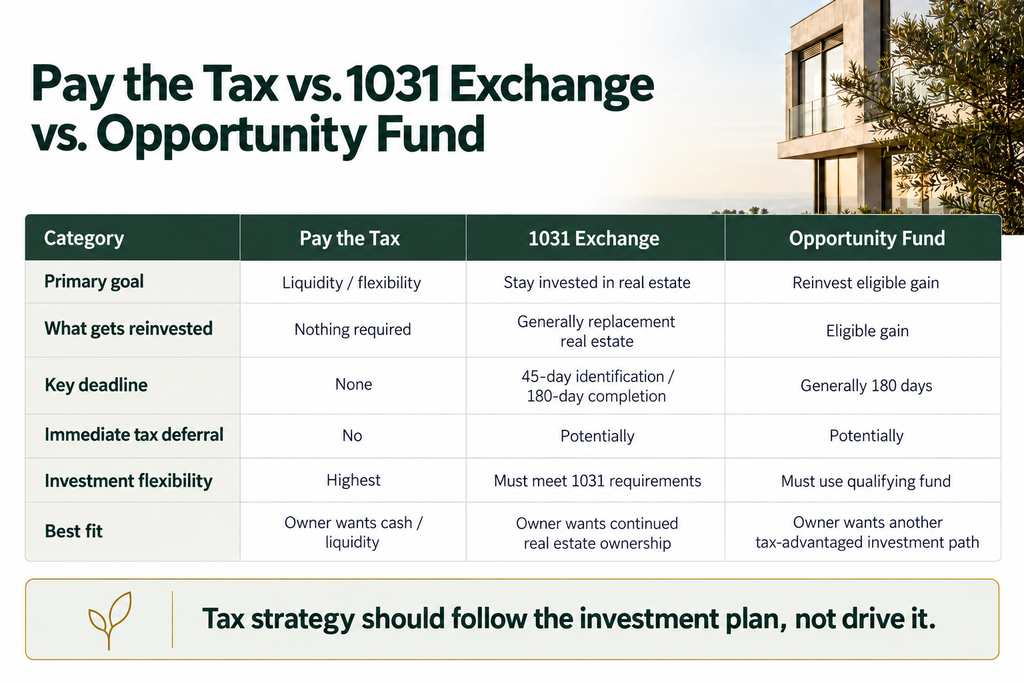
The right answer may be to pay the tax and move on. Liquidity and flexibility have value.
The right answer may be a 1031 exchange because the owner wants to remain invested directly in real estate.
The right answer may involve a Qualified Opportunity Fund because the owner wants to diversify and has an eligible gain.
Sometimes the best plan uses none of these strategies.
The important part is making that decision intentionally instead of learning about the tax consequences after the closing statement is final.
My Final Thoughts
Depreciation is valuable, but it is not free money. It lowers taxes while you own the property and also changes the tax calculation when you sell.
Cost segregation can accelerate those benefits, but it can also create additional recapture exposure. A property that appears to have a straightforward $500,000 capital gain may produce a much larger taxable gain once you account for the reduced basis and the different tax buckets.
That does not mean you should avoid depreciation, cost segregation, or appreciated real estate. It means your acquisition strategy and your exit strategy should connect.
If you own appreciated investment property and expect to sell, start modeling the transaction before you sign the closing documents. We run these numbers with DFW business owners and investors regularly, and we are glad to run yours. A 1031 exchange, a Qualified Opportunity Fund, or simply paying the tax may each make sense in the right situation.
The worst time to discover your options is after they have already expired.
This material is for educational purposes only and should not be considered individualized tax, legal, or investment advice. Tax consequences depend on the specific facts of each transaction. Investors should coordinate with their tax and legal professionals before implementing a strategy.