
You packed the house, found a new doctor and registered the car. The folder holding your will and powers of attorney probably came along in a box, signed years ago under another state’s law. Texas will usually honor those papers. The harder question is whether they will work quickly for the people who have to use them, at a Texas bank, a Texas hospital and a Texas probate court.
Leaving the folder alone is itself a choice. It means your family tests the old documents at the worst possible moment, during an illness or right after a death, when a clerk’s request for more paperwork costs weeks. A review now takes one meeting and settles those questions while you can still answer them yourself.
What Texas already honors
Start with the job each document does. Seven papers decide who acts for you when you cannot, and a move to Texas puts every one of them in question. The map below sorts them into money, health care and your estate.
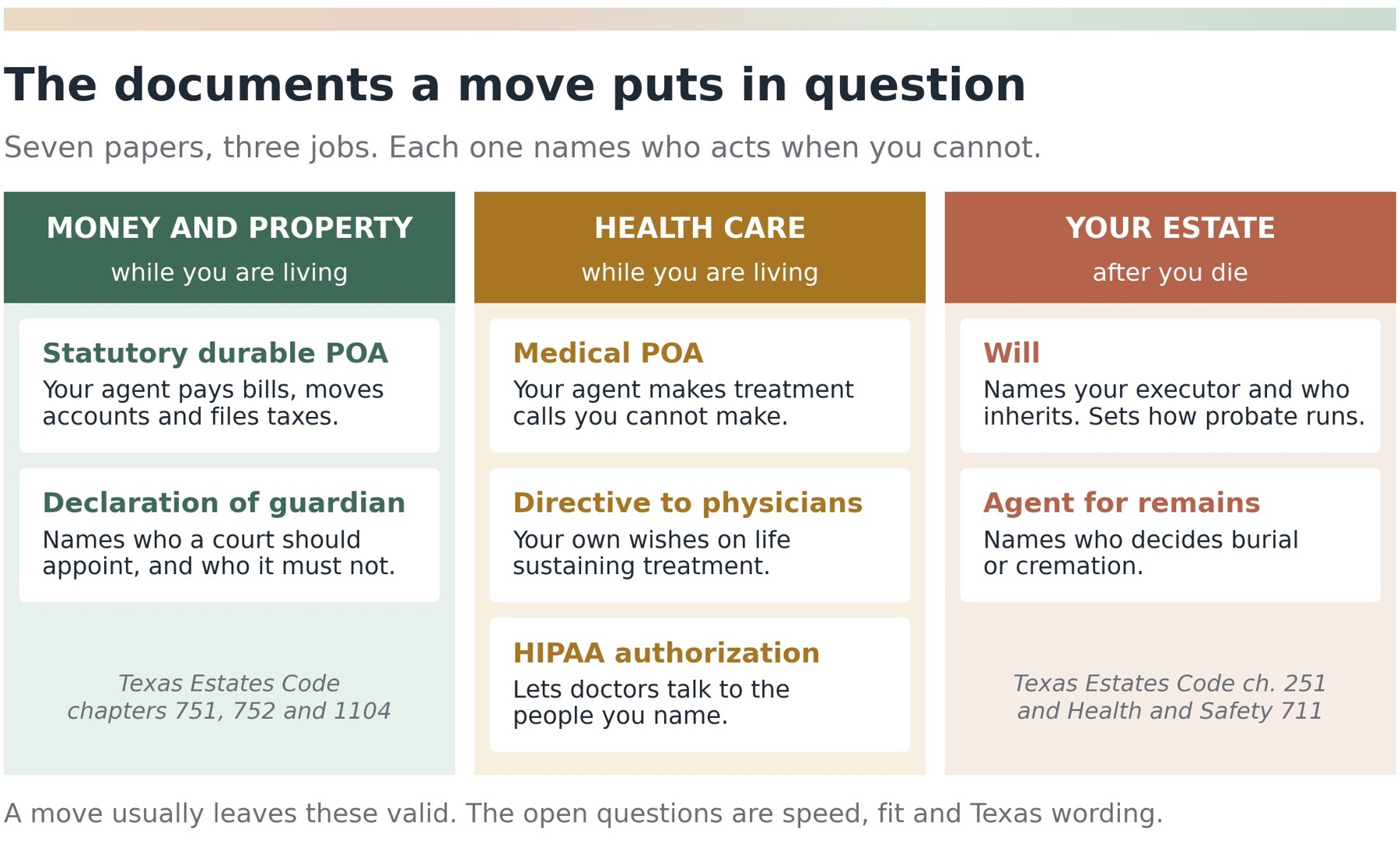
Texas law gives most out of state documents a path to recognition. A will counts as validly signed if it met the law of the place where you signed it, or the law of the state where you lived, when you signed it (Texas Estates Code 251.053). A durable power of attorney signed elsewhere stays valid if it met the law that governs it (751.0023). Medical directives from another state carry the same effect as Texas ones (Health and Safety Code 166.005). Valid, though, is not the same as ready, as the rest of this review shows.
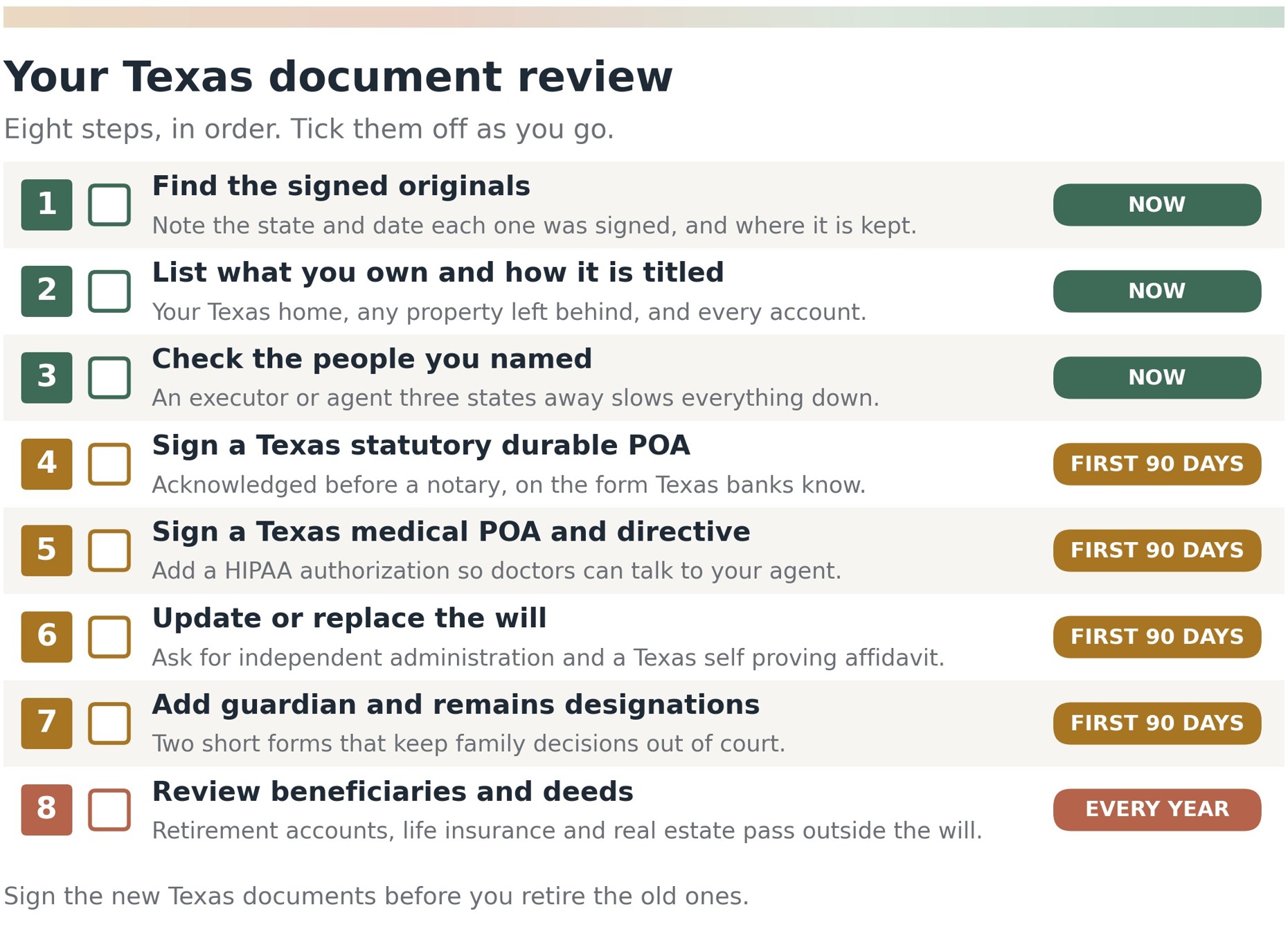
Your review, in order
The first three steps need only you and your folder. The next four happen with a Texas estate planning attorney, ideally within your first three months here. The last one repeats every year.
Why banks hesitate on an out of state POA
A valid document can still sit on a desk. Texas requires a bank or brokerage to accept a durable power of attorney, but the law also lets it ask the agent for a certification, an English translation or a lawyer’s opinion before it acts. The institution has 10 business days to accept or make that request, then 7 more business days after it receives the certification or opinion (Estates Code 751.201). Picture Mark and Priya, who moved from Ohio to Frisco. Mark has a stroke, and Priya brings his Ohio power of attorney to the firm holding his $480,000 IRA and brokerage account. A clerk unfamiliar with Ohio wording asks for an opinion of counsel. Nearly four weeks pass before Priya can move money for the mortgage and medical bills.
The Texas statutory form removes most of that friction. Texas clerks see the statutory durable power of attorney every week. It must be signed and acknowledged before a notary, and it states in plain words that it survives incapacity (751.0021). A fresh signature also tells the bank the document is current, which matters more than many people expect.
How an old will slows Texas probate
Texas probate is simple when the will asks for it. Texas wills commonly request independent administration, which lets the executor settle the estate with little court supervision, and waive the executor’s bond. Wills drafted in many other states never mention either. Without that language, every heir must agree to independent administration (Estates Code 401.002). One reluctant stepchild can push a $900,000 estate into court supervised administration, with a bond premium and a judge approving each step.
The affidavit matters too. A self proving affidavit lets a Texas court admit the will on paper without calling the witnesses. Texas expects that affidavit to follow its own statutory form in substance (251.104). An affidavit written for another state may not qualify, and tracking down witnesses who live a thousand miles away adds cost and delay.
Community property changes the math
Texas is a community property state. Most of what a married couple earns and buys while living here belongs to both spouses equally, and each spouse can leave only their own half by will. Assets you built in a separate property state generally keep their earlier character. A plan drafted in Illinois or Pennsylvania rarely accounts for that mix, so gifts and trust shares can land differently than you intended once the new Texas home and paychecks enter the picture. The mix matters at tax time too. When a spouse dies, community property generally receives a fresh cost basis on both halves, while a jointly owned asset brought from a separate property state usually receives it on only the deceased spouse’s half. Texas lets spouses convert separate property to community property by written agreement, a decision that belongs in the same conversation as your attorney and your tax planning.
Health care papers and the people you named
Your medical documents likely still work. Texas honors them under 166.005, but hospital staff move fastest with the Texas medical power of attorney and directive to physicians they already know. Add a HIPAA authorization so doctors can speak with your agent before any crisis. Then look at the names. An executor, agent or guardian chosen for life in the old state may now live three states away, and Texas lets you name a guardian in advance and rule out anyone you would never want (Estates Code 1104.202).
Property you left behind
A Texas will cannot keep your old house out of your old state’s court. If you kept a home, a rental or a lake cabin where you used to live, your executor generally must open a second, ancillary probate there. Picture Janet, who moved to Keller but kept a $310,000 cabin in Michigan. Her Texas estate settles in months, while the cabin waits on a Michigan court and a Michigan lawyer. A revocable trust, or a transfer on death deed where that state allows one, can move the property outside both courts. Texas offers the same deed for real estate here.
Originals, copies and where to keep them
The two documents follow different rules. Texas lets an agent use a photocopy or electronic copy of a durable power of attorney with the same effect as the original, unless the document says otherwise (751.0023). A will works the other way. The court wants the signed original, and a missing original can lead a court to presume you revoked it. Store the will somewhere safe, tell your executor exactly where, and give your agents copies of the Texas powers of attorney as soon as you sign them.
Keep or replace
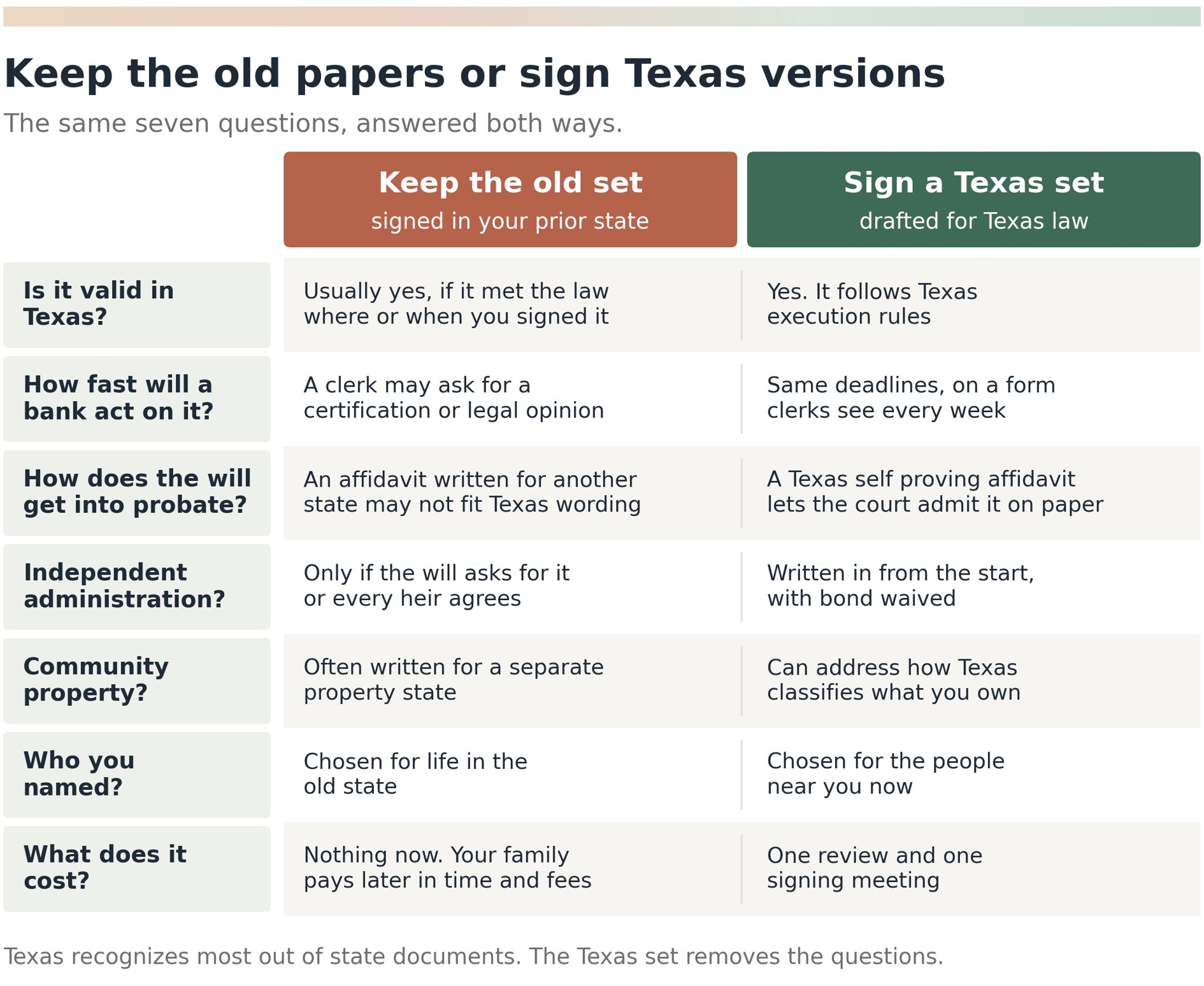
Side by side, the two sets differ less on validity than on speed. Your old papers usually still count in Texas, but a bank can ask for a certification or legal opinion before it acts. An affidavit written for another state may not fit Texas wording, and independent administration only happens if the will asks for it or every beneficiary agrees. A Texas set is drafted for community property and for the people who live near you now. Keeping the old set costs nothing today, but your family pays later in time and fees.
Who this fits
Three clients, three answers. Denise moved from Colorado to Southlake at 61 with a two year old will and an agent still living in Denver, so she kept the will, signed a Texas power of attorney and medical set, and named a local daughter. Ray and Linda came from New Jersey with a trust based plan and a house still up for sale, so their attorney rewrote the will for Texas community property and planned around the New Jersey deed. Tomas, 38, relocated from California with young children and no guardian named in any document, so he signed the full Texas set in one meeting.
One step before you file the folder away
Sign first, then retire. Keep your old documents in place until the Texas versions are signed, and then tell your agents and executor which set governs. Bring the folder, a list of accounts and deeds, and your beneficiary forms to a Texas estate planning attorney. We are glad to coordinate that review with your financial plan so the documents and the accounts point the same way. This article offers general education, not legal advice.