
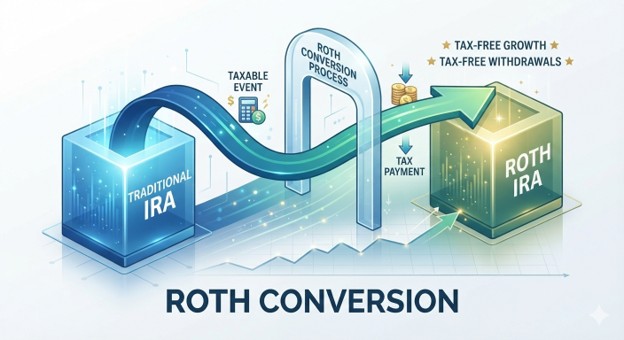
If you’ve recently retired, you may be sitting in the lowest tax brackets you’ll see for the rest of your life. The paychecks have stopped. Social Security may not have started. Required withdrawals from your IRA are still years away. For a lot of DFW retirees, that stretch is the best chance they’ll ever get to move money out of a pre-tax account at a discount.
A Roth conversion is how you do it. And the last three months of the year are when you can do it with the most information and the fewest surprises. The question we hear most isn’t whether to convert. It’s how much, and the answer usually comes down to a few income lines you can see on a page.
What a Roth Conversion Actually Does
A Roth conversion moves money from a pre-tax account, like a traditional IRA or an old 401(k), into a Roth IRA. The amount you move counts as ordinary income in the year you move it. That’s the whole cost. After that, the money grows tax-free, comes out tax-free in retirement, and never has to come out at all during your lifetime, because Roth IRAs have no required minimum distributions.
So, a conversion is really a bet about tax rates: you pay a known rate now to avoid an unknown rate later. It makes sense when today’s rate is lower than the one you, your surviving spouse, or your children would pay on the same dollars down the road.
Why October Through December Is the Sweet Spot
A conversion must be completed by December 31 to count for that tax year. That deadline is the reason to wait until fall, and the reason not to wait too long:
- You finally know your income. By October most of the year is on the books: the last paycheck if you retired this year, the pension, the interest, the consulting income. Mutual funds publish their estimated capital gain distributions in the fall and pay them in December. Converting in November means working from real numbers, not guesses.
- There are no do-overs. Until 2018 you could undo a conversion after the fact. Congress ended that, so a conversion today is permanent. Waiting until you know where your income lands is the only undo button left.
- A down market helps. If your account is down, the same number of shares converts at a lower value, and the recovery happens inside the Roth. There’s no guarantee the market will drop, but converting late in the year lets you act on a dip if one comes.
- Withholding can cover the tax on time. Taxes withheld from an IRA distribution are treated as paid throughout the year, even if it’s withheld in December. That can keep a late-year conversion from triggering an underpayment penalty. Most people are better off paying the tax from a taxable account, though, and making the fourth quarter estimated payment due January 15.
- December 31 really means mid-December. Custodians get busy, and many set their own processing cutoffs before the holidays. Plan to have instructions in by the first week of December.
The Window Between Retirement and RMDs
For early retirees, the conversion window is measured in years, not months. If you were born between 1951 and 1959, required minimum distributions start at 73. If you were born in 1960 or later, they start at 75. Retire at 62 and hold off on Social Security, and you may have a decade of unusually low taxable income before those withdrawals start.
RMDs are forced income, and they grow as the account grows. Stack them on top of Social Security and the couple that was in the 12% bracket at 64 can find themselves in the 22% or 24% bracket at 76. It gets worse for the survivor: when one spouse dies, the other moves to the single brackets, where the 24% rate starts at about half the income it does for a couple.
Texas adds one more reason. There’s no state income tax here, so a Texas retiree converts at the federal rate alone. Your children may not be so lucky. Most children who inherit an IRA must empty it within ten years, at their own federal rate, plus state tax if they live somewhere that has one. A Roth they inherit comes to them tax-free.
How Much to Convert: Fill the Bracket, Mind the Lines
The most common answer is to convert enough to fill up your current tax bracket and stop. For 2026 the 12% bracket for a married couple ends at $100,800 of taxable income and the 22% bracket ends at $211,400. But the bracket isn’t the only line that matters, and for retirees the others are often closer:
- The top of your bracket. Add up your taxable income for the year, subtract it from the top of the bracket, and that difference is your room.
- The Medicare surcharge. Medicare charges higher Part B and Part D premiums, called IRMAA, when your modified adjusted gross income crosses set thresholds. Two things make it easy to cross by accident. It’s based on your income from two years earlier, so a 2026 conversion sets your 2028 premiums. And it’s a cliff: in 2026 a married couple with income of $218,000 pays standard premiums, while $1 more adds about $96 a month to each spouse’s premiums, or about $2,300 a year combined.
- The senior deduction. Through 2028, each taxpayer 65 or older gets an extra $6,000 deduction. It shrinks by 6% of every dollar of income above $150,000 for a couple, or $75,000 if you’re single. In that range, a 22% conversion dollar really costs about 23.3%.
- Social Security. If you’ve already claimed benefits, conversion income can make more of each check taxable, up to 85%. Those thresholds aren’t indexed for inflation, so most retirees with a meaningful IRA reach them.
- Health insurance before 65. Retire before Medicare and buy coverage on the marketplace, and the premium subsidy depends on your income. The enhanced subsidies expired at the end of 2025, which brought back the cutoff at 400% of the poverty line. Cross it and the subsidy can drop to zero, often a far larger cost than the tax on the conversion itself.
A Simplified Illustration
Take a McKinney couple, both 66, retired and waiting until 70 to claim Social Security. They have $50,000 in pension and interest income and $1.4 million in traditional IRAs. Their combined deductions come to $47,500: the standard deduction ($32,200), the over 65 bonus deduction ($3,300), and the new OBBBA senior deductions ($12,000). Here’s what three different conversion amounts cost them in 2026:
- Fill the 12% bracket. Converting about $98,000 takes their taxable income to the top of the 12% bracket. The added federal tax is about $11,400, or 11.5% of what they moved.
- Stop under the Medicare line. Converting $165,000 keeps their income just under $218,000, the first IRMAA threshold. The added tax is about $26,900, or 16.3%, and they give back part of their senior deduction along the way.
- Fill the 22% bracket. Converting about $203,000 takes them to the top of the 22% bracket. The added tax is about $35,700, or 17.6%, and two years from now their Medicare premiums rise by about $96 a month each, or about $2,300 a year combined.
All three average well under the 22% or 24% they’d likely pay on those dollars once RMDs and Social Security arrive, and the middle one gets most of the benefit without touching Medicare.
(PLEASE NOTE: This example is hypothetical and for illustrative purposes only; it uses 2026 federal brackets and deductions, 2026 Medicare thresholds, and assumes no other income, credits, or changes in law, none of which any real situation guarantees. Results depend on your full tax picture, future tax rates, and how the converted assets perform — investments can and do lose value.)
Key Considerations and Risks
- Pay the tax from outside the IRA if you can. Tax paid out of the conversion itself shrinks what lands in the Roth. If you’re under 59½, the amount withheld is also an early distribution, with a 10% penalty on top.
- Each conversion starts its own five-year clock. If you’re under 59½, withdrawing converted dollars within five years of the conversion brings back the 10% penalty. After 59½ that clock stops mattering for converted amounts, though earnings have their own five-year rule.
- A conversion is a bet on future tax rates. You pay tax now because you expect a higher rate later. Today’s brackets are no longer set to expire, but Congress can still change them either way. The senior deduction ends after 2028, which makes 2026 through 2028 a little cheaper to convert. If later your rate turns out to be lower, you overpaid.
- Medicare looks back two years. If you retired this year, your current premiums may reflect your final working years. Work stoppage is a life-changing event Social Security will consider on Form SSA-44, so that surcharge can often be appealed.
- Mills Wealth Advisors is not a tax advisor. The right amount depends on your full return, including deductions, credits, and state residency, and should be coordinated with your CPA or tax advisor.
Where It Fits in a Wealth Strategy
Roth conversions work best as a plan spread over years, not a one-time move. A short list for this fall:
- In October, project your 2026 taxable income, including any capital gain distributions your funds have announced.
- Find your room: the distance to the top of your bracket, and the distance to the nearest IRMAA or subsidy threshold. Convert to whichever is closer.
- Decide how you’ll pay the tax and plan the January 15 estimated payment if it comes from outside the IRA.
- Get conversion instructions to your custodian by the first week of December.
- Map the years between now and your RMD age, so each fall’s conversion is one step in a plan rather than a guess.
The Bottom Line
For many retirees, the years between the last paycheck and the first RMD are the lowest tax years they’ll ever have, and the best time to convert. Wait until late in the year, when your income is known, then convert up to whichever line comes first: the top of your bracket or the Medicare threshold. And before any money moves, get your CPA and your investment advisor talking, so everyone is working from the same numbers.
Disclosure: This material is provided for informational and educational purposes only and does not constitute tax, legal, or personalized investment advice. Mills Wealth Advisors is not a tax or legal advisor. Tax brackets, deductions, Medicare premium thresholds, marketplace subsidy rules, and required minimum distribution ages change over time and depend on individual circumstances; figures cited reflect published amounts as of September 2026 and should be confirmed with your tax advisor before you act. A Roth conversion cannot be reversed once completed. Investing involves risk, including the possible loss of principal. Past performance is not a guarantee of future results.