

Two Very Different Answers to the Same Question
Back-to-school season has a way of making college feel closer, and September is a fitting month to think it through, because it is also when Texas opens enrollment for its prepaid tuition plan.
Texas offers both kinds of 529 plans, and they are not two versions of the same product. One is an investment account. The other is a contract to prepay tuition. That single difference decides which risk you hand off, what your dollars can pay for, and what happens if your child’s plans change. A savings plan leaves market risk with you and gives you flexibility in return. The prepaid plan transfers tuition inflation risk to the state and takes flexibility in return.
A Traditional 529 College Savings Plan
An investment account with a tax advantage. You contribute after-tax dollars, choose an investment option, and the balance rises and falls with the markets. Withdrawals for qualified education expenses come out free of federal income tax. Texas offers the direct-sold Texas College Savings Plan and the advisor-sold LoneStar 529 Plan, and you are not limited to your own state’s plan.
The qualified expense list is broad: tuition and required fees at virtually any eligible school in the country, books, supplies, equipment, computers, room and board within limits for students enrolled at least half-time, registered apprenticeship costs, up to $10,000 in lifetime student loan repayment per individual, K-12 expenses up to $20,000 per year per student, and postsecondary credentialing expenses. Texas has no state income tax, so there is no state deduction to chase and none to recapture. The account can also lose money, including principal.
The Texas Tuition Promise Fund
A prepaid tuition plan, so you are buying a contract rather than a balance. Each tuition unit represents one percent of an academic year of undergraduate resident tuition and schoolwide required fees at Texas public colleges and universities, excluding medical and dental schools. Buy 100 of the right unit type and you have prepaid one academic year. Texas public institutions must then accept the plan’s payment as payment in full for the credit hours those units cover, and must waive any difference from the actual charge. You are not hoping your account outran tuition. You prepaid the hours.
Enrollment runs September 1 through the last day of February, extended through July 31 for children under age 1. There is a one-time $25 application fee and no ongoing management fee, commission, or sales charge. Payment structure matters, though: a lump sum locks in today’s unit price outright, while an installment contract locks in the price but adds a 6 percent finance charge, and a pay-as-you-go account buys units at whatever price is in effect when each payment arrives. Units must be held three years before use, and they expire ten years after the beneficiary’s projected high school graduation date.
Visual 1. Tuition Unit Types, 2026-27 Sales Period
| Unit type | Priced on | Price per unit |
| Type I | The most expensive Texas public four-year college or university | $165.12 |
| Type II | The weighted average of all Texas public four-year colleges and universities | $115.92 |
| Type III | The weighted average of all Texas public two-year colleges | $32.58 |
Source: Texas Tuition Promise Fund 2026-27 tuition unit pricing schedule. Prices reset each September 1. Any unit type can be used at any eligible school, so 100 units buys an academic year only at the school matching that unit’s pricing index. One year at the University of Texas at Dallas fixed tuition plan costs $16,512, or 100 Type I units. The same year at Austin Community College costs $2,550, or about 15.
Side by Side
Visual 2. Traditional 529 College Savings Plan vs. Texas Tuition Promise Fund
| Category | 529 college savings plan | Texas Tuition Promise Fund |
| Structure | Investment account. You own a balance. | Prepaid contract. You own tuition units. |
| What it pays for | The full federal list: tuition, fees, books, supplies, equipment, computers, room and board within limits, apprenticeships, limited loan repayment, K-12 and credentialing expenses. | Undergraduate resident tuition and schoolwide required fees only. Nothing else. |
| Investment risk | Yours, including the risk of loss. | None on in-plan redemptions. Market results affect Refund Value and Transfer Value only. |
| Tuition inflation | You bear it. The account must outgrow tuition. | The plan bears it for covered hours at Texas public institutions. |
| Texas public schools | Pays qualified expenses like any other school. | Full unit value, and the school must waive the difference. |
| Private and out-of-state schools | Pays qualified expenses at full account value nationwide. | Transfer Value only, which may be well below actual cost. |
| Room, board, books, computers | Qualified expenses within federal rules. | Not covered. |
| Beneficiary changes | To a member of the beneficiary’s family, no federal income tax. | Same, but the new beneficiary must also meet Texas residency rules. |
| Unused funds | Change beneficiary, roll to another 529 or an ABLE account, use limited loan or K-12 amounts, or roll to the beneficiary’s Roth IRA if eligible. | Change beneficiary, move Transfer Value to a savings plan, roll to a Roth IRA if eligible, or cancel for Refund Value. |
| Financial aid asset | An investment, generally a parental investment for a dependent student. | Generally reported at refund value. Texas law excludes it from Texas state aid eligibility. |
| Time limit | None. | Ten years after projected high school graduation, extended only for military service. |
Sources: Texas Tuition Promise Fund Plan Description and Master Agreement and December 2025 supplement; IRS Topic No. 313 and Publication 970; Federal Student Aid 2026-27 guidance. Rules and dollar limits are subject to change.
Be Precise About What Prepaid Tuition Covers
Units pay undergraduate resident tuition and schoolwide required fees. They do not pay for housing, meals, transportation, books, supplies, equipment, or computers, and they do not cover fees that are not schoolwide required, such as lab or major-specific fees. A student attending a Texas public junior college from outside its taxing district also owes the out-of-district difference.
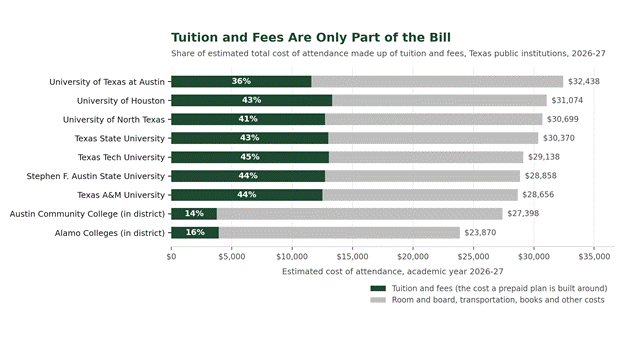
Visual 3. Source: Texas Higher Education Coordinating Board cost of attendance data as of January 5, 2026, as published in Texas Tuition Promise Fund materials for 2026-27. Four-year figures reflect resident undergraduates taking 15 credit hours in fall and spring; community college figures reflect in-district students. Reported tuition and fees may include fees that are not schoolwide required and therefore are not covered by tuition units.
Tuition and fees run roughly 36 to 45 percent of estimated total cost at these universities, and closer to 14 to 16 percent at the community college districts, where housing dominates. Prepaying four years of tuition is meaningful, but it does not finish the job, which is why the plan’s own materials suggest considering a prepaid plan and a savings plan together.
If Your Child Goes Out of State or Private
For a savings plan, a non-event. For the prepaid plan, this is the question that matters most. Units can still be used, but only at Transfer Value: the lesser of what they would cover at a Texas public school or their original purchase price plus or minus the plan’s net investment earnings or losses. That applies at Texas private schools, out-of-state schools, medical and dental schools, career schools, and apprenticeship programs, and the plan’s own disclosures state it may be significantly less than actual cost. You keep the dollars. You lose the promise. Transfer Value can also be moved into a 529 savings plan and spent on the broader federal expense list.
If You End Up With More Than Your Student Needs
- Scholarship. Unused units are refundable at Refund Value regardless of the three-year holding period, and the scholarship exception waives the 10 percent additional tax on earnings, though income tax still applies. The tax reporting goes to the purchaser, not the student.
- Change the beneficiary. Both routes allow a change to a member of the beneficiary’s family with no federal income tax. The prepaid plan adds a Texas residency requirement, and any change can raise gift or generation-skipping tax questions.
- Roth IRA rollover. Up to $35,000 lifetime per beneficiary, from an account open at least 15 years, by direct trustee-to-trustee transfer to the beneficiary’s own Roth IRA, excluding contributions and earnings from the prior five years, and capped each year at the beneficiary’s Roth IRA contribution limit, $7,500 for 2026, and their earned income. It is a ceiling reached over several years, not one transfer.
- Cancel the contract. After three years you receive Refund Value: purchase price plus or minus adjusted net earnings, at a rate the board sets up to 2 percent below actual net returns and capped at 5 percent. Earlier, or on default, you receive Reduced Refund Value, which includes losses but no earnings.
Where Grandparents Fit
- Ownership. A grandparent can purchase a prepaid contract if the grandchild is a Texas resident, or own a savings account with no residency requirement. In the prepaid plan, only the purchaser can direct redemptions, beneficiary changes, or refunds.
- Financial aid. Federal Student Aid treats 529 accounts, and the refund value of prepaid plans, as investments, and for a dependent student an account designated for that student is generally a parental investment. Its 2026-27 guidance provides that a dependent student who is only the beneficiary and not the owner does not report the account as a student asset, and that tax-free qualified distributions are not treated as other financial assistance. Federal rules can change and institutional forms such as the CSS Profile can differ.
- Gifting. Contributions are generally completed gifts that sit outside the contributor’s estate. For 2026 the federal annual gift tax exclusion is $19,000 per recipient per donor, unchanged from 2025, and each spouse has a separate exclusion. A separate election allows a larger 529 contribution to be treated as made over five years, currently up to $95,000, or $190,000 for a couple splitting gifts. The exclusion is a gift tax threshold, not a contribution limit; the ceiling is $500,000 across all Texas 529 programs per beneficiary.
- A Texas-only extra. The Texas Match the Promise Foundation matches tuition unit purchases for eligible prepaid plan beneficiaries in grades 3 through 9, with applications open September 1 through December 31. There is no savings plan equivalent.
Which Route Fits Your Family?
Most families find that two or three of these rows carry nearly all the weight.
Visual 4. What Different Circumstances Tend to Suggest
| Consideration | Points toward a savings plan | Points toward the prepaid plan |
| Certainty about a Texas public college | Unsure, or out-of-state and private schools are realistic. | Highly confident the answer is in-state public. |
| Which costs worry you most | Housing, meals, books, equipment, travel. | Tuition and required fees. |
| Comfort with market risk | You accept possible loss for potential growth. | You would rather not carry it on tuition. |
| Time until enrollment | Any horizon, including a student already in high school. | Longer horizons capture more benefit and clear the holding period easily. |
| Uncertainty about your child’s path | High. Graduate school, a gap year, or a trade credential are plausible. | Low, with a likely Texas-resident family member who could use the units. |
| Need for liquidity | You want access without holding periods or expiration dates. | You are comfortable committing funds with defined exits. |
| Grandparent involvement | A grandparent outside Texas wants to own it, or the child is not a Texas resident. | The child is a Texas resident and a grandparent wants to prepay tuition. |
For illustration and discussion only. Not a recommendation, and it does not account for your full financial picture, tax situation, or estate plan.
Could You Use Both? Often, Yes.
Use tuition units for the cost you can most reliably predict and most want to lock in, and a savings account for everything units cannot touch, plus the chance your child ends up somewhere else entirely. Two guardrails: the $500,000 cap counts both, and the split should reflect how certain you actually are.
Frequently Asked Questions
What happens if my student attends an out-of-state school?
A savings plan works normally at any eligible institution nationwide. Prepaid units can still be used, but only at Transfer Value, which the plan’s own disclosures note may be significantly less than actual cost.
What if we overfund or our student does not need all of the money?
Change the beneficiary, roll to another 529 or an ABLE account, use limited student loan or K-12 amounts from a savings plan, roll into the beneficiary’s Roth IRA within the limits above, or cancel a prepaid contract for Refund Value. Nonqualified withdrawals are taxable on earnings and generally carry a 10 percent additional tax, with exceptions for scholarships, death, and disability.
How do grandparent-owned accounts work?
The grandparent owns and controls the account. Under Federal Student Aid’s 2026-27 guidance, a dependent student who is only the beneficiary does not report it as a student asset, and tax-free qualified distributions are not treated as other financial assistance, a real change from the older FAFSA methodology. Institutional aid forms may still ask more.
What flexibility does each option provide if our plans change?
The savings plan is more flexible on school choice, expense type, and timing, with no expiration date. The prepaid plan flexes through beneficiary changes, a transfer to a savings plan, a Roth IRA rollover, or a refund, within the three-year holding period, the ten-year expiration, Texas residency rules, and the Transfer Value haircut.
The Bottom Line
These are different tools, not competing products. One buys certainty about a specific cost at a specific set of schools. The other buys flexibility, at the price of market risk. The decision turns less on projected college costs than on how much you actually know about your child’s future.
What every family needs is the same: a clear view of which risk they are transferring, which costs remain theirs, and how the choice interacts with retirement funding, tax planning, and their estate.That is planning work, and it is worth walking through with a financial planner who can see the whole picture. We help DFW families weigh this against retirement funding and their broader tax situation, and we are glad to work through it with you.
Important Disclosures
This article is provided for educational and informational purposes only and does not constitute individualized investment, tax, or legal advice or a recommendation of any specific savings vehicle, plan, or strategy. You should consult a qualified financial, tax, or legal professional regarding your specific circumstances before making a decision.
Neither prepaid tuition plans nor 529 college savings plans are guaranteed. Investment accounts may lose value, including principal. Prepaid tuition contracts are not deposits or obligations of, and are not guaranteed or insured by, the Texas Prepaid Higher Education Tuition Board, the state of Texas, or any agency of the state, and their Refund Value, Reduced Refund Value, and Transfer Value may be less than the amount paid. No representation is made regarding future college costs, tax outcomes, financial aid eligibility, admission, or investment performance.
Tax and financial aid rules described here reflect federal and Texas provisions as understood at the time of writing and are subject to change. Dollar limits, unit prices, matching program amounts, gift tax exclusions, and contribution limits are periodically adjusted. Prospective purchasers and investors should read the applicable plan description and participation or master agreement carefully before enrolling.
Sources and Notes
Texas Tuition Promise Fund, Plan Description and Master Agreement (effective April 2024) and Supplement dated December 2025. texastuitionpromisefund.com
Texas Tuition Promise Fund, 2026-27 plan presentation materials, including the Academic Year Tuition Unit Pricing Schedule and Unit Value Redemption Guide, enrollment periods, payment options, refund conditions, and plan asset and enrollment figures as of July 31, 2026.
Internal Revenue Service, Topic No. 313, Qualified Tuition Programs (QTPs). irs.gov/taxtopics/tc313
Internal Revenue Service, Publication 970, Tax Benefits for Education, Chapter 7. irs.gov/publications/p970
Internal Revenue Service, 529 Plans: Questions and Answers (page last reviewed January 30, 2026); COLA increases for dollar limitations on benefits and contributions; Frequently Asked Questions on Gift Taxes, updated December 2025. irs.gov
Texas Higher Education Coordinating Board, cost of attendance data for academic year 2026-27 as of January 5, 2026, as published in Texas Tuition Promise Fund plan materials.
Federal Student Aid, U.S. Department of Education, 2026-27 Federal Student Aid Handbook, Application and Verification Guide, Chapter 2, “Filling Out the FAFSA Form”; “FAFSA Checklist: What Students Need”; “Completing the FAFSA Form: Steps for Parents.” studentaid.gov
Texas Match the Promise Foundation, eligibility and program requirements. matchthepromise.org