

If you own rental or commercial property in Dallas, Fort Worth, or one of the surrounding suburbs, depreciation is probably already part of your annual tax picture. Whether it’s a duplex in Arlington, a small apartment building in Plano, or a warehouse in Grand Prairie, most owners don’t realize how much of that deduction is sitting on a slower clock than it needs to be. The default IRS schedule spreads a building’s value over 27.5 years for residential rentals or 39 years for commercial property, treating every dollar the same regardless of what it actually paid for. A cost segregation study changes that by identifying the parts of the building that qualify for a much shorter timeline, and the current tax law makes acting on that especially worthwhile.
What a Cost Segregation Study Actually Does
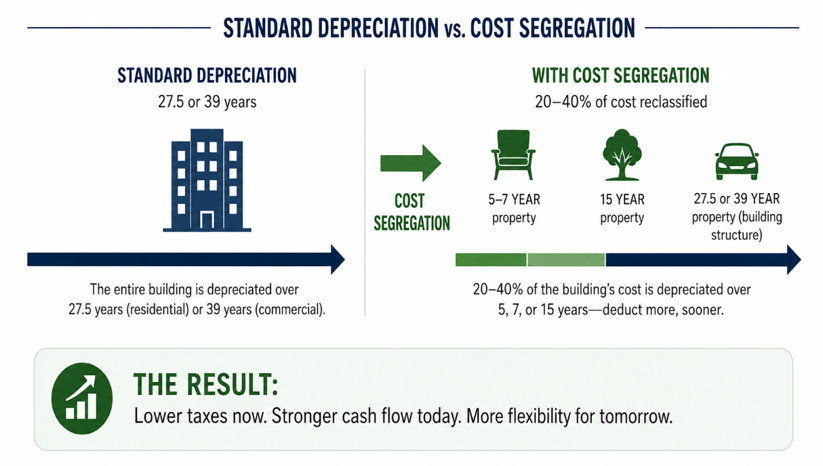
Left alone, the IRS treats a building as one asset: walls, roof, HVAC, parking lot, and carpet all depreciating at the same slow rate as the structural shell. A cost segregation study is an engineering-based analysis that separates the purchase price into its real components and identifies which ones wear out on a genuinely shorter schedule, things like carpeting and flooring, certain electrical and plumbing tied to appliances, decorative finishes, parking lots, fencing, and landscaping. Those get reclassified into 5-year, 7-year, or 15-year property instead of riding along on the 27.5-year or 39-year default.
In practice, 20% to 40% of a building’s cost usually qualifies for this faster treatment. On a $1 million property, that’s $200,000 to $400,000 no longer waiting decades to be written off.
Why the Timing Matters Right Now
The 2025 tax law (the One Big Beautiful Bill Act) restored 100% bonus depreciation, and made it permanent, for qualifying property placed in service after January 19, 2025. Once a cost segregation study identifies which components qualify for that shorter 5-year, 7-year, or 15-year life, you can generally deduct the full value of those components in the year the property is placed in service, not spread out, all of it, immediately. That’s a meaningfully different outcome than it would have been a few years ago, when bonus depreciation was scheduled to phase down toward zero. For a property owner deciding whether a study is worth commissioning, this is the detail that changes the math.
If you bought or renovated a rental or commercial property in the Dallas-Fort Worth area in the last year or two and didn’t have a cost segregation study done at closing, it’s worth revisiting. Studies can be done retroactively, through a “look-back” study, which catches up the missed depreciation in the current tax year through an accounting method change rather than requiring you to amend prior returns.
Simpler in Texas: No State Conformity to Untangle
The federal tax benefit from a cost segregation study is the same size no matter where the property sits; Texas doesn’t make the deduction any larger. What Texas does remove is a layer of complexity that comes up in states with income tax. In states that don’t fully conform to federal bonus depreciation rules, an investor still gets the full federal deduction but has to add back the bonus portion on the state return and track a separate, slower depreciation schedule at the state level. With no state income tax, Texas investors skip that reconciliation entirely: one depreciation schedule, one return, no addback to calculate.
That simplicity lines up with a market that gives cost segregation plenty to work with. Growth across Fort Worth, Frisco, McKinney, Grand Prairie, Irving, and Coppell has produced no shortage of apartment complexes, industrial and distribution buildings, single-family and short-term rentals, and mixed-use retail, exactly the property types where cost segregation firms have well-established methodologies and a track record of IRS-recognized studies to draw on.
What It Costs, and Who It’s For
A cost segregation study isn’t free, and it isn’t the right call for every property. Full engineering-based studies for larger commercial or multifamily properties run into the thousands of dollars; simpler, software-assisted studies for a single rental property cost less. The question worth asking isn’t the flat fee in isolation, it’s the ratio between that fee and the tax savings the study is likely to generate. On a smaller property with a modest purchase price, the savings may not clear the cost of the study. On larger properties, or ones with substantial improvements or renovations, the payback is often measured in months, not years.
In my experience, cost segregation tends to make the most sense for:
- Properties purchased or substantially renovated within the last few years
- Purchase prices or improvement costs above roughly $300,000 to $500,000, where the study fee is a small fraction of the likely deduction
- Owners with enough other taxable income to actually use a large first-year deduction (the benefit is limited if there isn’t income to offset)
One Thing to Watch: Depreciation Recapture
Accelerated depreciation is a timing benefit, not a permanent reduction in tax. When you eventually sell the property, some or all of the depreciation you took gets “recaptured” and taxed, generally at a higher rate than long-term capital gains. That doesn’t make cost segregation a bad idea on its own; a dollar of deduction today is worth more than the same dollar in year 15, and there are ways to manage recapture, including a 1031 exchange if you plan to reinvest in another property. But it’s the kind of tradeoff that belongs in the decision upfront, not something to discover at closing on the sale.
The Bottom Line
If you own rental or commercial real estate in Dallas, Fort Worth, or anywhere in between, purchased or improved recently, a cost segregation study is worth asking about. The current 100% bonus depreciation rules make the first-year impact larger than it’s been in years, which shifts the math in favor of studies that might not have penciled out before. It’s still not a fit for every property, and the recapture tradeoff deserves real attention before you commit. This is a decision best made jointly with your CPA and your advisor, since it touches both the tax return you file this year and the plan for the property down the road.
Schedule a 15-minute intro call and we’ll help you decide whether a cost segregation study pencils out for your situation — and coordinate it with your CPA before you file.