

Finding the Right Balance for Your Goals and Risk Tolerance
Real estate holds a natural appeal for many investors. It feels tangible, it can generate income, and it often behaves differently from stocks and bonds. Yet a common question follows close behind that appeal. How much of your portfolio actually belongs in real estate? The honest answer is that no single percentage fits everyone. The right allocation depends on your goals, your time horizon, your comfort with risk, and how you already hold property in your life.
Why Investors Add Real Estate
Real estate earns a place in many portfolios for three main reasons. It offers diversification, since property values and rents do not always move in step with the stock market. It can produce steady income through rents or dividends from real estate investment trusts. And over long periods it has served as a reasonable hedge against inflation, because both property values and rents tend to rise as prices climb.
Real estate also carries real tradeoffs. Direct property demands time, money, and management. Values can fall, tenants can leave, and selling a building takes far longer than selling a stock. A thoughtful allocation weighs these benefits and drawbacks together rather than chasing the appeal alone.
Common Allocation Ranges
Advisors and researchers often suggest that real estate occupy somewhere between 5 and 25 percent of an investment portfolio, with the exact target shaped by your profile. A conservative investor who prizes stability may lean toward the lower end. A growth minded investor with a long horizon may reach toward the higher end. The chart below shows how these ranges commonly shift across investor profiles.
Typical Real Estate Allocation by Investor Profile
| Investor Profile | Real Estate Allocation |
|---|---|
| Conservative | 5% to 10% |
| Balanced | 10% to 15% |
| Growth | 10% to 20% |
| Aggressive | 15% to 25% |
Illustrative ranges. Your target depends on goals, timeline, and risk tolerance.
Keep in mind that these ranges describe your investment portfolio and usually exclude the home you live in. Your primary residence serves your lifestyle first and behaves differently from an income producing asset, so many advisors treat it separately when they set an allocation target.
How Real Estate Fits Within a Diversified Mix
A helpful way to picture the decision is to view real estate as one sleeve within a broader, diversified portfolio. It sits alongside stocks, bonds, cash, and sometimes other alternatives. The goal is balance. You want enough real estate to capture its diversification and income benefits, but not so much that a single asset class dominates your financial life.
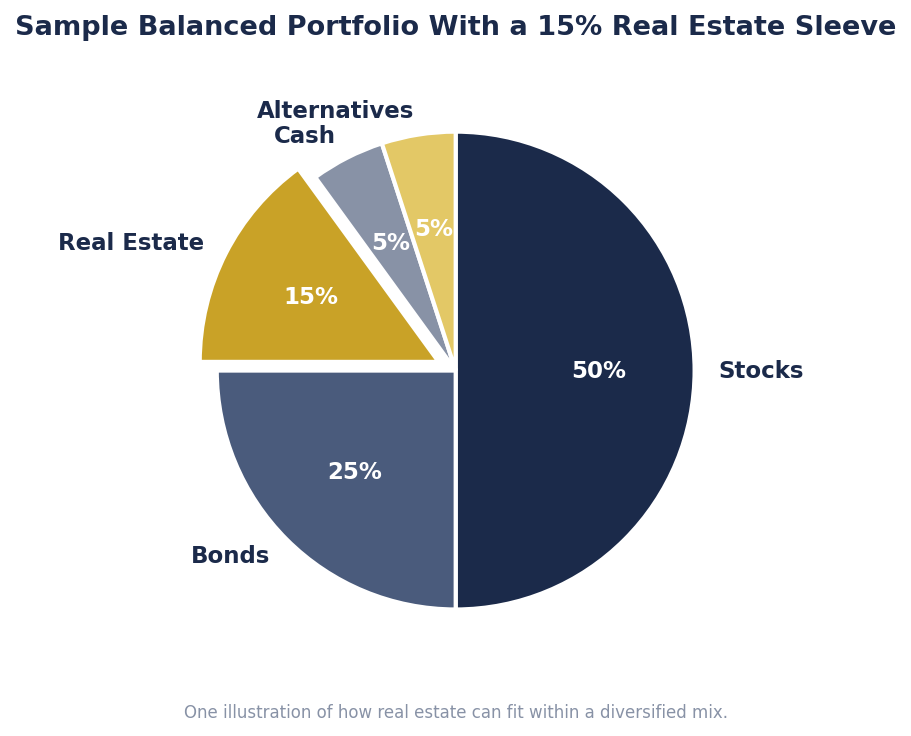
This sample allocation simply illustrates one possibility. Your own mix should reflect your objectives and the rest of your balance sheet. An investor who already owns rental property or a business tied to real estate may hold less within the investment portfolio, since real estate already shapes a large share of their net worth.
Choosing How to Hold Real Estate
Deciding how much to own is only half the question. How you gain that exposure matters just as much, because each approach carries a different mix of liquidity, cost, and effort. Public real estate investment trusts trade like stocks and offer easy access with little management. Direct rental property can deliver strong returns and control, but it demands active, hands on work. Private real estate funds fall somewhere in between.
Comparing Ways to Hold Real Estate Exposure
| Method | Liquidity (1–10) | Hands-On Effort (1–10) |
|---|---|---|
| Primary residence | 2 | 3 |
| Public REITs | 9 | 1 |
| Direct rental property | 2 | 9 |
| Private real estate funds | 3 | 4 |
Higher liquidity means easier to sell. Higher effort means more day-to-day management.
Investors who want simplicity and flexibility often favor publicly traded REITs, which let you adjust your allocation quickly and hold real estate inside retirement accounts. Investors who want direct ownership and are ready to manage tenants and maintenance may prefer rental property. Matching the method to your temperament and available time proves just as important as landing on the right percentage.
Factors That Shape Your Target
Rather than anchor on a single number, weigh the factors that make your situation unique:
- Your time horizon, since real estate rewards patience and suits investors who can hold through market cycles.
- Your need for liquidity, because direct property ties up money that you cannot access quickly.
- Your existing exposure, including your home and any property tied to your work or business.
- Your risk tolerance and appetite for the hands on management that direct ownership requires.
- Your income needs, as rents and REIT dividends can supplement cash flow in retirement.
The Bottom Line
Real estate can strengthen a portfolio through diversification, income, and inflation protection, and a range of roughly 5 to 25 percent works for many investors. Still, the right allocation for you flows from your own goals, timeline, and circumstances rather than a rule of thumb. Before you set a target, take stock of what you already own, decide how active you want to be, and align the choice with the rest of your plan.
Wondering where real estate fits in your plan? Schedule a 15-minute intro call and we’ll help you build an allocation that matches your goals.
Disclosure: This material is for educational purposes only and does not constitute individualized investment advice. The allocations shown are hypothetical illustrations and do not represent a recommendation for any specific investor. All investing involves risk, including the potential loss of principal. Real estate investments carry additional risks such as illiquidity and market volatility. Past performance does not guarantee future results.