

Selling a successful business can create life-changing wealth. It can also create one of the largest tax bills a business owner will ever face.
Imagine selling a company and recognizing $15 million of capital gain. At the highest federal long-term capital gains rate of 20%, plus the potential 3.8% net investment income tax, the federal tax bill could approach $3.57 million before considering state taxes.
Qualified Small Business Stock, commonly called QSBS, can change that outcome. When a shareholder satisfies the requirements under Section 1202 of the Internal Revenue Code, the shareholder may exclude millions of dollars of gain from federal taxable income.
This is not a deduction that merely reduces taxable income. It is not a deferral that pushes the bill into the future. It is an exclusion, which means the qualifying gain never enters federal taxable income.
Congress significantly expanded the QSBS rules in 2025. The changes increased the potential exclusion, raised the size limit for qualifying companies, and created partial exclusions for certain shares held for only three or four years.
The opportunity can be enormous, but QSBS rewards early planning. Owners who wait until a sale is already underway may discover that they started with the wrong entity, missed the required holding period, or failed another technical requirement.
What Is Qualified Small Business Stock?
QSBS refers to stock that satisfies Section 1202. Congress created the provision to encourage founders, employees, and investors to put capital and effort into smaller operating companies.
The exclusion applies separately to stock from each qualifying corporation, subject to a per-taxpayer, per-issuer limit.
For stock acquired on or before July 4, 2025, the maximum exclusion generally equals the greater of $10 million or 10 times the taxpayer’s adjusted basis in the QSBS sold during the year.
For stock acquired after July 4, 2025, the fixed-dollar limit increased to $15 million. The law also provides inflation adjustments for tax years beginning after 2026.
The 10-times-basis calculation can produce an exclusion above the fixed-dollar limit when a shareholder has substantial basis in the shares. Business owners should model both limits rather than assuming the exclusion stops at $10 million or $15 million.
The Core QSBS Requirements
QSBS involves more than a single election on a tax return. The company, stock, shareholder, and eventual sale must satisfy several requirements.
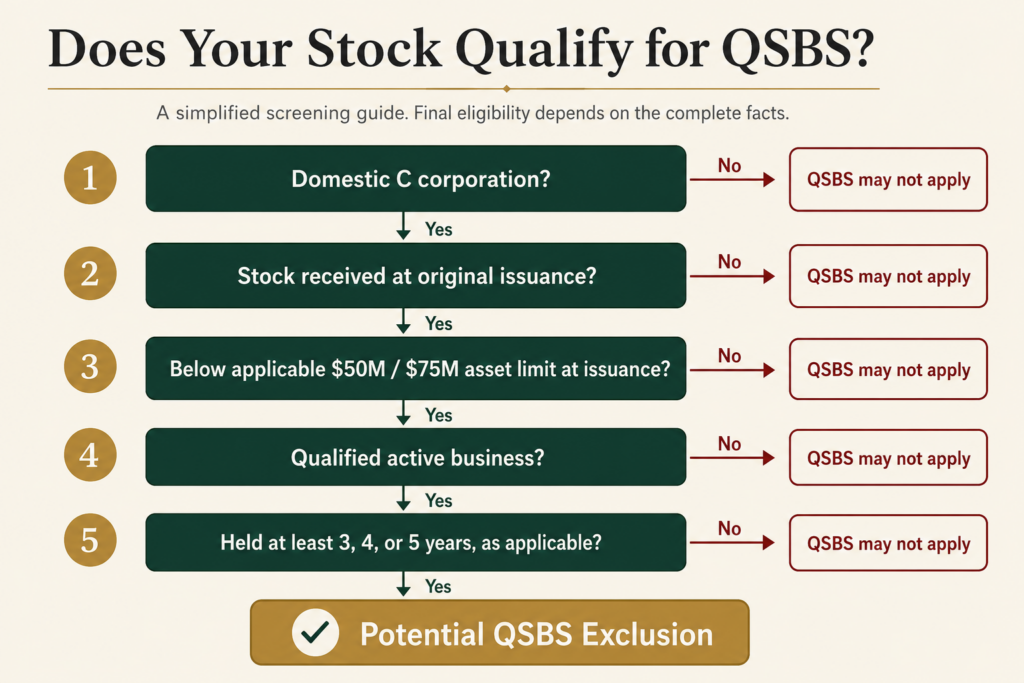
1. The Business Must Operate as a Domestic C Corporation
The stock must come from a domestic C corporation. An ownership interest in an LLC, partnership, sole proprietorship, or S corporation does not qualify.
This requirement eliminates many closely held businesses because owners often choose an LLC or S corporation for pass-through taxation. Those structures may offer other advantages, but they do not issue qualified small business stock.
The shareholder generally must also receive the stock at original issuance in exchange for money, qualifying property, or services provided to the corporation. Buying existing shares from another shareholder usually does not qualify.
2. The Corporation Must Meet the Gross-Asset Test
For stock issued on or before July 4, 2025, the corporation generally could not have aggregate gross assets above $50 million before or immediately after the issuance.
For stock issued after July 4, 2025, the law increased that threshold to $75 million. The threshold will receive inflation adjustments after 2026.
This test looks at gross assets, not annual revenue, profit, or the eventual sale price. A company can later grow beyond the threshold without automatically disqualifying shares that qualified when issued.
That distinction matters for fast-growing companies. A founder does not necessarily lose QSBS treatment simply because the business eventually sells for hundreds of millions of dollars.
QSBS Rules: Before vs. After July 4, 2025
| QSBS Rule | On or Before July 4, 2025 | After July 4, 2025 |
|---|---|---|
| Company gross-asset limit | $50 million | $75 million |
| Maximum fixed exclusion | $10 million | $15 million |
| 3-year holding period | No exclusion | 50% exclusion |
| 4-year holding period | No exclusion | 75% exclusion |
| 5-year holding period | 100% exclusion | 100% exclusion |
Key takeaway: more companies may qualify, and the full exclusion can reach $15 million.
3. The Company Must Conduct a Qualified Active Business
During substantially all of the shareholder’s holding period, the corporation generally must use at least 80% of its assets in qualified active business activities.
The law excludes several industries. Disqualified fields include many businesses involving health, law, engineering, architecture, accounting, consulting, athletics, financial services, and brokerage services.
The exclusions also cover banking, insurance, financing, leasing, investing, farming, certain extraction businesses, hotels, motels, and restaurants.
Technology, manufacturing, wholesale distribution, and certain retail or product-based companies may have a stronger path to qualification. However, the company’s actual activities, assets, revenue sources, and reliance on employee skill or reputation matter more than its industry label. A company that operates near an excluded industry may still qualify when it creates value through products, proprietary technology, manufacturing processes, or intellectual property rather than professional services. The facts determine the result.
4. The Shareholder Must Meet the Holding-Period Rules
The 2025 law created two sets of holding-period rules.
For qualifying stock acquired on or before July 4, 2025, a shareholder generally must hold the shares for more than five years to receive the available exclusion.
For qualifying stock acquired after July 4, 2025, the exclusion phases in as follows:
- At least three years: 50% exclusion
- At least four years: 75% exclusion
- At least five years: 100% exclusion
These partial exclusions give founders and investors more flexibility when an attractive offer arrives before the fifth anniversary. Before the 2025 changes, an early sale could cause a shareholder to miss the Section 1202 exclusion entirely.
However, owners should model an early sale carefully. The taxable portion of eligible QSBS gain can fall into the 28% maximum capital gains rate category, and the 3.8% net investment income tax may also apply.
How Large Can the QSBS Benefit Be?
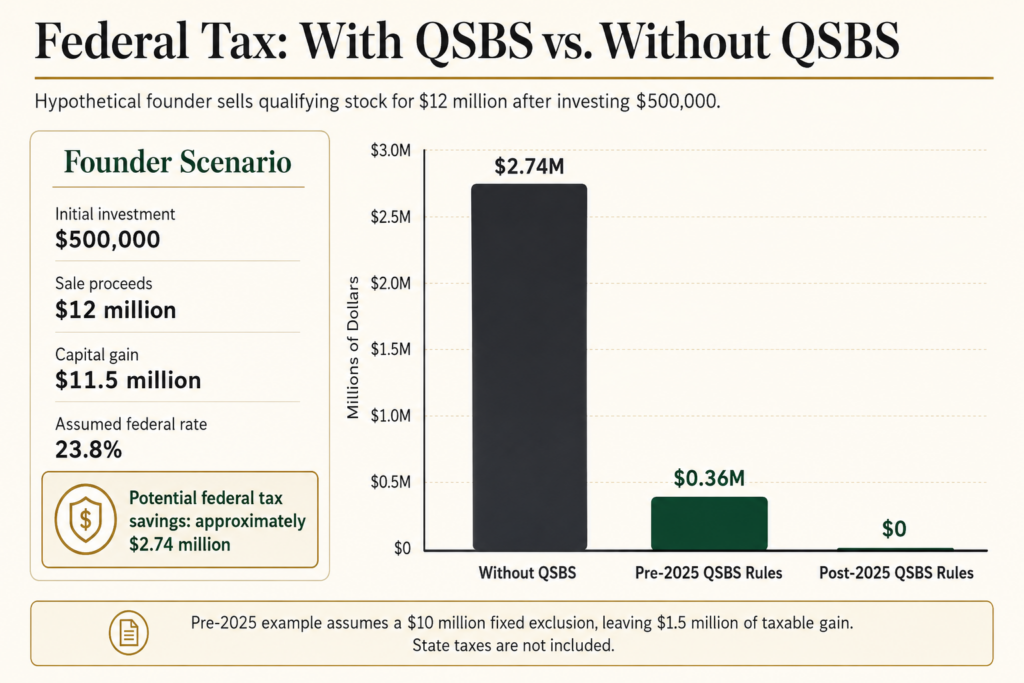
Consider a founder who invests $500,000 in a qualifying C corporation and sells the shares after five years for $12 million. The founder realizes an $11.5 million gain.
Without QSBS, a 23.8% combined federal rate could produce approximately $2.74 million of federal tax. State income taxes could increase the bill further.
If the founder acquired the shares after July 4, 2025, and every requirement remains satisfied, the full $11.5 million gain could fall below the new $15 million fixed-dollar exclusion. The federal tax on that qualifying gain could be zero.
If the founder acquired the shares before July 4, 2025, the fixed-dollar limit would generally remain $10 million. The founder could potentially exclude $10 million and pay tax on the remaining gain, subject to the complete facts and the alternative 10-times-basis limitation.
A decision made when a company has little value can therefore affect millions of dollars when the company eventually sells.
Can a Family Multiply the QSBS Exclusion?
Section 1202 applies its limitation per taxpayer and per issuing corporation. That creates advanced planning opportunities when separate taxpayers each own qualifying shares.
A founder may gift QSBS to an adult child or a properly structured non-grantor trust. The tax code generally allows gifted shares to retain the transferor’s acquisition method and holding period. If the recipient qualifies as a separate taxpayer, the recipient may have a separate Section 1202 limitation.
For shares acquired after July 4, 2025, four genuinely separate taxpayers could potentially hold four separate $15 million limits from the same issuer. That could create as much as $60 million of aggregate exclusion.
The actual result depends on ownership, filing status, prior exclusions, basis, trust structure, and compliance with broader tax rules.
This strategy requires caution. A married couple filing jointly does not automatically receive two full limits. Gifts can consume gift and estate tax exemption, transfer economic ownership, reduce the founder’s control, and create fiduciary obligations.
Owners should also complete gifts well before a sale becomes practically certain. Last-minute transfers can face assignment-of-income, step-transaction, valuation, and economic-substance challenges.
QSBS trust planning requires coordination among the estate planning attorney, CPA, valuation professional, and wealth advisor. No single professional should design the strategy in isolation.
The Costliest QSBS Mistake
The most common mistake occurs when an owner builds a valuable company inside an LLC or S corporation and first learns about QSBS after receiving a letter of intent.
The owner may consider converting the company into a C corporation before the sale. A conversion can begin a new QSBS holding period, but it does not retroactively convert the company’s earlier growth into excludable QSBS gain.
For QSBS purposes, the stock generally starts its holding period when the C corporation issues it. Special rules also prevent pre-conversion appreciation in contributed business property from receiving the same QSBS treatment as future growth.
Assume an LLC grows into a company worth $20 million. The owner then converts it into a C corporation and sells it five years later for $25 million.
Even if the new shares qualify, the conversion does not ordinarily turn the first $20 million of value into QSBS gain. The primary opportunity relates to eligible appreciation after the corporation issued the stock.
A late conversion can also delay a sale while the owner waits for the holding period. The business, buyer, economy, or owner’s goals can change during that time.
The tax strategy should support the business plan. It should not force the owner to accept unnecessary operating or concentration risk simply to chase a potential exclusion.
Build the QSBS File Before the Sale
Business owners should not wait until due diligence to prove that their shares qualify.
They should maintain formation documents, stock agreements, capitalization tables, proof of original issuance, financial statements, asset calculations, board approvals, redemption records, and support for the active-business test.
The company should review QSBS status after major financings, acquisitions, redemptions, reorganizations, or changes in business activity. One overlooked transaction can complicate an otherwise strong claim.
Founders should ask their attorney and CPA for written analysis rather than relying on an informal statement that the company “should qualify.” Section 1202 contains detailed requirements, and the taxpayer must support the exclusion when filing the return.
The Bottom Line
QSBS can create one of the most valuable tax outcomes available to a founder or early investor. Under the expanded rules, one taxpayer may exclude up to $15 million or more of qualifying gain from a single issuer, and coordinated family planning may increase the total benefit substantially.
The strategy only works when the owner addresses it early. Entity selection, original issuance, company size, business activity, holding period, documentation, and gifting strategy all require attention before a buyer controls the timeline.
If you own shares in a C corporation, plan to launch a new company, or expect a future liquidity event, schedule a 15-minute intro call to review the QSBS question now, while you still have every option open.
This article provides general educational information and does not constitute individualized tax or legal advice. Business owners should consult qualified tax and legal professionals before implementing a QSBS strategy.