
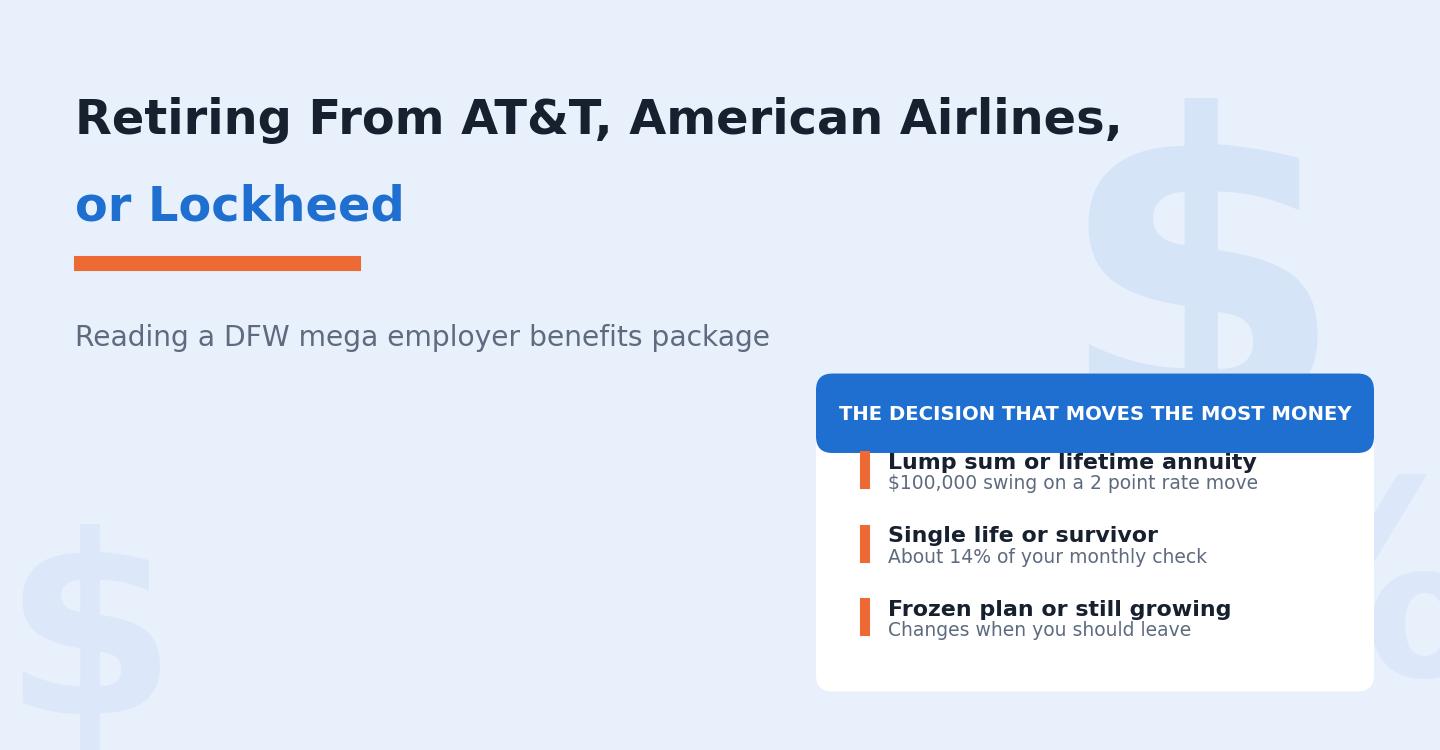
You spend thirty years earning a pension and about six weeks deciding what to do with it. The packet lands, it names a deadline, and it buries the one number that changes your retirement by six figures. Here is how to read it.
Name the plan you actually have
- Two shapes exist.
- A traditional plan pays a monthly benefit built from your years of service and your final average pay.
- A cash balance plan shows you an account with a dollar figure in it, which looks like a 401(k) and is not one, because the plan still owes you a benefit no matter how its investments perform.
- The three big North Texas employers sit in different places.
- AT&T runs a cash balance formula for most current management participants and generally allows a lump sum.
- American Airlines froze its defined benefit plans in 2012, so your benefit stopped growing then, and most workgroups collect it as an annuity rather than a lump sum.
- Lockheed Martin froze its salaried pension and shifted the money into larger automatic 401(k) contributions, and it has moved blocks of retiree obligations to insurance companies, which changes who writes your check and who stands behind it, though not the amount.
Confirm your own status on your plan statement, because formulas differ by hire date, union agreement, and acquired company.
Your lump sum is a calculation, not an offer
The plan does not negotiate. Federal law tells it to convert your monthly benefit using published interest rates and a mandated mortality table. Higher rates shrink the lump sum. Lower rates grow it. Nothing about your health, your investing skill, or your intentions enters the math.
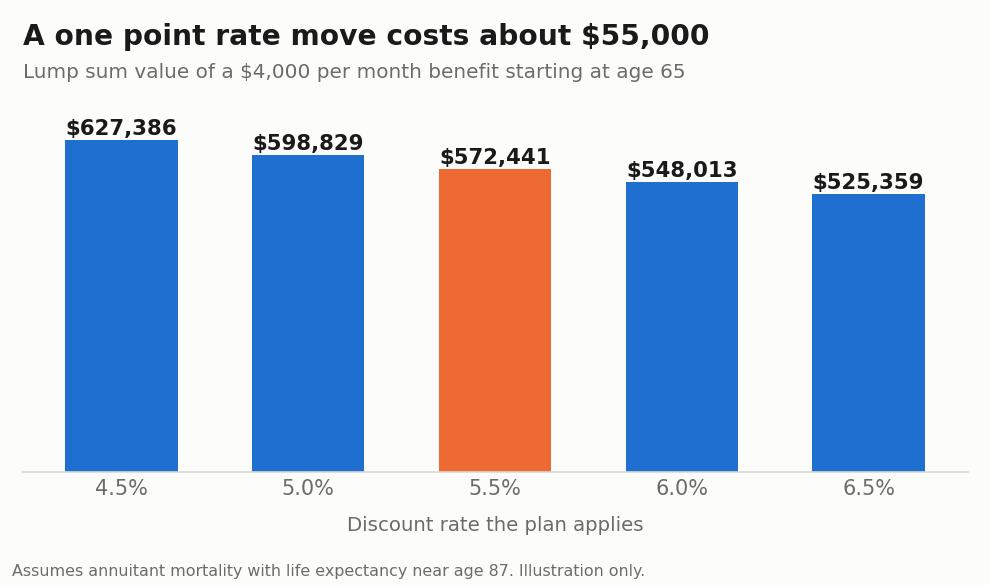
Rate sensitivity of a lump sum. Illustration, not a quote from any plan.
Timing carries real money. Plans lock a rate for a stability period, usually the plan year, based on a lookback month set months earlier. So the rate pricing a January retirement was often fixed the previous autumn. Ask your benefits center for the plan document language on the stability period and the lookback month, in writing, before you pick a date.
Run the payout rate test
Divide, then compare. Take the annual annuity and divide it by the lump sum. A $4,000 monthly benefit is $48,000 a year. Against a $572,441 lump sum, the plan pays you 8.4 percent of that money every year for life. Now ask what your portfolio must earn to match that promise while you spend the same amount.
It is also worth asking what the same money would buy on the open market. A retail lifetime annuity for a 65-year-old typically pays less than a pension’s built-in rate, which is why taking the lump sum to buy an annuity rarely comes out ahead.
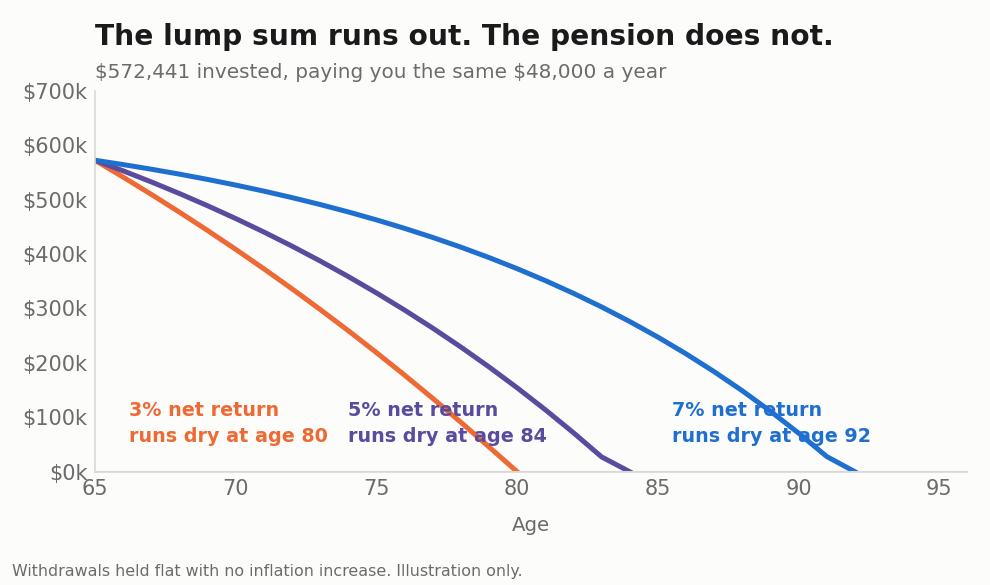
The same $48,000 a year, funded from the lump sum instead.
The chart makes the trade visible. Strong returns beat the annuity and leave money to your children. Weak returns in the first decade leave you spending down principal in your eighties. The pension transfers that risk to the plan sponsor and, behind it, to the Pension Benefit Guaranty Corporation up to the insured limit. If your benefit has been transferred to an insurance company, the backstop becomes your state’s insurance guaranty association instead, which has its own limits. The lump sum hands the risk back to you along with the upside.
Decide what your spouse gets first
The default protects the survivor for a reason. A married participant must take a joint and survivor annuity unless the spouse signs a waiver witnessed by a notary or a plan representative. Advisors see that form signed in a hurry, in a lobby, without anyone pricing what the signature gives away.
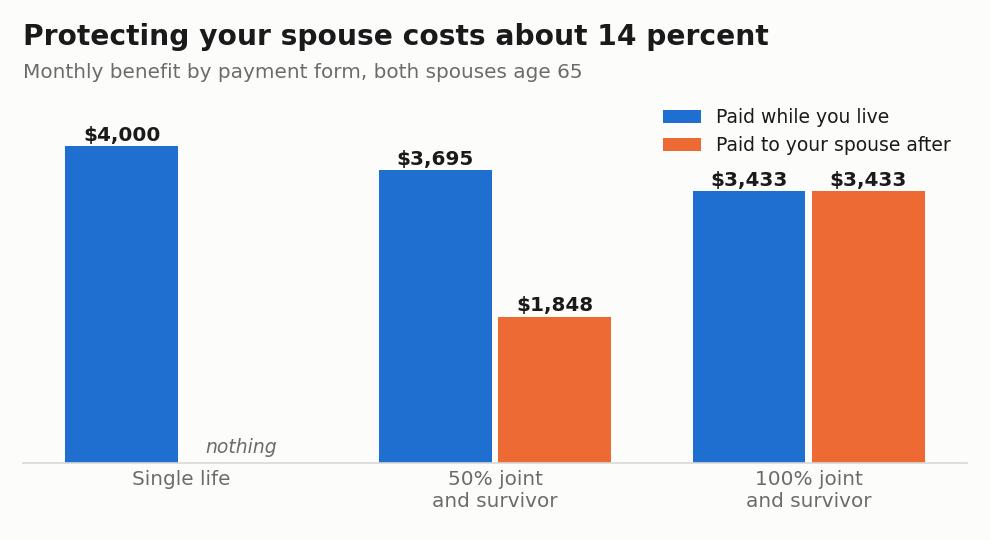
Illustration: in this example, survivor protection costs roughly 14 percent of the monthly check. Your plan’s reduction depends on both spouses’ ages and the survivor percentage you choose.
Sometimes the waiver makes sense. Taking the larger single life benefit and buying life insurance to replace the survivor income works when you are insurable, the premium costs less than the reduction, and the policy stays in force for life. Price the policy and get the approval before you sign anything. A term policy that lapses at 80 protects nobody.
Then coordinate the rest of the package
The pension decision reshapes everything downstream. Retiring in the year you turn 55 or later lets you tap the 401(k) at that employer without the 10 percent early penalty, so rolling it out too early can cost you the bridge to 59 and a half. Company stock inside the 401(k) may qualify for net unrealized appreciation treatment, which turns growth into capital gain instead of ordinary income, and a rollover destroys that election permanently. Retiree medical coverage before Medicare deserves its own line in the budget.
Fill the plan while you still can. In 2026 you may defer $24,500, plus $8,000 more at age 50, or $11,250 instead if you turn 60 through 63 this year. Total additions from you and your employer can reach $72,000. If your 2025 wages from that employer topped $150,000, your catch-up dollars have to go in as Roth, so they come out of your paycheck after tax. A final partial year of employment often leaves room you never use.
What to bring to the conversation
Your pension estimate at three different start dates, the relative value disclosure the plan must give you comparing each payment form, the 401(k) statement showing any company stock and its cost basis, the retiree medical summary, and your Social Security estimate. Those five documents answer most of the question. The rest is deciding how much risk you want to carry yourself, and that is a conversation we have with North Texas retirees regularly. Bring the five documents and we will work through it with you.
This material is for educational purposes only and is not individualized investment, tax, or legal advice. Pension plan provisions vary by employer, hire date, and workgroup; confirm the terms of your plan with your benefits center. References to specific employers are not a recommendation regarding any security.