

If you’ve spent years at a company that offers employer stock in your 401(k), and that stock has grown significantly, you may be sitting on a tax opportunity that most people overlook when they retire or change jobs. It’s called Net Unrealized Appreciation, or NUA. The strategy is straightforward in concept, the potential savings are real, and almost no one talks about it until it’s too late to use it.
The Problem With the Default Approach
When most people leave an employer, they roll their entire 401(k) into an IRA. That’s often the right call, but it’s not always the best call when you hold appreciated employer stock. Here’s why: inside a traditional IRA, every dollar you eventually withdraw is taxed as ordinary income. At the top federal bracket, that’s 37 cents on the dollar. Even at 24%, the tax drag on a large position can be staggering. The problem isn’t that IRAs are bad, it’s that ordinary income rates are expensive, and appreciated company stock doesn’t have to face them.
How NUA Works
Instead of rolling employer stock into an IRA, you take an in-kind distribution—the actual shares move directly into a taxable brokerage account. What happens next is where the tax break kicks in:
- Cost basis: You pay ordinary income tax immediately, but only on the plan’s cost basis—what the plan originally paid to acquire those shares on your behalf. Not the market value. Just the original cost.
- NUA: The difference between the cost basis and the market value at the time of distribution is taxed at long-term capital gains rates when you sell—currently 0%, 15%, or 20% depending on your total taxable income (2026 IRS rates).
- Post-distribution growth: Any additional appreciation after the distribution date also qualifies for long-term capital gains treatment, as long as you hold the shares for at least one year before selling.
The Numbers Side-by-Side
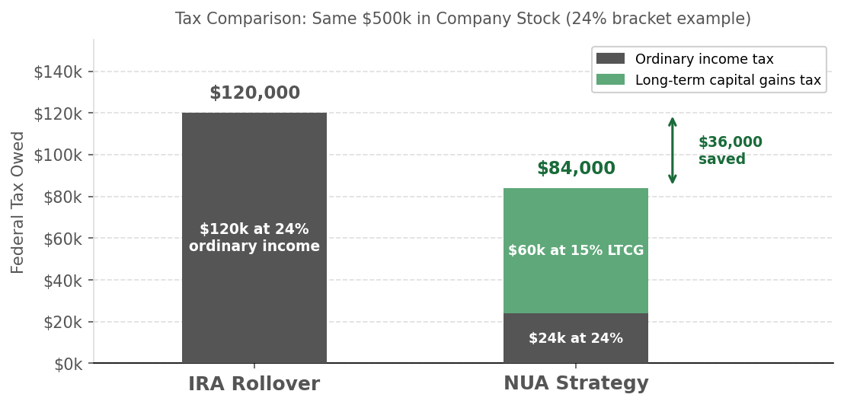
Here’s a concrete example. Suppose you have $500,000 of company stock in your 401(k), and the plan’s cost basis in those shares is $100,000. The NUA is $400,000.
If you roll everything to a traditional IRA and later withdraw in a 24% tax bracket, you owe $120,000 in federal tax on the full $500,000. Using the NUA strategy, you pay $24,000 in ordinary income tax on the cost basis this year, and $60,000 in long-term capital gains tax on the $400,000 of NUA when you choose to sell. Total: $84,000. That’s $36,000 less in federal tax on the same dollars.
What You Need to Qualify
NUA only applies to employer securities—your own company’s stock, not mutual funds held in the plan. Beyond that, there are four requirements to keep in mind:
- Lump-sum distribution: Your entire plan balance must be distributed within the same calendar year. However, you can roll the non-stock portion into an IRA and still qualify for NUA treatment on the stock.
- Triggering event: You must have separated from service (retired or left the employer), reached age 59½, become disabled, or the distribution is due to death.
- Early withdrawal penalty: If you’re under age 59½, the 10% early withdrawal penalty applies to the cost basis, not the NUA, so the math still often works in your favor.
- Net Investment Income Tax: High earners above $200,000 (single) or $250,000 (married filing jointly) may also owe an additional 3.8% NIIT on the NUA when the shares are sold.
When It Makes Sense—and When It Doesn’t
The strategy is most powerful when your cost basis is a small fraction of the current stock price. If the plan paid $400,000 for shares now worth $500,000, the NUA is only $100,000, you’re not saving much compared to a rollover. But if the plan paid $80,000 for shares now worth $500,000, the math is hard to ignore.
It also matters what your tax rates will look like in retirement. If your total income will be low enough that your capital gains rate would be 0%, the NUA strategy and an IRA rollover may produce very similar outcomes—the IRA just defers the decision. Where NUA really wins is when you’d face ordinary income rates of 24% or higher on IRA withdrawals but could sell the stock at a 15% or 20% long-term rate.
One trade-off worth planning for: NUA triggers a tax bill in the year you take the distribution. You’re paying tax on the cost basis now, not later. That immediate cost needs to fit your cash flow and your overall tax picture for that year, including any other income you’ll recognize.
There’s also concentration risk to consider. An NUA distribution means holding a significant chunk of a single stock in a taxable account. That’s a meaningful investment decision, not just a tax one. How long you plan to hold the shares, whether you intend to diversify, and when you might need the liquidity are all part of the analysis.
The Bottom Line
NUA is one of those strategies that’s easy to miss. It comes up at a busy transition point when the default rollover advice is simpler. But for employees with significant appreciated company stock, the analysis is worth doing before a single share moves. Done right, it can permanently convert a large portion of your retirement savings from ordinary income into capital gains—a meaningful difference spread across decades of retirement.
If you’re approaching retirement or a job change and hold company stock in your 401(k), schedule a 15-minute intro call before you roll anything over. We’ll run the numbers specific to your situation.