
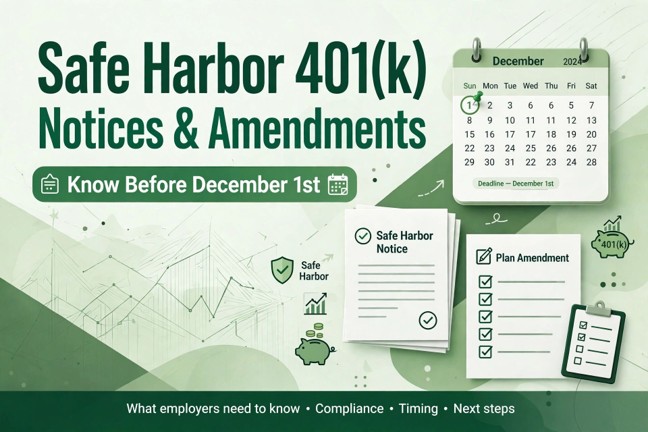
A guide to the safe harbor 401(k) notice deadline, which plans still need an annual notice, and how amendments change the timing.
Why December 1 Gets Employers’ Attention
It is early fall, and the owner of a growing Fort Worth company is walking through year-end items with her controller. Headcount is up by a dozen people, and someone asks: “Didn’t our 401(k) provider mention a December 1 deadline?”
For many Texas employers with a safe harbor 401(k), December 1 is a date worth circling. But it is not a universal deadline. Whether anything is due depends on your plan year, your safe harbor formula, and what you plan to change for next year.
The bigger risk is waiting. Some useful plan-design options close well before December.
What Is the Safe Harbor 401(k) Notice Deadline?
A safe harbor 401(k) is a plan that skips the annual nondiscrimination tests (the ADP and ACP tests, which compare what highly paid employees save and receive against everyone else) in exchange for a required employer contribution, specific vesting rules, and, for many designs, an annual employee notice. For owners, that trade matters: failed tests can limit what owners and key employees save.
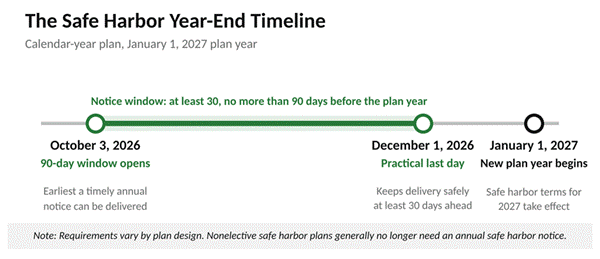
Where a safe harbor 401(k) notice is required, the IRS treats it as timely if employees receive it at least 30 days and no more than 90 days before the plan year begins. Outside that window, timeliness turns on the facts and circumstances, which is a harder position to defend.
For a calendar-year plan starting January 1, 2027, the 90-day window opens October 3, 2026. Most recordkeepers treat December 1 as the practical last day to deliver, because it keeps the notice safely more than 30 days ahead. That is where the “December 1 safe harbor deadline” comes from. A July 1 plan year applies the same logic around July 1.
Employees who become eligible during the year follow a separate rule: their notice generally goes out no more than 90 days before, and no later than, their eligibility date.
Does Your Safe Harbor Formula Require an Annual Notice?
This is where older articles cause confusion. For plan years beginning after December 31, 2019, the SECURE Act eliminated the annual safe harbor notice requirement for plans that use the nonelective contribution, meaning an employer contribution made for every eligible employee whether or not that employee defers. Plans built on a safe harbor 401(k) match still need the notice.
“No notice” does not mean “no communication.” Employees in a nonelective plan must still have the chance to make or change their deferral election at least once a year.
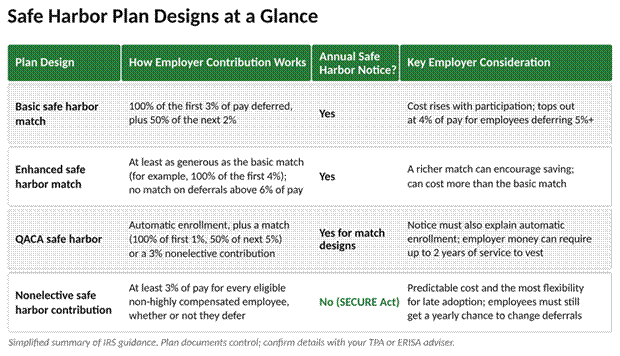
Here is how the cost tradeoff can look. Consider a hypothetical Arlington manufacturer with 50 eligible non-highly compensated employees (NHCEs) earning $3,000,000 combined. A 3% nonelective contribution costs about $90,000 no matter who participates. A basic match tops out at 4% of pay, or $120,000, only if everyone defers at least 5%. If roughly half of that payroll defers at that level, the match might cost closer to $60,000.
Neither design is automatically better. The match rewards savers and can cost less when participation is modest, but it carries the annual notice. The nonelective design often costs more but is predictable and far more flexible at year-end.
Starting a New Safe Harbor Plan vs. Changing an Existing One
- Starting a new 401(k). For a brand-new plan, the eligibility-date notice rule applies to employees for the first plan year. New plans carry their own first-year requirements, so have your TPA (third-party administrator) confirm the latest practical start date.
- Adding safe harbor to an existing plan. Safe harbor provisions should generally be adopted before the plan year starts and stay in place for the full 12-month year. For a match design taking effect January 1, that means the amendment and notice both need to be ready before December 1.
- Moving to a nonelective design. The SECURE Act created a special rule here. An employer may amend to a 3% nonelective safe harbor any time before the 30th day before the plan year ends, which lands around December 1 for a calendar-year plan. A 4% nonelective amendment can be adopted as late as the last day of the following plan year.
- Changing the design for next year. Changes effective at the start of the plan year, and described in that year’s notice when required, avoid the mid-year rules entirely.
The late-adoption rule is helpful, but it is not free. Using the example above, waiting until late 2027 to make 2026 a safe harbor year would require a 4% contribution, or $120,000 instead of $90,000. Conditions apply, so treat this as a backstop, not a plan.
Can You Change a Safe Harbor 401(k) Mid-Year?
Sometimes. Under IRS Notice 2016-16, a safe harbor 401(k) amendment does not break the safe harbor rules merely because it happens mid-year, as long as any required notice and election conditions are met and the change is not on the prohibited list.
If the change affects information the safe harbor notice must contain, employers generally need to deliver an updated notice 30 to 90 days before the change takes effect and give employees a reasonable chance to change their deferral election (30 days is deemed reasonable). A few practical examples:
- Raising a nonelective contribution from 3% to 4% going forward: generally permitted, with an updated notice.
- Moving plan entry dates from monthly to quarterly: generally permitted, and no updated notice is needed because entry dates are not required notice content.
- Increasing the match formula: generally restricted unless the change is adopted at least three months before year-end, made retroactive to the start of the plan year, and paired with an updated notice and election opportunity at least three months before year-end. For a 2026 calendar-year plan, that window closed around the end of September.
- Narrowing who receives safe harbor contributions, or switching from a traditional safe harbor to a QACA: generally not permitted mid-year.
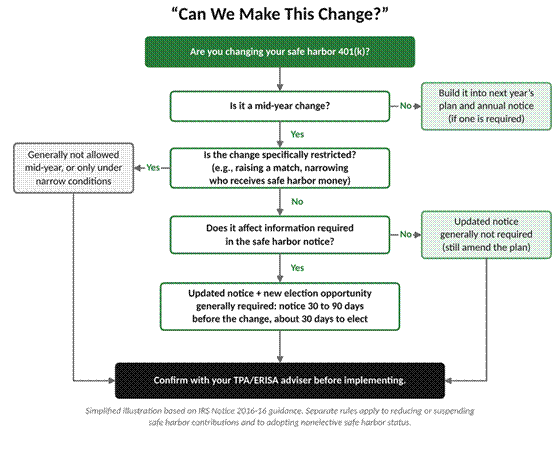
Infographic 3: “Can We Make This Change?” Decision Tree
What Happens If You Miss a Required Safe Harbor 401(k) Notice?
A missed notice is an operational failure, and it should not be ignored. An employer also cannot “opt out” of safe harbor status for the year by simply running the ADP and ACP tests instead.
The right correction depends on how each employee was affected. In an IRS example, an employee earning $20,000 who was never told she could defer required a corrective contribution of $300 for her missed deferral opportunity plus $600 for her missed match, adjusted for earnings. A participant who was otherwise informed needed only a procedural fix. IRS correction programs may apply, but the facts drive the answer, so work through it with your TPA, recordkeeper, ERISA counsel, or retirement plan adviser rather than self-correcting.
Texas Employer Year-End Checklist
- Confirm the plan’s safe harbor design
- Determine whether an annual notice is required
- Review the employer contribution formula
- Confirm which employees must receive notices
- Review planned amendments
- Coordinate with the TPA/recordkeeper
- Document when required notices were delivered
- Begin next-year plan-design conversations before December
Safe Harbor 401(k) FAQ
Is December 1 always the safe harbor 401(k) notice deadline?
No. It is the practical cutoff for calendar-year plans that require a notice.
Do nonelective safe harbor plans still need an annual notice?
Generally no, for plan years beginning after 2019, though employees still need a yearly election opportunity.
What is the difference between a basic and enhanced safe harbor match?
The basic match is 100% of the first 3% deferred plus 50% of the next 2%. An enhanced match must be at least as generous at every deferral level, such as 100% of the first 4%.
Can an employer change its safe harbor match mid-year?
Some changes are allowed with an updated notice and election period. Increasing a match is restricted.
Can a company start a safe harbor 401(k) after January 1?
New plans can, under first-year rules, and existing plans may adopt a nonelective safe harbor late in the year. Match designs generally must be in place before the plan year begins.
What happens if a safe harbor notice is late?
It depends on whether employees lost the chance to defer. Corrections range from procedural fixes to corrective contributions.
The Planning Perspective
A safe harbor 401(k) for a small business is a business decision as much as a compliance one. The right formula depends on payroll, how many employees actually participate, how much the owners want to save themselves, and how much year-end flexibility the company needs as it grows. The notice is simply where those choices become visible to employees.
If your company sponsors a 401(k), or you are weighing a safe harbor design for 2027, this is a good time to review your current formula, notice obligations, and upcoming deadlines with your retirement plan advisory team. Starting in October leaves room for choices that December may not.