

If you spend enough time around successful business owners in Southlake, Westlake, or other affluent Dallas-Fort Worth communities, you will eventually hear about an investment opportunity that sounds almost too good to pass up.
Maybe it’s a commercial real estate development, a private lending fund, an oil and gas partnership, or a stake in a promising business. Someone you know has already invested, the projected returns look attractive, and there may only be a few spots remaining.
These opportunities often come through trusted relationships. A business partner, longtime friend, or fellow country-club member introduces the deal. That personal connection can make the opportunity feel more credible than something presented by a stranger.
But knowing the person presenting an investment is not the same as understanding the investment itself.
At Mills Wealth Advisors, we believe private investments deserve careful consideration, not automatic rejection. Some offer legitimate opportunities for investors with the financial resources and risk tolerance to participate. Others introduce unnecessary complexity, excessive fees, or risks that investors don’t fully appreciate.
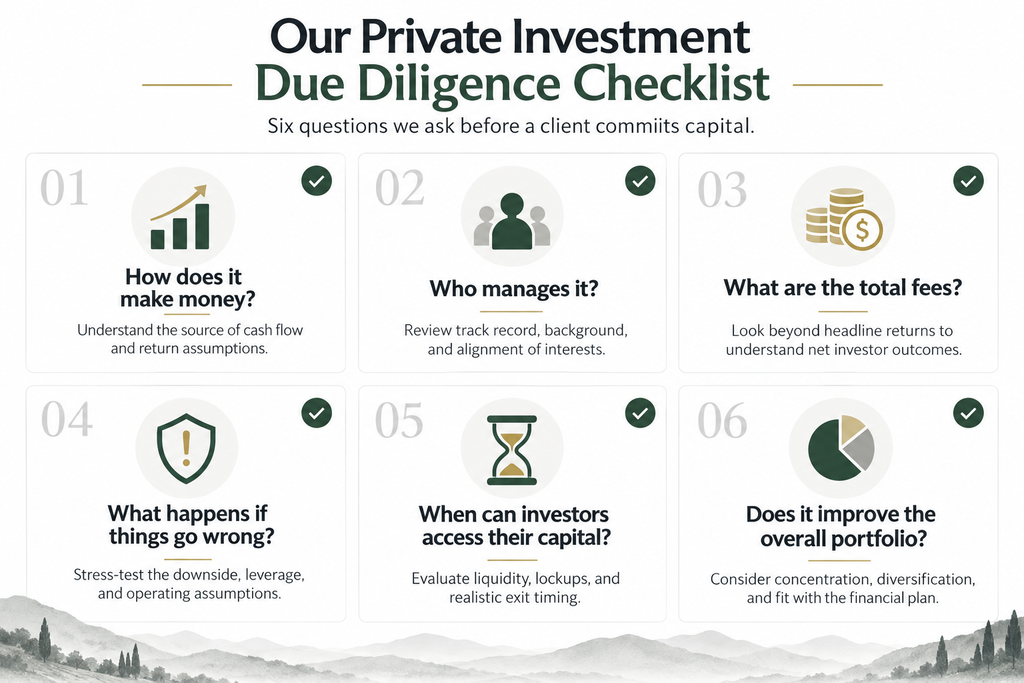
Before committing capital, we want to understand what we’re buying, how the investment generates returns, what could go wrong, and whether it actually improves the client’s overall financial plan.
Why Private Investments Appeal to Successful DFW Investors
Dallas-Fort Worth has a strong entrepreneurial culture. Many of the families we work with have built substantial wealth by starting, operating, or selling privately held businesses.
These investors understand that significant wealth can come from owning assets outside the public stock market. They may also have personal experience with real estate, private lending, or business acquisitions.
That experience can create an understandable interest in alternative investments.
Private investments can offer access to opportunities that traditional stocks and bonds don’t provide. Depending on the structure, investors might seek income, capital appreciation, diversification, or participation in a particular industry.
However, an investment’s exclusivity doesn’t automatically make it superior.
A private offering may have fewer reporting requirements, limited liquidity, substantial leverage, and fees that reduce the investor’s actual return. Its reported value may also change less frequently than a publicly traded security’s price, even when the underlying economic risks remain significant.
For our clients, the objective isn’t to gain access to the most exclusive opportunity. It’s to build and preserve wealth while maintaining enough flexibility to accomplish their financial goals.
1. We Start by Understanding How the Investment Makes Money
Every investment should have an understandable economic foundation.
When reviewing a private opportunity, one of the first things we want to establish is how the underlying business or asset generates cash flow.
Consider a commercial real estate syndication. The sponsor might project a 15% annualized return over five years. That projection certainly gets an investor’s attention.
But where does that return come from?
Does the property generate enough rental income to support distributions? Does the investment depend on raising rents, refinancing debt, or selling the property at a higher valuation?
What happens if occupancy declines or borrowing costs remain elevated?
We want to separate the investment’s underlying economics from the assumptions used to produce an attractive presentation.
The same principle applies to private credit, business acquisitions, and other alternative investments. Understanding the source of returns helps us determine whether the projected compensation reasonably reflects the risks.
If we cannot clearly explain how an investment makes money, we should not recommend committing capital to it.
2. We Examine the People Behind the Deal
A strong investment thesis means very little without capable management.
We want to know who controls the money, who makes operating decisions, and whether the management team has successfully executed similar strategies.
Experience matters, but we look beyond impressive biographies.
A sponsor might advertise decades of combined experience without demonstrating a meaningful track record investing through difficult market conditions.
We would rather review actual realized outcomes than rely exclusively on projected performance.
That includes examining unsuccessful investments. Every experienced operator encounters challenges. How management handles those challenges often reveals more than a presentation highlighting its strongest deals.
We also want to understand whether the sponsor invests meaningful personal capital alongside outside investors.
Having money invested does not eliminate conflicts of interest, but it can help align incentives.
Background checks, regulatory records, references, and independent verification of important claims can all contribute to the due diligence process.
A personal introduction may justify a conversation. It should never replace this investigation.
3. We Review the Fees and Determine Who Gets Paid First
Private investments frequently contain several layers of compensation.
Investors might encounter acquisition fees, annual management fees, servicing fees, financing fees, disposition fees, and performance-based compensation.
Individually, some of these charges may appear reasonable. Together, they can meaningfully reduce an investor’s return.
More importantly, certain fees compensate the sponsor regardless of whether investors ultimately make money.
Consider the following simplified illustration.
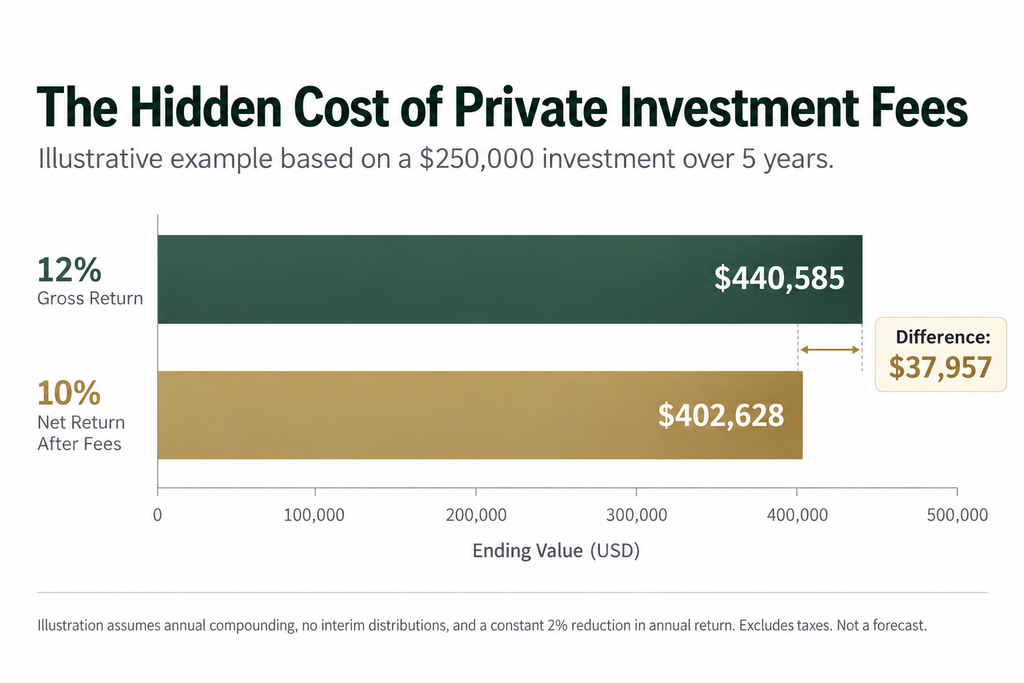
Illustration assumes annual compounding, no interim distributions, and a constant two-percentage-point reduction in annual return. It excludes taxes and does not represent an actual private investment.
The difference approaches $38,000 on a single $250,000 commitment.
Actual private investment fee structures are often more complicated than a simple annual percentage. Some sponsors receive compensation upfront, while others participate in profits after investors achieve certain returns.
We want to understand the complete distribution waterfall, including preferred returns, carried interest, and the order in which investors and sponsors receive proceeds.
The relevant question isn’t simply what the investment could earn before expenses. It’s how much the investor might actually keep after every fee, expense, and applicable tax.
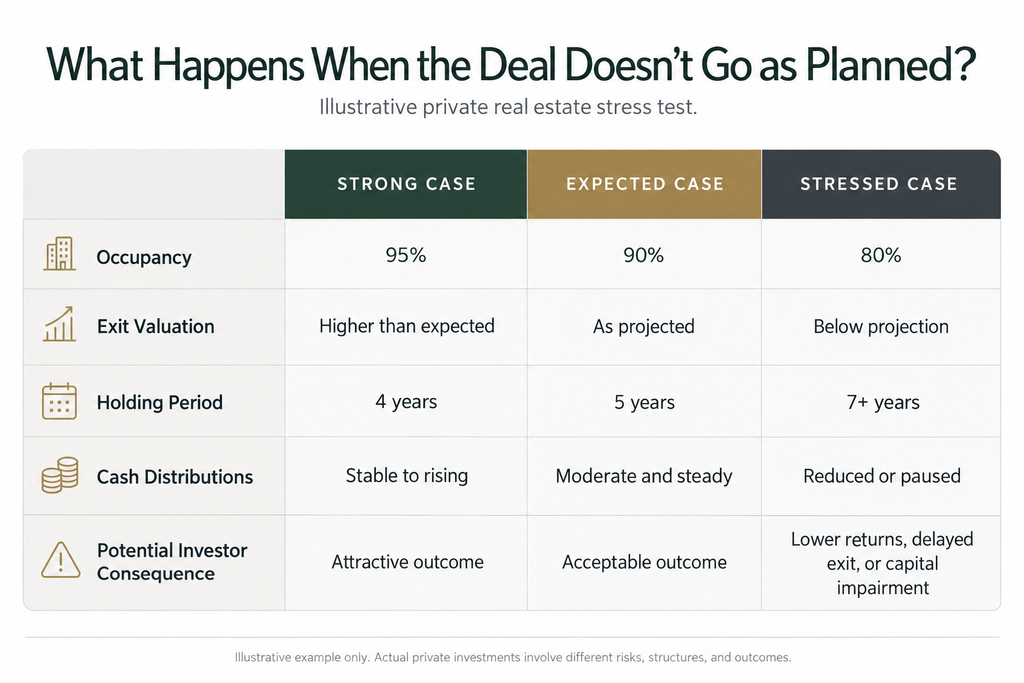
4. We Stress-Test What Happens When Things Go Wrong
Investment presentations naturally focus on what management believes will happen.
Our responsibility is to consider what happens when those expectations prove incorrect.
Suppose a real estate investment assumes a five-year holding period, rising rental income, and a profitable sale.
We might examine what happens if revenue falls below expectations, operating expenses rise, or the property sells at a lower valuation.
For private lending, we would evaluate potential borrower defaults, collateral quality, underwriting standards, and recovery assumptions.
For a private business investment, we might examine slower revenue growth, declining margins, additional capital requirements, or difficulty finding an eventual buyer.
These scenarios matter because private investments often combine several risks simultaneously.
A leveraged property can experience declining cash flow while facing higher financing costs. A struggling private company may require additional funding precisely when existing investors have little liquidity.
We want to know whether an investment can survive unfavorable conditions without permanently impairing capital.
An attractive projected return cannot compensate for every possible downside.
5. We Evaluate Liquidity Before Looking at Returns
One of the biggest differences between public and private investments is the ability to access your money.
Publicly traded investments generally provide an established market where investors can sell during normal trading conditions.
Many private investments offer no comparable option.
A sponsor might describe an expected three-to-five-year holding period, but that expectation is not necessarily a contractual guarantee.
Market conditions, financing constraints, or operational challenges could extend the investment considerably.
The SEC specifically warns that private placements can be highly illiquid and that investors may need to hold restricted securities indefinitely.
Before investing, we consider whether a client could comfortably leave the money untouched for longer than anticipated.
That analysis becomes particularly important for business owners preparing for retirement, families anticipating major expenses, or individuals who may need capital for future opportunities.
A 15% projected return becomes much less attractive when accessing the money at the wrong time is impossible.
6. We Determine Whether the Investment Fits the Overall Portfolio
Even a well-structured investment can be a poor decision for a particular investor.
Consider a DFW business owner whose wealth already includes a privately held company, commercial real estate, and a substantial concentration in local economic activity.
Adding another Texas real estate syndication could increase existing exposures rather than provide meaningful diversification.
That doesn’t automatically make the investment inappropriate, but it changes how we evaluate the opportunity.
We consider the proposed commitment alongside the client’s existing holdings, cash flow requirements, tax circumstances, and long-term objectives.
We also look for risks that may not be obvious from an investment’s label. For example, private credit and commercial real estate may appear to be separate asset classes while both remain vulnerable to the same economic downturn.
The goal is to understand how the opportunity affects the entire financial picture.
Portfolio construction should drive investment decisions, not the excitement surrounding an individual deal.
7. We Look for Warning Signs That Deserve Additional Scrutiny
Not every concerning detail means an investment is fraudulent or fundamentally flawed. Some, however, should prompt deeper investigation.
Here are several warning signs we take seriously:
- Pressure to invest immediately. Artificial deadlines can prevent investors from conducting meaningful due diligence.
- Guaranteed or unusually high returns. Higher expected returns generally involve meaningful economic risks.
- Unclear or incomplete documentation. Investors should understand the offering terms, financial information, and material risks.
- Complex compensation arrangements. Sponsors should clearly explain their fees and potential conflicts of interest.
- Limited transparency. Reluctance to provide supporting financial information or answer reasonable questions deserves attention.
- Reliance on personal relationships. A respected individual can introduce a legitimate opportunity without fully understanding its risks.
The SEC has repeatedly warned investors about these characteristics, particularly in private offerings.
Importantly, even legitimate private investments can result in a total loss. Fraud prevention and investment analysis are related but separate responsibilities.
Passing a background check does not establish that a particular investment offers attractive risk-adjusted returns.
8. We Compare the Opportunity Against Simpler Alternatives
One of the most important parts of our evaluation involves opportunity cost.
A private investment doesn’t exist in isolation. Committing capital means choosing not to use that money somewhere else.
If an investment projects a 10% annualized return, we need to consider whether the additional illiquidity, fees, concentration, and operational risk justify its expected return relative to other available investments.
For some clients, a diversified portfolio of publicly traded investments may offer a more appropriate combination of return potential, liquidity, and transparency.
For others, a carefully selected private investment could complement their existing strategy.
We also consider the administrative burden. Some private investments generate complicated tax reporting, delayed Schedule K-1s, or unexpected taxable income without corresponding cash distributions.
These details can make a seemingly attractive investment less appealing after accounting for its complete financial impact.
Ultimately, the decision should come down to whether the opportunity provides a meaningful benefit that justifies its additional complexity.
My Final Thoughts
I’ve spent much of my career working with successful business owners and families who have built wealth by identifying opportunities other people overlooked.
I understand why private investments appeal to them. Many entrepreneurs became wealthy precisely because they were willing to take calculated risks.
But successful investing requires distinguishing between calculated risk and unnecessary risk.
The country-club connection, impressive presentation, and possibility of outsized returns should never substitute for a thorough evaluation of the underlying economics.
At Mills Wealth Advisors, our objective is to help clients make informed decisions within the context of their complete financial lives. That includes examining opportunities that fall outside a traditional investment portfolio.
Sometimes the right decision will be to participate. Other times, the smartest investment decision will be to walk away.
If someone has presented you with a private investment opportunity, our team can help you evaluate its risks, potential benefits, and place within your broader financial strategy.
Before committing a significant amount of capital, make sure you understand not only what you could earn, but also what you could lose.
This material is for general informational purposes only and is not a recommendation to buy or sell any security or to invest in any private offering. Private investments involve substantial risk, including illiquidity and the possible loss of the entire investment, and are generally available only to investors who meet certain eligibility requirements. Examples are hypothetical and do not represent any actual investment. Consult qualified legal and tax professionals before investing.