

Most military retirees get paid from three places. DFAS sends retired pay. VA sends disability pay. Your Thrift Savings Plan sits off to the side, waiting for you to decide what to do with it. Each one follows its own rules for taxes, inflation and what happens to your spouse when you die. The Survivor Benefit Plan ties them together, and it is one of the few choices you cannot easily undo.
Doing nothing is still a choice. If you skip the SBP form, the law enrolls your spouse at full coverage. If you never file a VA claim, you leave tax free income on the table. If you leave the TSP on autopilot, you may draw from the wrong account in the wrong year and pay tax you never needed to pay. This article walks through each layer, then shows how to stack them into one plan, whether you retire next spring or retired years ago.
How the three layers fit together
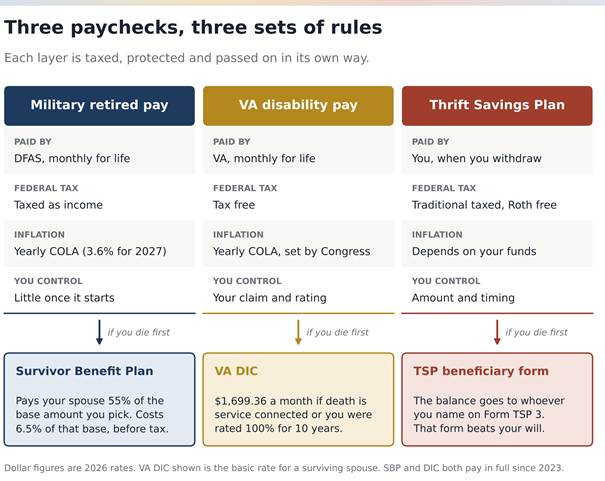
Think of it as a stack. Retired pay forms the base: a check for life that rises with inflation each year. For 2027 it rises 3.6%, starting with the January check. VA disability pay sits on top. It is tax free, also rises with inflation, and depends on your rating. The TSP is the flexible layer you control. The chart shows how each one behaves and what your spouse receives from each if you die first.
Each layer does a different job. Retired pay answers how much you can count on every month. VA pay answers how much of that income the IRS never sees. The TSP handles the surprises: a new roof, a market drop, a child’s tuition, or a spouse who outlives you by 20 years. A good plan uses each layer for the job it does best instead of treating them as one pot of money.
Not everyone holds all three, and the sizes differ. Under the older High 3 system, retired pay equals 2.5% of your highest 36 months of base pay for each year served, so 20 years earns 50%. The Blended Retirement System uses 2%, so 20 years earns 40%, and the TSP match is meant to make up the difference. A VA rating stands apart from retirement. You can retire with no rating, or hold a rating without ever retiring. Reserve and Guard retirees usually wait until age 60 for their first check, or a little earlier with qualifying active duty. The layers you have decide which parts of this article matter most to you.
The Survivor Benefit Plan
SBP protects the pension, and only the pension. Your retired pay stops when you die. SBP keeps a share of it going to your spouse for life: 55% of the base amount you choose, with the same yearly raises as retired pay. Full coverage costs 6.5% of the base amount, taken out before federal tax.
A worked example. Marcus, a hypothetical Army master sergeant, retires at 42 with $3,400 a month of gross retired pay. Full coverage costs him $221 a month and would pay his wife $1,870 a month for life. Because the premium comes out before tax, in the 22% bracket it really costs him about $172. Premiums stop once he has made 360 payments and reached age 70. For Marcus that happens at 72, and the protection continues with nothing more to pay.
Life insurance is not a clean swap. Some retirees decline SBP and buy term life instead. That can work, but term coverage ends, its payout does not grow with inflation, and your spouse has to make a lump sum last. SBP cannot run out. To decline or reduce coverage, your spouse must consent in writing before a notary.
Already retired? Between the second and third anniversary of your first retired pay check, you get a one time window to stop SBP with your spouse’s consent. You get no refund of past premiums and cannot restart coverage later, so treat that window with care.
The widow’s tax is gone. Until 2023, a surviving spouse who received VA Dependency and Indemnity Compensation (DIC) saw SBP cut by that amount. Congress phased the offset out, and since January 2023 survivors receive both in full. DIC pays $1,699.36 a month in 2026 when the death is service connected or the veteran held a 100% rating for the 10 years before death.
VA disability pay and the offset
VA pay is tax free, but it can shrink your pension. By law, retired pay drops a dollar for each dollar of VA pay you receive. Most retirees rated below 50% see the VA check simply replace part of the pension. The total stays the same, and only the tax bill falls.
Two programs end the offset. Concurrent Retirement and Disability Pay (CRDP) restores the full pension for 20 year retirees rated 50% or higher, and it starts automatically. Combat Related Special Compensation (CRSC) pays back the offset for disabilities tied to combat, hazardous duty or training that simulates war, at ratings of 10% or more. You apply to your branch for CRSC, and it pays tax free. You cannot receive both at once, but you can switch during an annual open season.
The rating changes the math. Using Marcus’s $3,400 pension, the chart shows his monthly income at four ratings. At 30%, his total stays at $3,400. At 70%, CRDP lifts it to $5,208.
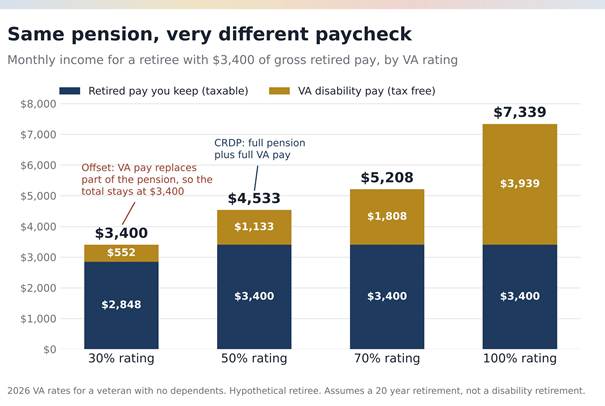
Get the rating right before you retire. The Benefits Delivery at Discharge program lets you file 180 to 90 days before separation, so your rating can arrive with your first retired pay. A rating that crosses 50% is worth far more than its own check, because it unlocks CRDP. The 3.6% raise for 2027 reaches VA pay once Congress passes its yearly adjustment bill.
Medical retirees with less than 20 years face a gap. Chapter 61 retirees with under 20 years of service cannot use CRDP. The Major Richard Star Act would fix that for combat related cases, but as of this writing it has not passed.
Seven moves that tie the plan together
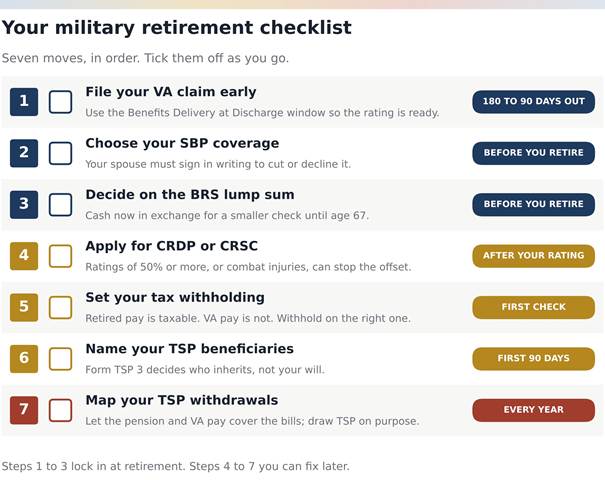
Order matters. Here is the whole plan in order. The first three moves lock in on your retirement date. You can fix the rest later, but each month you wait costs money.
The TSP as the flexible layer
Keep saving while you can. For 2026, you can defer up to $24,500, plus $8,000 more at age 50 and up, or $11,250 more at ages 60 to 63. The IRS has not yet released the 2027 limits. Under the Blended Retirement System, the government adds up to 5% of base pay. Combat zone pay you put into the Roth TSP escapes tax going in and coming out.
Retirement does not force you out. You can leave the money in the TSP, which keeps some of the lowest fund costs around, roll it to a new employer’s plan, or move it to an IRA. Roth TSP balances no longer face required minimum distributions, so they can keep growing for your heirs.
Let the pension cover the bills. With retired pay and VA pay covering fixed costs, the TSP can wait out a bad market instead of selling into it. In low income years, such as the gap between retirement and a second career, draw from traditional TSP or convert some to Roth at a low tax rate. In high income years, lean on Roth money. Texans get one extra break: no state income tax on any of it.
BRS retirees face one more choice. You can take 25% or 50% of your pension’s discounted value as a lump sum in exchange for a smaller check until age 67. The discount is steep, so the lump sum seldom beats the full pension unless you have a specific, high cost use for the cash.
How three retirees might stack it
Marcus retires next spring with a likely 70% rating. He files his claim now, elects full SBP for his wife, and plans on CRDP lifting his income past $5,200 a month. Denise, a retired Navy commander rated 100%, lets her VA pay cover the mortgage, uses the years before Social Security for Roth conversions, and keeps SBP because her husband is eight years younger. Ray, a retired Air Force technical sergeant rated 30%, gains nothing beyond tax savings from his VA check, so he asks his veterans service officer whether his conditions now warrant a higher rating and draws on his traditional TSP in his lower income years. No two of them use the same mix, which is why a stack that works for a neighbor or a former unit mate may not work for you.
Four mistakes worth avoiding
Declining SBP to save the premium. A spouse who outlives you by 20 years can lose more than half of the household income overnight. If cost worries you, choose a lower base amount instead of declining outright. Coverage can start from a base as low as $300 a month.
Waiting to file the VA claim. If you file within a year of leaving service, VA can pay back to the day after discharge. Wait longer and the back pay usually starts only from the date you file, while you pay tax on income that could have been tax free.
Skipping the CRSC application. CRDP starts on its own, but CRSC does not. Retirees rated below 50% whose conditions trace back to combat, parachute duty, training exercises or similar service often never apply, and they keep losing pension to the offset every month. The application goes to your branch, not to VA.
Cashing out the TSP in one year. A large withdrawal stacks on top of retired pay and any new salary, which can push much of it into a higher bracket. Spreading withdrawals over several years, or leaving the money where it is, usually keeps more of it in your pocket.
Your next step
Bring three papers to one meeting. Your retired pay estimate or Retiree Account Statement, your VA rating letter, and your latest TSP statement. Side by side, they show how much income is guaranteed, how much is taxed, and what your spouse keeps. That picture should drive the SBP choice, not the other way around. If you have not retired yet, the checklist deadlines arrive faster than most people expect.
Already retired? Check the stack every January. Confirm the raise showed up on both checks. Make sure your TSP beneficiary form still names the right people after any marriage, divorce or birth. Ask whether your VA rating still matches your health, since a rating increase you never request is income you never receive. And if your marriage ends, remember that SBP can cover a former spouse, which a divorce decree may require you to keep in place.