

Picture a Fort Worth owner who has spent 25 years building a commercial HVAC company. Revenue is steady, margins are healthy, and a larger competitor has started calling. She figures she will sell sometime in 2027 and plans to start getting ready once she hires a broker.
That plan has a timing problem. A profitable business is not automatically a sale-ready business. Much of what shapes the outcome, from how far a buyer trusts your numbers to how much of the price you receive at closing, is decided before anyone sends a letter of intent.
She would have plenty of company. In the Q2 2026 Market Pulse survey from the IBBA and M&A Source, advisors reported that 60% to 90% of sellers across deal sizes had completed less than one year of exit planning, or none at all (IBBA and M&A Source, 2026). If a 2027 sale is on your radar, here is a practical one-year checklist to prepare your business for sale, and to prepare you for what comes after.
Figure 1. The 12-Month Business Sale Preparation Timeline
Illustrative planning framework, not a mandatory timeline. Some owners will need more than 12 months, particularly if financial records, management depth, or customer concentration need significant work. National survey data shows deals often take six to 12 months from engagement to close on top of this preparation (IBBA and M&A Source, 2026).
Get Your Financial House in Order First
Buyers are paying for confidence that your profit is real and will continue. That confidence starts with records a stranger can follow.
Start by working with your CPA to produce consistent statements and move personal expenses out of the business. A family vehicle or a spouse’s phone run through the company becomes an add-back you must document and defend.
Add-backs matter because they feed the earnings figure a buyer prices from. Smaller companies are often valued on seller’s discretionary earnings (SDE), which adds back one owner’s compensation. Larger companies are usually valued on normalized EBITDA, which replaces your pay with a market-rate salary for the person who would replace you. If you pay yourself $150,000 but a capable general manager would cost $250,000, normalized earnings fall by $100,000 (a hypothetical example).
Also flag one-time items, such as a legal settlement or a contract that will not repeat, and explain them before a buyer’s diligence team finds them. When earnings cannot be verified, buyers tend to lower the price or shift more of it into contingent terms.
Reduce Key-Person Risk, Starting With You
Every buyer is asking the same question: what happens the Monday after you leave? If your largest customers call your cell phone, if only you know how to price a job, and if no one is ready to run operations, the buyer sees transition risk. That risk usually shows up as a lower price, a longer required transition period for you, or both.
Twelve months will not rebuild a company, but it can show a buyer clear direction:
- Introduce key customers to a second point of contact and let that person own the relationship.
- Document core processes such as estimating, purchasing, hiring, and month-end close.
- Identify the one or two managers who could lead after you, and give them real authority now.
- Put key customer and vendor relationships in writing and reduce reliance on any account with an outsized share of revenue.
Figure 2. What Buyers See as Red Flags
| Potential Red Flag | Why It Matters |
| Inconsistent financial records | Reduced confidence in reported earnings |
| Heavy owner dependence | Greater transition risk |
| Customer concentration | Revenue vulnerability |
| Undocumented processes | Operational uncertainty |
| Unresolved legal issues | Potential transaction complications |
General planning considerations. Not every buyer weighs these factors equally, and the severity of each depends on the size of the business, the industry, and the buyer type.
Business Valuation Before Selling: What Is It Actually Worth?
Three different numbers tend to get blurred together. An informal estimate, such as a broker’s opinion or a multiple a friend mentioned, is a starting point. A professional valuation from a credentialed appraiser uses income, market, and asset-based approaches (SBA, 2026) and gives you a defensible range. The transaction price is what a specific buyer agrees to pay on specific terms.
Value is shaped by profitability, growth prospects, recurring revenue, customer concentration, industry, and buyer type. A strategic buyer may pay for synergies. A private equity buyer focuses on cash flow and management depth. An individual buyer is often constrained by what a lender will finance.
North Texas owners should be careful with neighborhood comparisons. A Frisco contractor’s reported multiple says little about your margins or your buyer. National data helps with context, not pricing: the Q2 2026 Market Pulse reported strong buyer competition for deals above $5 million, while the smallest deals continued to favor buyers, and advisors expected more businesses coming to market without a broad increase in pricing (IBBA and M&A Source, 2026). That is national survey data, not a forecast for DFW in 2027.
Business Sale Tax Planning: The Price Is Not What You Keep
Deal structure drives taxes. Buyers often prefer asset purchases, while sellers often prefer selling stock or membership interests. In an asset sale, the IRS generally treats the transaction as a sale of each individual asset, with the price allocated across asset classes and reported on Form 8594 (IRS, Publication 544). That allocation matters, because some assets, such as depreciated equipment, can produce gain taxed at ordinary income rates, while goodwill is generally taxed as a capital gain.
Long-term capital gains are currently taxed at federal rates up to 20%, and the 3.8% net investment income tax may also apply depending on your involvement in the business (IRS, Topics 409 and 559). Texas has no personal income tax, which helps, but it does not reduce the federal bill. Confirm the rules for your 2027 tax year with your CPA as terms take shape.
Figure 3. Sale Price vs. Net Proceeds
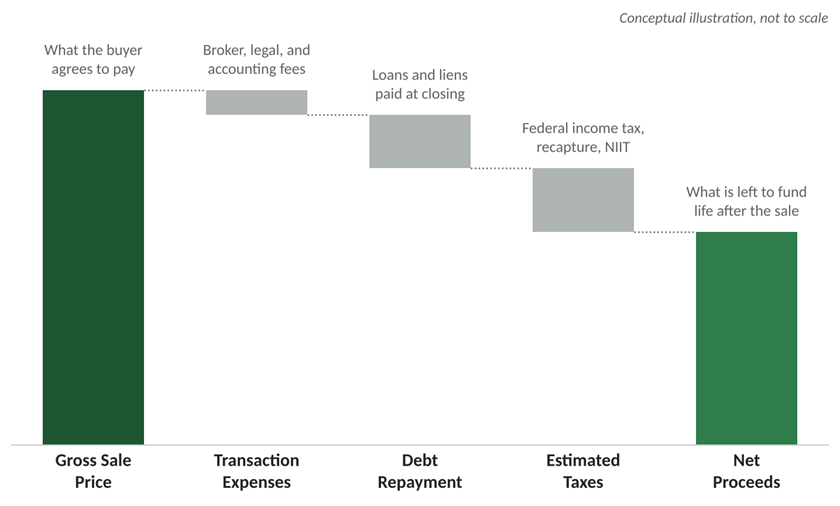
Conceptual illustration only. Bar heights are not to scale and do not represent any actual or typical transaction. Actual proceeds depend on deal structure, purchase price allocation, working-capital adjustments, liabilities assumed or paid off, deferred payments, and other transaction-specific factors.
Not all of the price may arrive at closing. Earnouts, seller financing, and rollover equity defer part of your proceeds and put them at risk. National survey data showed sellers received 83% to 92% of the price in cash at close on average in Q2 2026 (IBBA and M&A Source, 2026).
Then comes the personal question: will what you keep support the life you want? In EPI’s 2023 national survey, only 41% of owners had a formal, written plan for what they would do after selling (Exit Planning Institute, 2023). Before signing a letter of intent, know the after-tax proceeds you need to fund retirement income and how that money will be invested once the paychecks stop.
Know When to Tell Employees
There is no universal answer here. Tell people too early and you risk rumors, anxious employees, and competitors recruiting your best people. Tell them too late and the managers a buyer considers essential may feel blindsided and decline to stay.
Many buyers will want to meet key managers during diligence. A common approach is to bring a small circle into the process under confidentiality agreements, sometimes paired with retention bonuses, and share more broadly closer to closing. Your M&A attorney should help design the agreements and the communication plan.
Start Your Exit Plan Before Your Buyer Search
Preparing for a sale means preparing two things at once: a company a buyer can trust, and a personal financial plan that works after the sale. Not every owner should sell in 2027. But this work tends to make a business better to own, so it rarely goes to waste if you wait.
If a 2027 sale is on your radar, our exit planning team can help you map the next 12 months, from valuation and tax modeling to what your life after the sale needs to look like financially.
Frequently Asked Questions
How far in advance should I prepare my business for sale?
Twelve months is a practical minimum for most owners, and two to three years gives you room to fix larger issues such as management depth or customer concentration. Remember that the sale process itself often adds six months or more.
Do I need to clean up my financial statements before getting a valuation?
Not necessarily. An early valuation can show you which issues are costing you value. Just expect the estimate to change as your records improve, and get an updated view before going to market.
When should I tell employees that I am considering selling the business?
It depends on your company, your buyer, and your key people. Decide the timing with your attorney before anyone outside your advisory team hears about a possible sale, since early leaks are hard to undo.
This article is for educational purposes only and is not individualized tax, legal, or investment advice. Examples are hypothetical and do not guarantee any outcome. Tax rules can change; consult your tax and legal advisors about your situation.
References
Exit Planning Institute. (2023). 2023 National State of Owner Readiness Report. https://exit-planning-institute.org/2023-soor-pc
IBBA and M&A Source. (2026, August 25). The Market Pulse Survey Q2 2026 Reports the Latest Trends in Business Sales up to $50M. PR Newswire. https://www.prnewswire.com/news-releases/the-market-pulse-survey-q2-2026-reports-the-latest-trends-in-business-sales-up-to-50m-302858664.html
Internal Revenue Service. Publication 544 (2025), Sales and Other Dispositions of Assets. https://www.irs.gov/publications/p544
Internal Revenue Service. Topic No. 409, Capital Gains and Losses (reviewed September 24, 2026). https://www.irs.gov/taxtopics/tc409
Internal Revenue Service. Topic No. 559, Net Investment Income Tax. https://www.irs.gov/taxtopics/tc559
U.S. Small Business Administration. Close or Sell Your Business (updated October 2026). https://www.sba.gov/business-guide/manage-your-business/close-or-sell-your-business