

Most of our clients give generously. Most of them also assume the method doesn’t matter, because a gift is a gift and the receipt goes in the tax folder. That has never been fully true, and for 2026 it matters more. Three federal rule changes took effect this year, and they reward some ways of giving and shrink the payoff from others.
This post compares the three tools we see most often with DFW families: direct gifts, donor-advised funds (DAFs), and qualified charitable distributions (QCDs). Texas has no state income tax, so the only tax math in play is federal.
What changed for 2026
Per Kiplinger’s summary of the new law, itemizers can now deduct only the portion of their giving that exceeds 0.5% of adjusted gross income. On $300,000 of AGI, the first $1,500 of gifts earns no deduction. Filers in the 37% bracket also see the value of itemized deductions capped at 35%. Both changes lower the payoff from steady, modest giving.
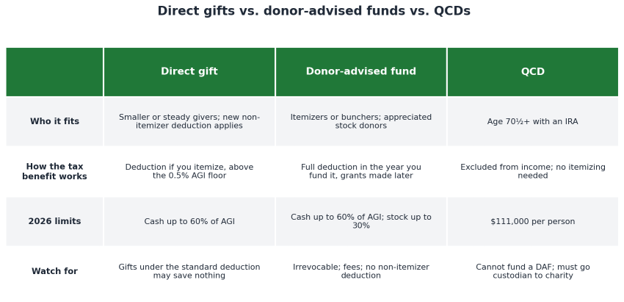
There is a new benefit on the other side. Taxpayers who take the standard deduction can deduct up to $1,000 of cash gifts ($2,000 for joint filers) to public charities. Gifts to a DAF do not count for this deduction, and QCDs are unaffected by the 0.5% floor.
One more number frames everything below. The IRS set the 2026 standard deduction at $32,200 for married couples filing jointly and $16,100 for single filers. Your giving only changes your tax bill when your itemized deductions clear that bar.
Direct gifts: simple, flexible, and often not enough on their own
Writing a check to the North Texas Food Bank or Texas Scottish Rite Hospital for Children is the easiest method, and the charity gets the money right away. The trouble is the standard deduction. A Southlake couple giving $15,000 a year may find that most of it sits beneath the line where itemizing starts to pay.
Direct gifts fit best when you already itemize comfortably, when you want no middleman, or when your giving is small enough that the new non-itemizer deduction covers it.
Donor-advised funds: bunching years of giving into one
A DAF is a charitable account at a sponsor such as Communities Foundation of Texas or The Dallas Foundation. You contribute, take the deduction that year, and recommend grants to charities whenever you like. That separation lets you “bunch”: put two or three years of giving into one tax year, itemize that year, and take the standard deduction in the years between.
A bunching year can also be a good moment to look at a Roth conversion, because the larger deduction can absorb some of the added income. Our post on Roth conversion season covers that side of the decision.
The tradeoffs are real. Contributions are irrevocable, sponsors charge fees, and, as noted above, DAF gifts do not qualify for the new non-itemizer deduction.
QCDs: giving straight from your IRA
If you are 70½ or older, a QCD sends money directly from your IRA to a qualified charity. Per Fidelity’s QCD guidance, the 2026 limit is $111,000 per person, and a QCD can count toward your required minimum distribution. The amount never shows up as income, so it needs no itemizing and no 0.5% floor, and it can help keep adjusted gross income lower for Medicare premium surcharges and the taxation of Social Security.
Two cautions. QCDs cannot go to a DAF, and the money must move from the IRA custodian to the charity, not through your own checking account. If you plan to leave IRA assets to charity at death, that belongs in your estate plan too. Our post on why Texans still need an estate plan explains why.
Side by side
A worked example: the Southlake couple
Say a married couple has $300,000 of AGI and $20,000 of other itemized deductions, such as property tax and mortgage interest. They give $15,000 a year and sit in the 24% bracket (it starts at $211,400 of taxable income for joint filers).
Giving $15,000 each year: Itemized deductions are $20,000 plus $15,000, minus the $1,500 floor, or $33,500. That beats the $32,200 standard deduction by only $1,300. Over two years, the gift buys $2,600 of deduction above the standard.
Bunching $30,000 into a DAF in 2026: Itemized deductions are $20,000 plus $30,000, minus the $1,500 floor, or $48,500. That is $16,300 above the standard deduction. In 2027 they take the standard deduction and grant from the DAF to the same charities.
The bunching approach produces $13,700 more deduction over the two years. At 24%, that is about $3,300 of federal tax savings with no change in what the charities receive. This is an illustration that uses 2026 figures for both years and assumes cash gifts and steady income. Your numbers will differ.
FAQ
Does bunching still work after the 0.5% floor?
Yes, and the floor is one more reason to use it. You absorb the floor once instead of twice, as the example above shows. Bunching works best when your regular giving plus other itemized deductions land just under the standard deduction.
Should I give appreciated stock instead of cash?
Often, yes. If you have held the shares more than a year, you generally deduct the fair market value (up to 30% of AGI) and skip the capital gains tax on the appreciation. Gifts of stock can go directly to a charity or into a DAF.
What are the deadlines?
DAF contributions and direct gifts need to be completed by December 31. Stock transfers and QCD requests move through custodians, and many set earlier cutoffs in December, so start in early December, not the last week.
The Bottom Line
For most DFW families, the right answer is a mix. QCDs suit retirees with required distributions to cover. DAFs suit itemizers who want to bunch or give appreciated stock. Direct gifts still work for smaller or regular giving. The best combination depends on your income, your age, and what is in each account.
If you would like to see which one saves you the most before year-end, we’d be glad to talk it through with you.
This post is for educational purposes only and does not constitute tax, legal, or investment advice. Consult a qualified professional about your specific situation.