
If your estate is worth less than $15 million, you might assume estate planning has become a nonissue. For most families, federal estate taxes probably are not the primary concern, but that does not mean you no longer need an estate plan.
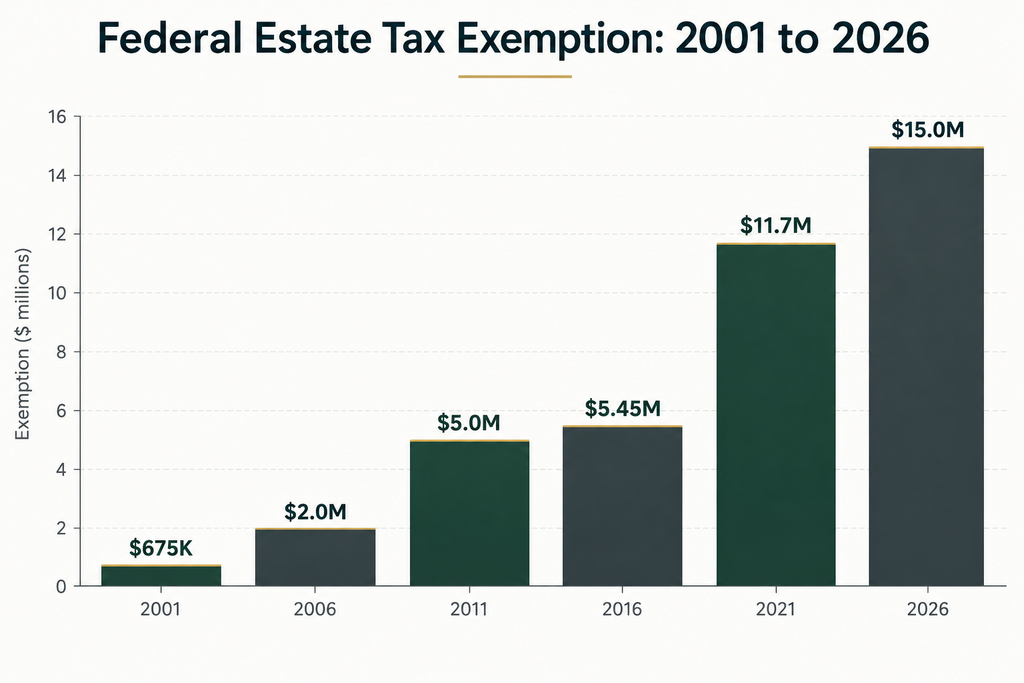
In 2026, the federal estate tax basic exclusion amount is $15 million per individual, up from $13.99 million in 2025. For a married couple, proper planning can potentially allow both spouses’ exemptions to be used, which means federal estate tax affects a relatively small percentage of American families.
Texas adds another advantage. Texas does not currently impose its own estate or inheritance tax, and Texas voters approved a constitutional amendment in 2025 prohibiting the state from imposing most death, inheritance, and similar transfer taxes.
That sounds like great news, and it is. But I think it also creates a misconception because people hear “$15 million estate tax exemption” and conclude, “My estate is nowhere near $15 million, so I don’t need to worry about estate planning.”
Estate taxes are only one piece of estate planning. For many of the Texas families we work with, taxes are not even the most important piece.
What Does the $15 Million Estate Tax Exemption Actually Mean?
The federal estate tax generally comes into play when the value of a taxable estate exceeds the available federal exclusion. For someone dying in 2026, the basic exclusion amount is $15 million, although the IRS adjusts certain estate and gift tax amounts over time.
That means someone with a $3 million, $5 million, or even $10 million estate may have no federal estate tax liability based solely on the size of the estate. But estate planning answers a much broader set of questions than simply whether you will owe estate tax.
Who receives your property, and when do they receive it? Who manages your affairs if you become incapacitated, who makes medical decisions if you cannot, and what happens to your business or other major assets?
Those questions exist whether your estate is worth $500,000 or $50 million. They also matter whether your family is simple or complicated, and whether your children are young, grown, financially responsible, or dealing with challenges of their own.
Estate Planning Is Really About Control
At its core, estate planning gives you more control over what happens when you cannot personally make decisions anymore. A good plan tells everyone involved what you want and gives the right people the authority to carry those wishes out.
Without a plan, Texas law makes many of those decisions for you. A will lets you specify how certain assets should pass after your death and whom you want to serve as executor, but the details of how that will is drafted can make a major difference in how smoothly the estate is administered.
Texas also allows a properly drafted will to provide for independent administration. That can give an executor significantly more freedom to administer an estate without requiring court approval for every step, which can reduce friction and unnecessary court involvement.
That is one reason having “a will” is not necessarily the same thing as having a well-designed estate plan. The goal is not just to have documents. The goal is to have documents that actually match your family, assets, and long-term intentions.
Your Estate Plan Matters Before You Die
One of the biggest misconceptions about estate planning is that it only matters after death. Some of the most important estate planning documents deal with incapacity and can become relevant decades before anyone is thinking about estate taxes.
Imagine you suffer a stroke, serious accident, or medical event that leaves you unable to manage your finances for several months. Someone may need to deal with your bank, manage investments, pay bills, oversee property, or handle business matters on your behalf.
A durable power of attorney can give someone authority to handle those financial responsibilities if necessary. Without the right documents in place, your family can face unnecessary delays and potentially need court involvement before someone has authority to act.
Medical decisions require their own planning as well. A Texas medical power of attorney allows you to appoint an agent to make health care decisions if you become unable to make those decisions yourself.
For many families, these incapacity documents are more likely to be used than sophisticated estate tax strategies. They are also one of the clearest examples of why estate planning matters even when your net worth is well below the federal exemption.
Beneficiary Designations Can Override the Rest of Your Plan
One of the first things I would review in almost any estate plan is something much simpler than a trust: beneficiary designations. Retirement accounts, life insurance policies, annuities, and certain other accounts can transfer according to the beneficiary designation attached to the account.
That makes beneficiary maintenance incredibly important. You may have created a will ten years ago but never updated the beneficiaries on an old 401(k), or you may have named your spouse but never added contingent beneficiaries.
Maybe your children were minors when you originally completed the paperwork and are now adults. Maybe you have remarried, an intended beneficiary has died, or your family situation has changed in another meaningful way.
An estate plan should not just be a stack of legal documents sitting in a binder. Your legal documents, account registrations, beneficiary designations, insurance policies, and overall financial plan should work together.
I call this beneficiary hygiene. It is not exciting, but it is one of the most practical steps families can take to prevent avoidable problems.
Texas Community Property Adds Another Layer
Texas is a community property state. As a general rule, property acquired during marriage is presumed to be community property, although there are important exceptions and the characterization of specific assets can become complicated.
That can affect estate planning in ways families may not expect. You need to understand what each spouse actually owns, how accounts and real estate are titled, what property may be separate property, and how assets are supposed to transfer at each spouse’s death.
This becomes especially important in second marriages and blended families. A husband and wife may each have children from prior marriages while also wanting to provide financially for the surviving spouse.
Their long-term goal might be to support the surviving spouse for life while ultimately leaving certain assets to their respective children. Simply saying, “Everything goes to my spouse,” might not accomplish that objective.
This is where estate planning moves well beyond tax planning. The issue is not how to avoid tax. The issue is how to make sure your assets eventually end up where you intended.
Business Owners Have Even More to Think About
Business owners should pay particularly close attention because a privately held company may represent a large percentage of the owner’s net worth. At the same time, the business creates succession and liquidity issues that a traditional will cannot solve by itself.
Who can operate the company if you become incapacitated? Who takes control when you die, and do your children actually want to own the business?
If one child works in the company and two do not, equal ownership may not produce an equal or practical outcome. You also have to think about whether the business can generate enough liquidity to provide for family members who are not involved.
A buy-sell agreement may help address some of these issues, but it still has to reflect the current structure and value of the company. An agreement drafted years ago may no longer fit the business that exists today.
As a Certified Exit Planning Advisor, I think this is where estate planning and exit planning have to intersect. Your business succession plan, estate plan, insurance coverage, investment portfolio, and retirement plan cannot operate as five separate strategies.
They need to tell the same story.
You May Still Need a Trust Even Without an Estate Tax Problem
People sometimes think trusts exist primarily for ultra-wealthy families trying to avoid estate taxes. That is not always the case because trusts can serve many purposes that have little or nothing to do with the federal estate tax.
A family may want additional control over when children receive an inheritance. Leaving $1 million outright to a responsible 45-year-old child is very different from leaving $1 million outright to an 18-year-old.
Another family may have a beneficiary with special needs, concerns about a child’s marriage, creditor issues, addiction, or poor financial judgment. A trust can sometimes provide additional structure and protection around those situations.
A revocable living trust may also play a role in incapacity planning and can help assets titled in the trust avoid probate. But creating a trust without properly funding and maintaining it can defeat much of its purpose.
That is why I would not start with the question, “Do I need a trust?” The better question is, “What do I want this plan to accomplish, and what structure best gets me there?”
Don’t Confuse “No Estate Tax” With “No Tax Planning”
Even when federal estate tax is unlikely, taxes can still influence an estate plan. Income taxes, capital gains, retirement account taxation, required minimum distributions, inherited asset rules, Roth conversions, and charitable giving can all affect the overall strategy.
The best strategy is not always the one that minimizes estate tax. Sometimes aggressively moving assets out of an estate can solve one tax problem while creating another issue elsewhere.
That is why I prefer to look at estate planning as part of the family’s entire financial plan rather than treating it as an isolated legal exercise. Your CPA, estate attorney, financial advisor, and insurance professionals should all understand the overall strategy.
The goal is coordination. A tax-efficient plan that creates family problems is not a good plan, and a legally valid plan that ignores taxes and account structure may not be a good plan either.

Who Should Review Their Estate Plan in 2026?
You do not need to redesign your estate plan every year, but you should review it periodically and whenever your circumstances materially change. Major life changes are often more important than changes in the federal estate tax exemption.
I would especially consider a review if you have moved to Texas from another state, bought or sold a business, experienced a significant increase in net worth, married, divorced, remarried, had another child or grandchild, lost a spouse or beneficiary, purchased substantial real estate, or changed your charitable goals.
I would also review your plan if it has simply been a long time. An estate plan created 10 or 15 years ago may still be legally valid, but that does not mean it still reflects your current family structure, assets, or intentions.
The people you named to serve in important roles may need to change too. The executor you selected years ago may no longer be your first choice, the person you named as financial power of attorney may have moved away, or your children may now be old enough to serve in roles previously assigned to siblings or friends.
Your life changes over time. Your estate plan should occasionally change with it.
My Final Thoughts
The $15 million federal estate tax exemption in 2026 is good news for many families. Most Texans will never owe federal estate tax, and Texas does not currently impose its own death or inheritance tax.
But I would not use that as a reason to ignore estate planning. Estate planning is not just about keeping money away from the IRS.
It is about making sure the right people can make decisions for you if you cannot make them yourself. It is about making sure your assets pass the way you intended and protecting your spouse, children, business, and the financial plan you spent decades building.
For some families, sophisticated tax planning is absolutely necessary. For many others, the biggest opportunity is much simpler: get the basic documents right, coordinate them with your financial accounts, keep beneficiaries updated, and make sure the entire plan still reflects what you actually want.
A $15 million exemption does not eliminate the need for an estate plan. It simply changes what the estate plan needs to accomplish.
This material is for general informational purposes and is not intended as legal or tax advice. Estate planning strategies should be reviewed with qualified legal and tax professionals based on your individual circumstances.