
Your employees may soon ask for bitcoin. Fund companies already pitch target date funds with a slice of private equity, private credit or real estate inside them, and several crypto managers now court 401(k) plans directly. Washington has spent the past year and a half clearing the way. If you sponsor a 401(k), you will likely face a pitch for one of these products within the next year.
Saying no still counts as a decision. ERISA does not require you to add alternatives, and it does not forbid them either. What it requires is a careful, documented process for every fund on the menu. A committee that rejects a private markets fund after a real review stands on firm ground. A committee that never looks, or that adds one because a provider made it easy, does not. The goal of this playbook is to help you reach either answer the right way.
What counts as an alternative
The executive order names six groups. Executive Order 14330 lists private market investments such as private equity and private credit, real estate, actively managed vehicles that invest in digital assets such as bitcoin, commodities, infrastructure projects, and lifetime income strategies such as annuities. What they share is that they trade less often, cost more to run, or behave differently from the stock and bond index funds that fill most menus today. That difference is the source of both the appeal and the risk.
What changed and what has not
The rules swung twice in six years. In 2020 the Labor Department said private equity could sit inside a diversified fund such as a target date fund. In late 2021 it walked that back for most small plans, and in March 2022 it told sponsors to use “extreme care” before offering crypto. In 2025 the pendulum swung again. The Department withdrew the crypto warning on May 28, the President signed Executive Order 14330 on August 7, and the Department rescinded the 2021 statement five days later.
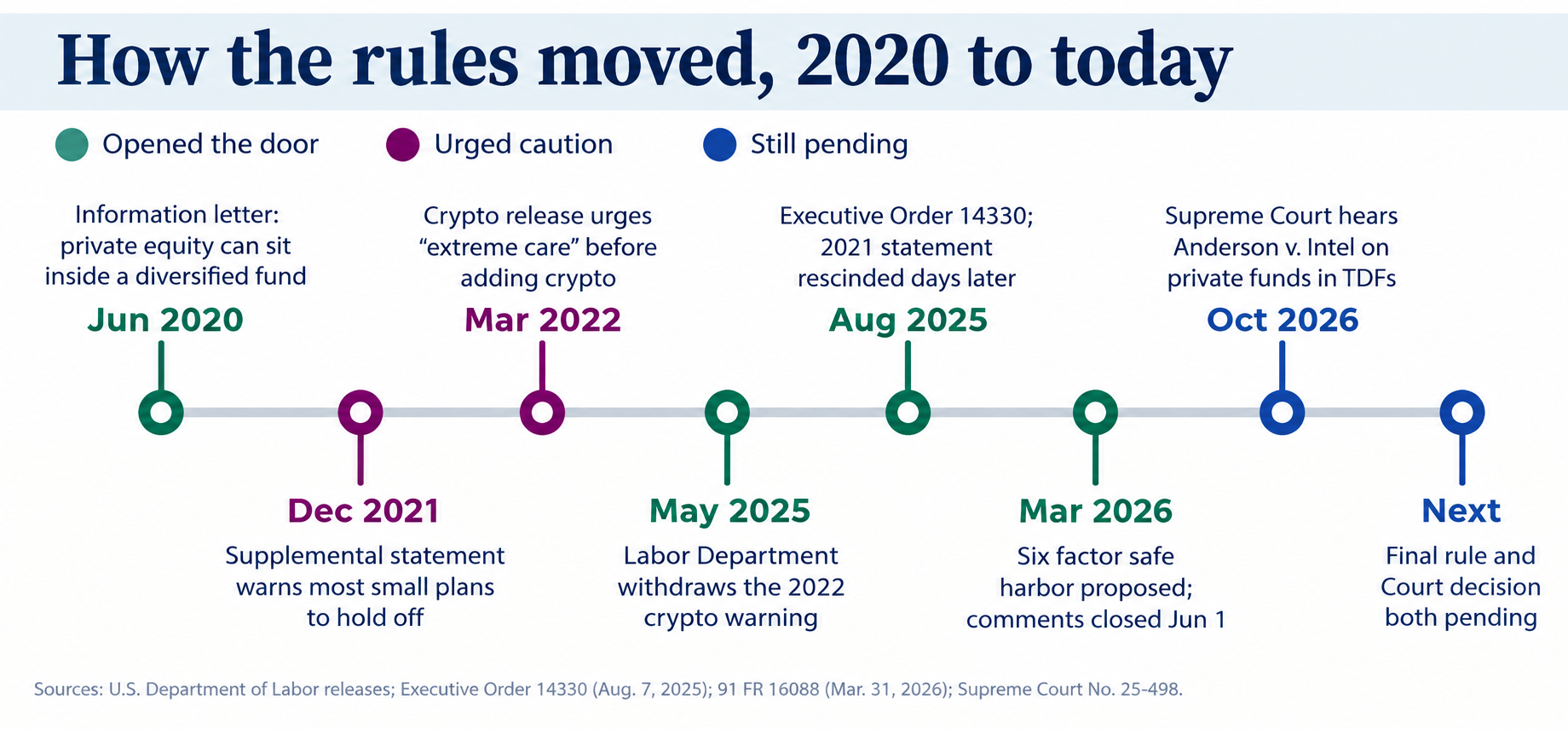
The newest piece is still a proposal. On March 31, 2026, the Department published a proposed rule that gives fiduciaries a safe harbor when they select a fund for the menu. It treats every asset type the same way; ERISA bars only illegal investments. Comments closed June 1, and as of late October no final rule has appeared. What has not changed is the core duty: you must act prudently and solely in your participants’ interest.
The six factors in the proposed safe harbor
If your committee weighs six factors “objectively, thoroughly and analytically” and bases its choice on them, the proposal presumes the choice was prudent and gives your judgment significant deference. Use the list below as the spine of every fund review, whether the fund holds crypto or plain index shares.
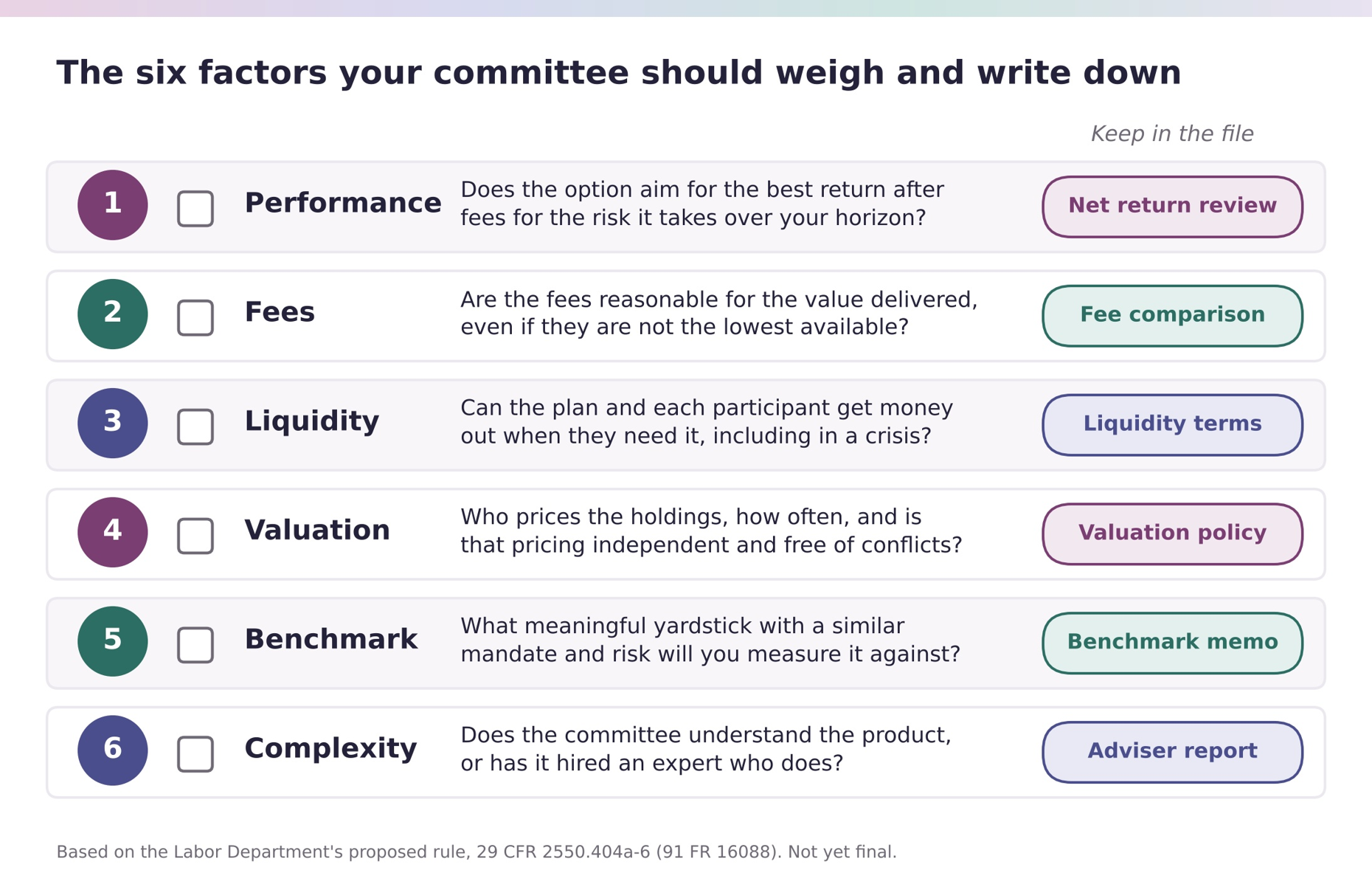
Lowest cost is not the test. The proposal says you do not have to pick the cheapest fund, the most liquid fund or the one with the best past return. You do have to show why the fee buys something. On a $40,000 balance, a fund that charges 0.05% costs $20 a year, while one that charges 1.5% costs $600. Your notes should explain what the extra $580 delivers, such as diversification, lower swings or a better expected return after fees.
Hiring help counts. If your committee lacks the expertise, the proposal says that relying on a prudently chosen investment adviser or manager points to a prudent process. That help must be real. Keep the adviser’s report, record the questions your committee asked, and note how it weighed the answers.
Where the safe harbor stops
It covers the pick, not the follow up. The protection applies only to choosing a fund. It does not cover the ongoing duty to monitor that fund, the duty of loyalty, or the prohibited transaction rules. If a provider pays your adviser more for placing its private markets fund, the safe harbor will not help you. Ask every vendor how it gets paid and put the answer in writing.
Private equity usually arrives in a wrapper. Few plans will offer a standalone private equity fund. The common route places a 5% to 15% sleeve of private assets inside a target date fund or a managed account. That raises your review questions one level: you must understand the sleeve, how the manager values it, and what happens if many participants retire or leave in the same year.
Crypto asks the hardest questions. A spot bitcoin ETF trades daily, so liquidity looks fine on paper. Valuation, custody and benchmarking are harder. Prices move around the clock and can fall by half in months. Before you add crypto, decide whether it belongs on the core menu or only inside a self directed brokerage window, and write down why.
Tell participants what they own. A private markets sleeve inside a target date fund can be invisible to the employee who holds it. Ask the provider for plain language fact sheets, include the fund in your annual fee disclosure review, and brief employees at enrollment meetings. People who understand why their fund holds private assets are less likely to panic when its value lags the stock market in a strong year.
What the Intel case adds
On October 6, 2026, the Supreme Court heard Anderson v. Intel, a suit claiming Intel put too much of its target date funds into hedge funds and private equity. The justices appeared ready to require plaintiffs to compare an underperforming fund to a meaningful benchmark. A ruling for Intel would make weak lawsuits harder to bring, but it would also make your own benchmark choice the first thing a court examines. Choose it with care and record the reasons.
Expect a ruling by next summer. The Court usually decides cases argued in October before its term ends in late June. Until then, treat benchmark selection as a formal agenda item. For each fund, write down the benchmark, why it fits the fund’s strategy and risk, and what gap in returns would prompt your committee to take a closer look. That one page can carry a lot of weight if a participant ever questions a choice.
Comparing your options
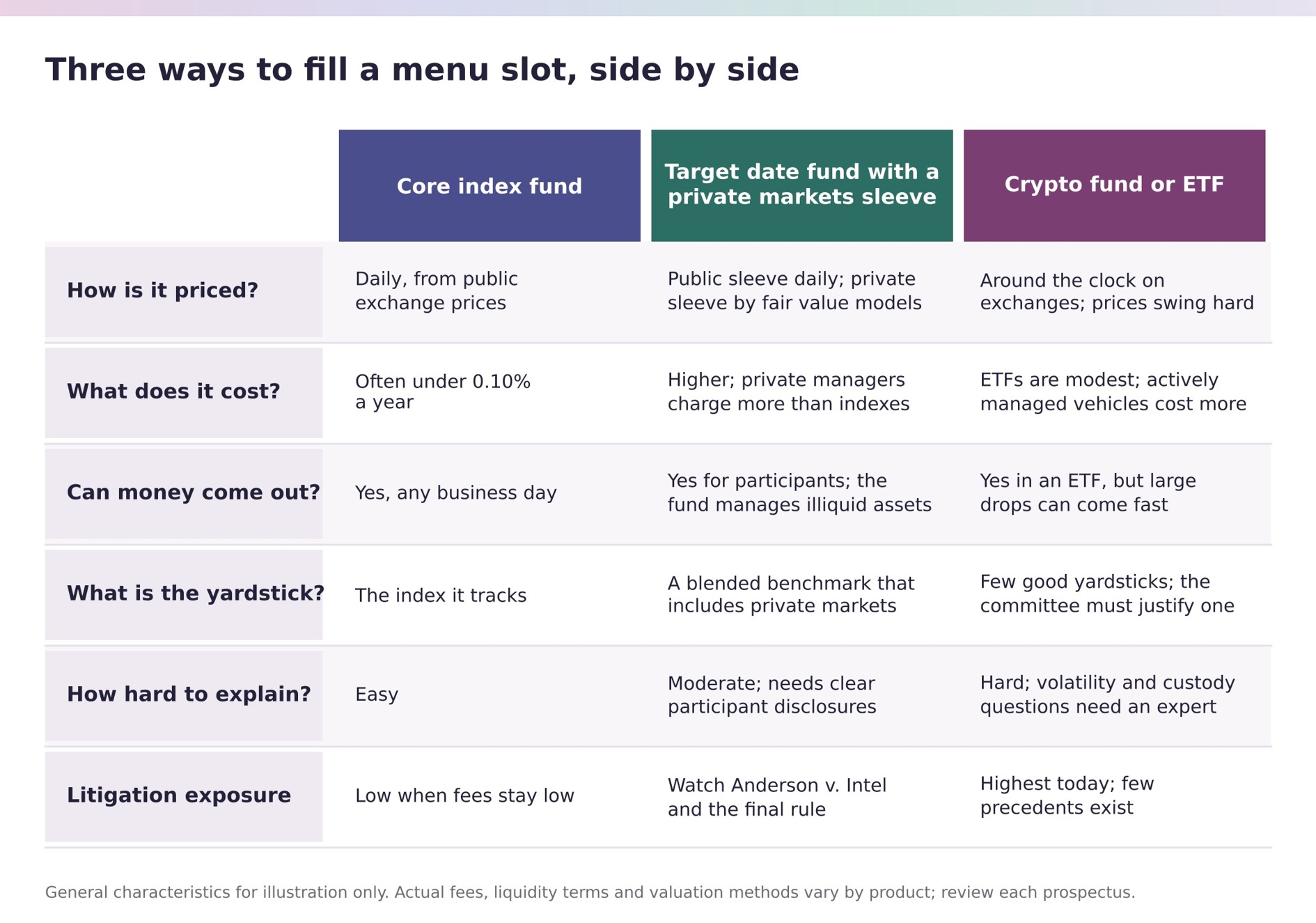
The table compares a plain index fund with the two kinds of products you are most likely to see pitched.
How three sponsors might respond. Maria runs a 40 person engineering firm with a part time committee; she keeps her lineup as is, documents the review, and revisits it once the rule is final. Darnell runs a 300 person manufacturer that already uses a 3(38) investment manager; he asks the manager to evaluate a target date series with a private markets sleeve against the six factors. Priya’s younger staff keep asking about crypto; she leaves the core menu alone and lets her recordkeeper offer a brokerage window with clear risk warnings.
Your next step
Get ahead of the pitch. Update your investment policy statement so it names the six factors and says how your committee will handle alternative assets. Then hold one committee meeting this quarter to walk through it, even if you plan to add nothing. When the final rule arrives, you will already have the process that earns its protection.