

A woman in Grapevine loses her husband of 31 years. Within a week, someone tells her to “just call Social Security.” Within a month, someone else tells her to take the survivor benefit right away because she’s entitled to it. Neither piece of advice is quite right, and the gap between them can be worth tens of thousands of dollars over a retirement.
Here is the short answer to the question most people searching this topic are asking. As a widow or widower, you can usually choose between your survivor benefit and your own retirement benefit, and you can often take one first and switch to the other later. Social Security says it plainly: “The payments won’t be added together,” but “you can also switch benefits later.” The skill is in picking the order.
Who Qualifies
According to the Social Security Administration (SSA), you may qualify for survivor benefits if you are 60 or older (or 50 to 59 with a disability) and were married to the deceased for at least nine months. Divorced spouses can qualify if the marriage lasted at least 10 years. If you are caring for the deceased’s child, you may qualify at any age.
Survivor benefits do not start on their own. You have to apply, and the amount depends on when you do.
How the Amount Works
SSA says survivor payments start at 71.5% of your spouse’s benefit and rise the longer you wait. You get over 75% at 61, over 80% at 63, and over 90% at 65. You reach 100% at your full retirement age for survivor benefits, which falls between 66 and 67. For anyone born in 1962 or later, that age is 67.
Your own retirement benefit follows a different clock. It is reduced if you claim before your full retirement age and grows if you wait until 70. Because the two benefits run on separate schedules, you can let one grow while you draw the other. That is the whole strategy.
A Worked Example
Take a hypothetical Southlake widow, age 60, whose husband was drawing $2,200 a month from his Social Security benefit. Her own benefit would be $2,000 a month at her full retirement age of 67, or $2,480 if she waits until 70. These numbers are simplified, before taxes, and ignore cost-of-living adjustments.
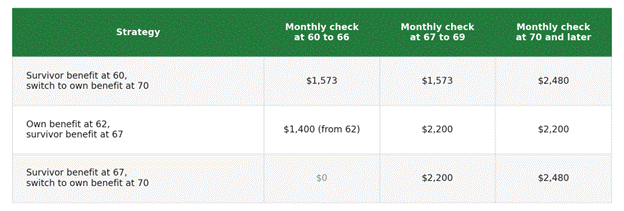
The first row gives her income now but gives up the most per month in the early years. The third row pays nothing until 67 and delivers the best lifetime monthly amount, but only works if she has other money to live on in the meantime. The second row locks in a smaller own benefit permanently, which is why we rarely recommend it unless her own benefit is already close to the survivor amount. The right answer depends on her other assets, her health, and how much she needs from the portfolio in the next few years. That is why we model it before anyone files.
Two details from your late spouse’s record also matter. If he claimed early, your survivor benefit can be capped below what he would have received at his full retirement age. If he delayed past full retirement age, your survivor benefit generally includes those extra credits. In many couples, the higher earner’s claiming age ends up setting the survivor’s income for life, which is one reason we cover the survivor side of the decision in our break-even math for Social Security at 62, 67, or 70.
What Changes for a Texas Widow
Texas has no state income tax, so the tax question on your benefits is a federal one. Your filing status generally moves to single after the year of your spouse’s death, which can push you into a higher bracket on the same income. That deserves a look before you decide how much to draw from retirement accounts.
Texas is also a community property state. For community property, both halves of an asset typically receive a step-up in cost basis at the first death, which can reduce the tax on selling a home or appreciated stock. Your estate documents matter here too, especially if you moved to Texas from another state, as we explain in our post on why an out-of-state will and power of attorney need a Texas review. If your spouse had the over-65 school tax ceiling on your home, it can continue for you as long as you were at least 55 when they died and you keep living there.
Frequently Asked Questions
Can I take the survivor benefit first and switch to my own benefit later?
Yes, in most cases. SSA’s own example is starting with survivor benefits and changing to retirement at 70, when your own payment is highest. The reverse also works. The order you choose can change your lifetime income significantly.
What happens to my survivor benefit if I remarry?
If you remarry before age 60 (or before 50 if you are disabled), you generally lose eligibility. If you remarry after those ages, SSA’s rules say you can still qualify. Check your situation with SSA before you set a wedding date.
Does working reduce my survivor benefit?
It can, if you claim before your full retirement age. For 2026, SSA withholds $1 in benefits for every $2 you earn above $24,480, and that limit rises to $25,560 in 2027. Once you reach your full retirement age, the earnings test no longer applies.
Is there a death benefit?
SSA pays a one-time $255 payment to a surviving spouse or eligible child.
The Bottom Line
Losing a spouse is the worst time to make a permanent financial decision, and Social Security is one of the few decisions where waiting a few months to get the order right is often worth the delay. You have two benefits and one switch. Choosing which one to start first is a planning question as much as an SSA form.
If you’re facing this decision or helping a parent through it, we’d be glad to talk it through. A 15-minute intro call is a good place to start.
This article is for educational purposes only and is not individualized tax, legal, or investment advice. Social Security rules and benefit amounts change, and every household’s situation is different. Please consult a qualified professional before making decisions.