

If you or your spouse takes time away from the workforce, whether to raise children, care for a family member, or support a household in other ways, it can feel like retirement savings become a one-sided effort. The good news is that a spousal IRA exists precisely to address this gap. It is one of the most underused tools in retirement planning, and understanding how it works could meaningfully improve your household’s long-term financial security.
In this article, we will walk through what a spousal IRA is, who qualifies, the rules that govern it, and how to decide whether it fits into your overall retirement plan.
What Is a Spousal IRA?
First, let’s clear up a common misconception: a spousal IRA is not a special or separate type of account. It is simply a rule within the tax code that allows a married individual to contribute to an IRA on behalf of a spouse who has little or no earned income. The account itself is a standard Traditional or Roth IRA, opened in the non-working spouse’s name and owned entirely by that spouse.
The term “spousal IRA” describes how the contribution is made, not the type of account. That distinction matters because the non-working spouse has full ownership of the account, the ability to name beneficiaries, and the same investment options available to any other IRA holder.
Why a Non-Working Spouse Can Still Contribute to an IRA
Normally, you need earned income to contribute to an IRA. Earned income includes wages, salaries, self-employment income, and similar compensation. It does not include investment returns, rental income, Social Security benefits, or alimony received under agreements finalized after 2018.
The spousal IRA rule is an exception built into the tax code. Congress recognized that a stay-at-home spouse contributes meaningful value to a household even without a paycheck. The rule allows the working spouse’s earned income to count toward the non-working spouse’s IRA contribution, provided the couple files a joint tax return and meets all IRS requirements.
Spousal IRA Rules: What You Need to Know
Before making a spousal IRA contribution, there are several rules to keep in mind. Always confirm current IRS guidelines before contributing, as limits and income thresholds can change from year to year.
You Must File Taxes Jointly
The spousal IRA rule only applies to couples who file a joint federal tax return. Married individuals filing separately are not eligible.
The Working Spouse Must Have Sufficient Earned Income
The working spouse must earn at least as much as the total combined IRA contributions for both spouses. For example, if each spouse plans to contribute the annual maximum, the working spouse must have earned income equal to at least twice that amount.
Annual Contribution Limits
Each spouse can contribute up to the annual IRA limit set by the IRS. These limits are subject to inflation adjustments each year. Individuals age 50 and older may make an additional catch-up contribution above the standard limit. Refer to the current IRS guidelines or speak with a financial professional to confirm the amounts that apply in the current tax year.
Age and Eligibility
There is no age restriction for contributing to a Roth IRA. For a Traditional IRA, you can contribute at any age as long as you or your spouse has qualifying earned income. Keep in mind that Traditional IRA contributions may or may not be tax-deductible depending on your income level and whether either spouse participates in an employer retirement plan.
Income Limits for Roth IRA Eligibility
Roth IRA contributions are subject to income phaseout limits based on your modified adjusted gross income. If your household income exceeds the IRS threshold for the year, your ability to contribute directly to a Roth IRA may be reduced or eliminated. These limits change periodically, so check the current year’s IRS guidance or consult a CFP® professional to determine your eligibility.
| Key Takeaways A spousal IRA is not a separate account type. It is a contribution rule for married couples. The non-working spouse owns the IRA in their own name. You must file a joint tax return to use the spousal IRA rule. The working spouse’s earned income must cover contributions for both spouses. Both Traditional and Roth IRA options are available, depending on income and tax situation. Contribution limits and income phaseouts are set by the IRS and can change each year. |
Traditional vs. Roth Spousal IRA: Which Makes More Sense?
Once you determine that a spousal IRA is an option for your household, the next decision is whether to use a Traditional or Roth IRA. Both are valid choices, and the right one depends on your household’s tax situation and long-term goals. The table below summarizes the key differences.
| Feature | Traditional IRA | Roth IRA |
| Tax Deduction on Contributions | Potentially deductible | No deduction |
| Tax on Investment Growth | Tax-deferred | Tax-free |
| Withdrawals in Retirement | Taxed as ordinary income | Tax-free (if qualified) |
| Income Limits to Contribute | None (deductibility may phase out) | Yes, phaseout applies |
| Required Min. Distributions | Yes, starting at age 73 | No (during owner’s lifetime) |
| Best Fit For | Higher income now, lower later | Lower income now, higher later |
Traditional Spousal IRA
Contributions to a Traditional IRA may be tax-deductible, which can lower your taxable income today. The account grows tax-deferred, meaning you pay taxes on withdrawals in retirement. This can be a good fit for households that expect to be in a lower tax bracket in retirement than they are now.
Roth Spousal IRA
Roth IRA contributions are made with after-tax dollars, so there is no upfront tax deduction. However, the account grows tax-free, and qualified withdrawals in retirement are also tax-free. A Roth may be more advantageous for couples who expect their tax rate to rise over time, who want tax diversification in retirement, or who value the flexibility Roth accounts offer since contributions (not earnings) can be withdrawn before retirement age without penalty.
A Financial Advisor can help you model both scenarios based on your household’s income, current tax rate, and retirement timeline to identify which approach is the better fit.
A Real-Life Example: Building Retirement Savings as a Team
Consider Marcus and Priya. Marcus works full-time and earns $95,000 per year. Priya left her career two years ago to stay home with their two young children and currently has no earned income of her own.
Because Marcus earns enough to cover both contributions and because they file their taxes jointly, both Marcus and Priya can each contribute the annual maximum to their respective IRAs. Marcus contributes to his own IRA, and Priya contributes to her own IRA using the spousal IRA rule. Each account is separate, owned by the individual spouse, and grows independently over time.
By the time their children are in school and Priya is ready to re-enter the workforce, she will already have years of retirement savings in her own name. The chart below illustrates just how much those early years of contributions can matter. Starting at age 30 versus waiting until 50 can result in a difference of more than $790,000 at retirement, all from the same annual contribution.
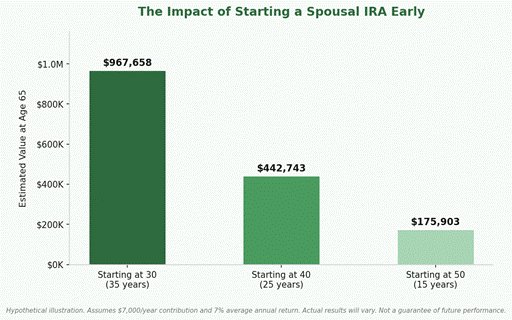
Figure 1. Hypothetical illustration only. Assumes $7,000/year contribution and a 7% average annual return. Actual results will vary. This is not a guarantee of future performance.
Those years of compounding growth can make a significant difference over a 20 to 30-year investment horizon, which is exactly why using the spousal IRA rule early, rather than waiting until a spouse returns to work, can have lasting impact.
Common Misconceptions About Spousal IRAs
“My spouse doesn’t work, so they can’t save for retirement.”
This is the most common misconception. If you file a joint return and the working spouse has sufficient earned income, a non-working spouse can contribute to their own IRA every year.
“A spousal IRA is a joint account.”
It is not. Each IRA is an individual account. The non-working spouse owns the account outright, names their own beneficiaries, and makes their own investment decisions within it.
“Only the working spouse benefits from saving for retirement.”
The spousal IRA allows both spouses to build retirement savings in their own names. This is especially important for the non-working spouse’s long-term financial independence, particularly in the event of divorce or the death of the working spouse.
What An Advisor Would Consider
Opening a spousal IRA is a worthwhile step, but it should be evaluated as part of your broader financial picture. Here are the areas a Financial Advisor would typically review:
- Overall retirement goals: What age do you want to retire, and what kind of lifestyle do you envision? These answers shape how aggressively you need to save.
- Household cash flow: Can your budget support contributions for two IRAs each year without straining your emergency fund or other financial priorities?
- Tax planning: Is a Traditional or Roth IRA more advantageous given your current and projected future tax rates?
- Emergency savings: Most financial planners suggest maintaining three to six months of living expenses in accessible savings before maximizing retirement contributions.
- Employer retirement plans: If the working spouse has access to a 401(k) or similar plan with an employer match, capturing that match should generally come first.
- Long-term investment strategy: Asset allocation, risk tolerance, and investment selection inside the IRA should align with the couple’s overall retirement plan.
When a Spousal IRA May Be Especially Valuable
While the spousal IRA rule can benefit any qualifying couple, there are situations where it is particularly impactful:
- Stay-at-home parents who have stepped away from the workforce for an extended period.
- A spouse taking time off to care for an aging parent or a family member with a health need.
- A spouse in a career transition, between jobs, or returning to school.
- A situation where one spouse has retired early while the other continues to work.
In each of these scenarios, the spousal IRA allows the non-working partner to continue building retirement savings without waiting until they return to paid employment.
Is a Spousal IRA Right for Your Family?
A spousal IRA is a straightforward and often overlooked strategy that can help both spouses build retirement savings, even when only one earns a paycheck. If you file jointly and the working spouse has enough earned income to cover both contributions, you may already qualify. The decision of whether to use a Traditional or Roth IRA, how much to contribute, and how to invest the funds should be made as part of a comprehensive financial plan tailored to your household’s specific goals.
If you have questions about spousal IRA rules and whether this strategy belongs in your retirement plan, schedule a 15-minute intro call and we’ll review your full financial picture with you.
Frequently Asked Questions
What is a spousal IRA?
A spousal IRA refers to a contribution made to an IRA on behalf of a spouse who has little or no earned income. It is not a separate type of account. It is a standard Traditional or Roth IRA opened in the non-working spouse’s name and funded using the working spouse’s earned income under IRS rules.
Can a non-working spouse contribute to an IRA?
Yes, under the spousal IRA rule. The couple must file a joint federal tax return, and the working spouse must have earned income equal to at least the combined total of both spouses’ contributions for the year. The non-working spouse’s IRA is separate and owned solely by that individual.
Is a spousal IRA a joint account?
No. A spousal IRA is an individual account held in the non-working spouse’s name. The account belongs to that spouse alone, including the right to name beneficiaries and direct how the funds are invested.
What are the key spousal IRA rules?
The main requirements are: (1) the couple must file a joint federal tax return, (2) the working spouse must have earned income equal to at least both spouses’ combined contributions, (3) contributions cannot exceed the annual IRS limit per person, and (4) Roth IRA contributions are subject to income phaseout limits. These rules and limits are subject to change, so always verify current IRS guidance before contributing.
Should I choose a Roth or Traditional Spousal IRA?
It depends on your current tax rate, your expected tax rate in retirement, and your overall financial plan. A Traditional IRA may provide a tax deduction now, while a Roth IRA offers tax-free growth and withdrawals in retirement. Our team can help evaluate which option is more beneficial based on your household’s specific circumstances.
Can a spousal IRA contribution be made for a prior tax year?
Yes. IRA contributions for a given tax year can generally be made up until the federal tax filing deadline, typically April 15 of the following year. This applies to spousal IRA contributions as well, provided all IRS requirements are met. Confirm the current deadline with your tax advisor or financial planner.
Mills Wealth Advisors is a Registered Investment Advisor. This article is for educational purposes only and does not constitute individualized financial, tax, or legal advice. Consult a qualified CFP® or tax professional before making financial decisions.