
December is the wrong month to start thinking about taxes. Most of the decisions that move a high earner’s tax bill lock in before the calendar turns, and the return your accountant prepares next spring simply records choices you finished making months earlier. Texas levies no individual income tax, so your planning energy goes toward federal income tax, investment income, business income, and your estate.
What changed for 2026, and which way it cuts
Five provisions take effect this year. One widens a deduction you can use, and four narrow deductions that high earners rely on, so a strategy that worked in prior years may quietly underperform now.
- The SALT cap grew from $10,000 to $40,400. For a Texas homeowner paying high property taxes, that increase alone can make itemizing beat the $32,200 standard deduction.
- That same cap now phases down. Once modified adjusted gross income passes $505,000, the cap falls by 30 cents for every additional dollar of income until it bottoms out at $10,000. A couple at $600,000 keeps only $11,900 of it.
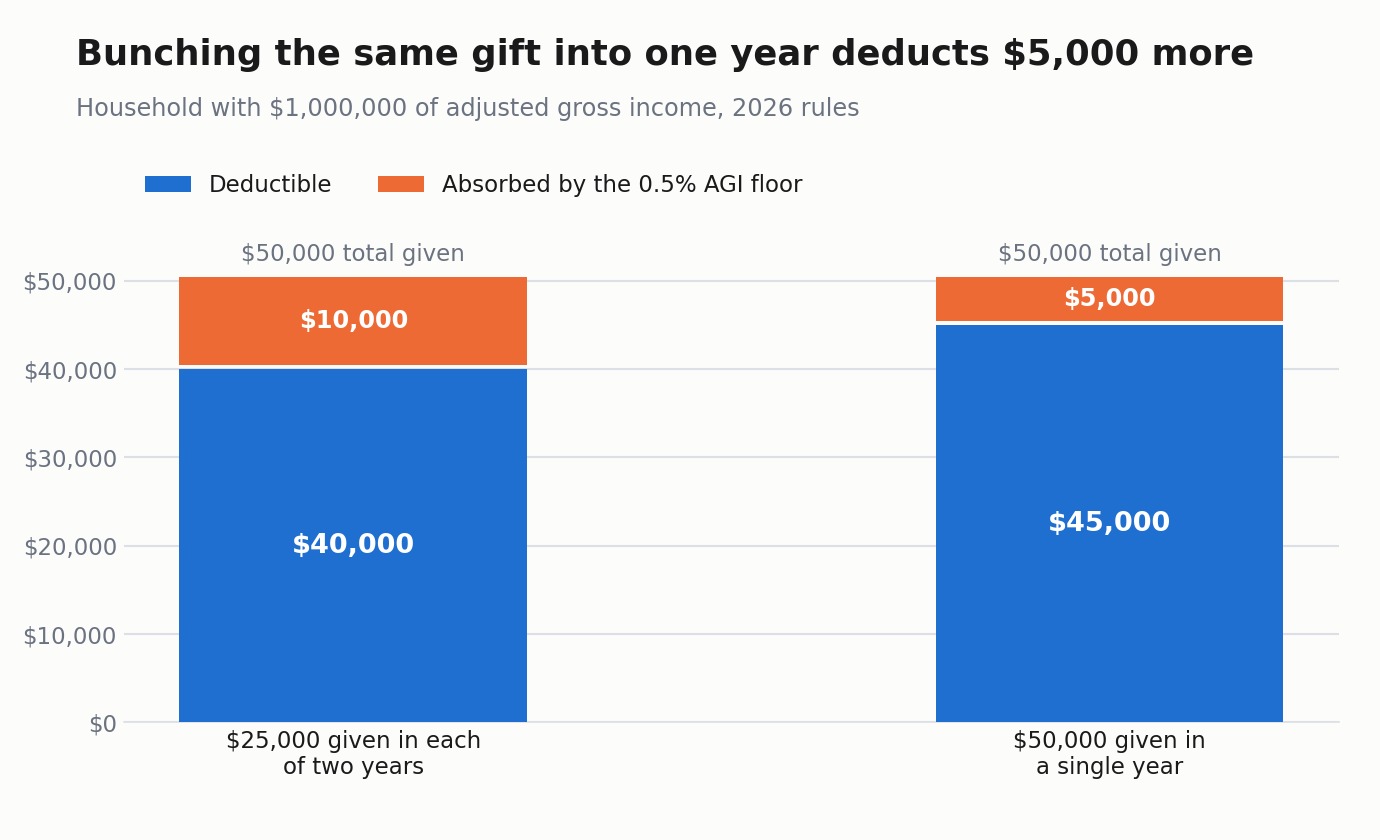
- Charitable gifts now sit behind a floor. You deduct only the giving that exceeds 0.5 percent of adjusted gross income, so at $1 million of income the first $5,000 you give produces no deduction.
- Itemized deductions are less valuable for taxpayers in the top bracket. For 2026, itemized deductions are reduced by 5.4 percent of the lesser of total itemized deductions or taxable income above the 37 percent threshold. For taxpayers subject to the limitation, the federal tax benefit of an additional deduction is generally capped at about 35 cents per dollar.
- Catch-up contributions must go in as Roth for certain higher earners. For catch-up contributions made in 2026, the rule generally applies when your 2025 FICA wages from the employer sponsoring the plan exceeded $150,000. Those catch-up contributions no longer reduce your current taxable income. Confirm how your plan administrator has implemented the rule.
Retirement, conversions, and your portfolio
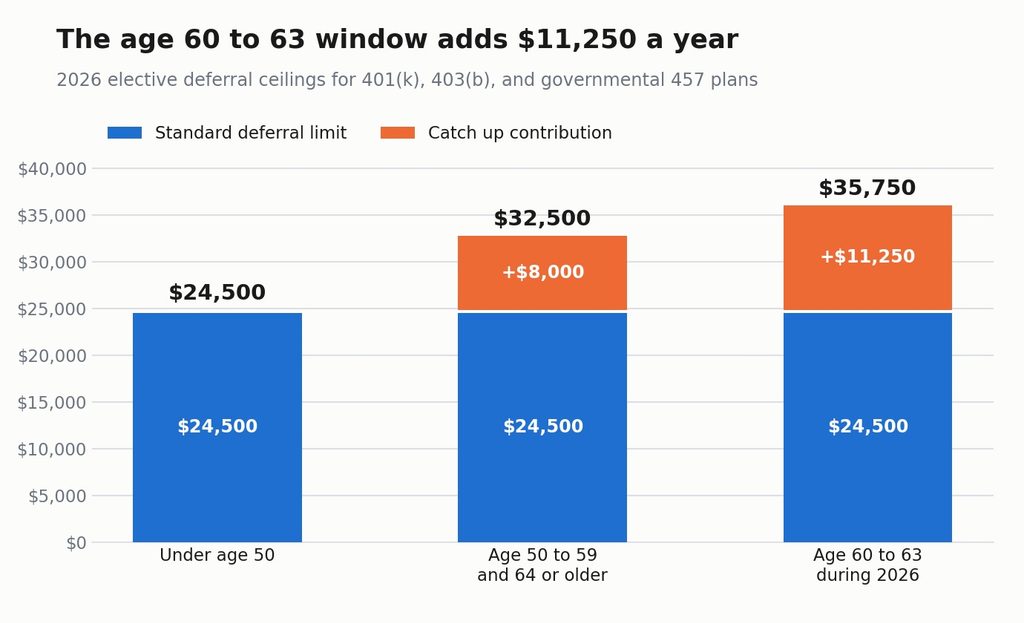
Finish your contributions while payroll still runs. You can defer $24,500 into a 401(k) for 2026, plus $8,000 at age 50 and older, or $11,250 if you turn 60 through 63 during the year. Deferrals must come out of wages paid by December 31, and if your plan matches per pay period and you hit the ceiling in October, your December paychecks earn no match unless the plan offers a true up.
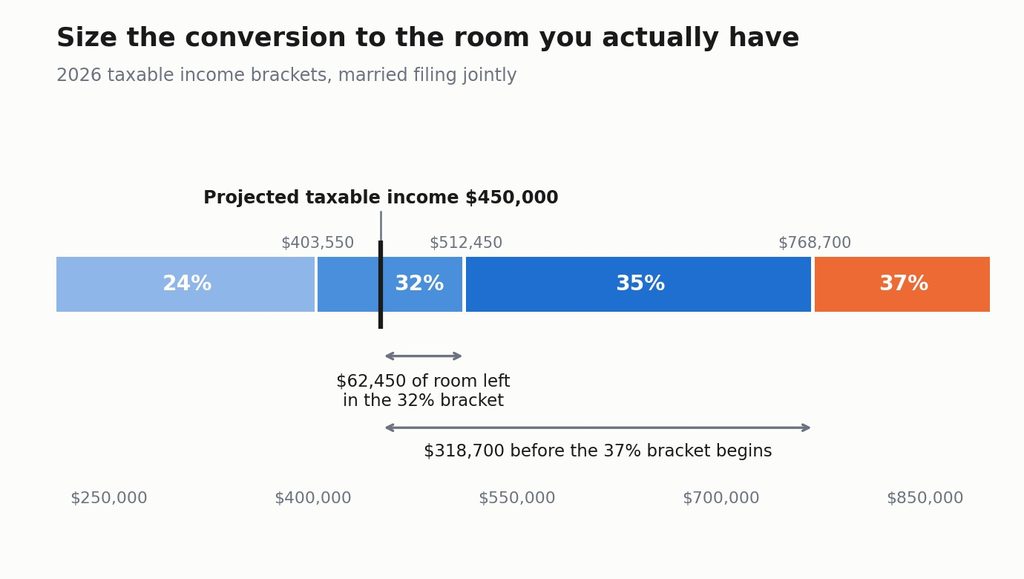
Size a Roth conversion against your bracket. A conversion creates ordinary income in the year you complete it, and you cannot undo one. Project your full year taxable income first, then measure the space to the top of your bracket. For joint filers 32 percent runs to $512,450 and 35 percent to $768,700, so a couple projecting $450,000 holds $62,450 of room. Conversion income also raises Medicare premiums two years later and shrinks your SALT cap in the same year.
Harvest losses, and mind the surtax. Add the December capital gain distributions your funds will declare to what you have already realized, then look for positions carrying losses. The 3.8 percent net investment income tax applies above $250,000 of income for joint filers, so a 20 percent gain often costs 23.8 percent.
Bunch your charitable giving instead of pacing it
The new floor rewards concentration. A household with $1 million of adjusted gross income absorbs a $5,000 floor every year it gives, so splitting $50,000 across two years loses $5,000 twice.
A donor-advised fund may allow you to claim a deduction in the contribution year and recommend grants over time. When eligible appreciated securities held for more than one year are donated directly to a qualifying charity, the deduction may be based on fair market value without first realizing the embedded capital gain, subject to applicable deduction limits and substantiation rules. IRA owners age 70½ or older may make qualified charitable distributions of up to $111,000 per person in 2026. An eligible QCD is excluded from adjusted gross income and can count toward that person’s required minimum distribution.
Run the SALT math before you prepay property taxes
Texas has no individual state income tax, but locally assessed property taxes can make the SALT deduction relevant for homeowners who itemize. The amount actually deductible depends on total eligible state and local taxes, modified adjusted gross income, filing status, and the applicable cap.
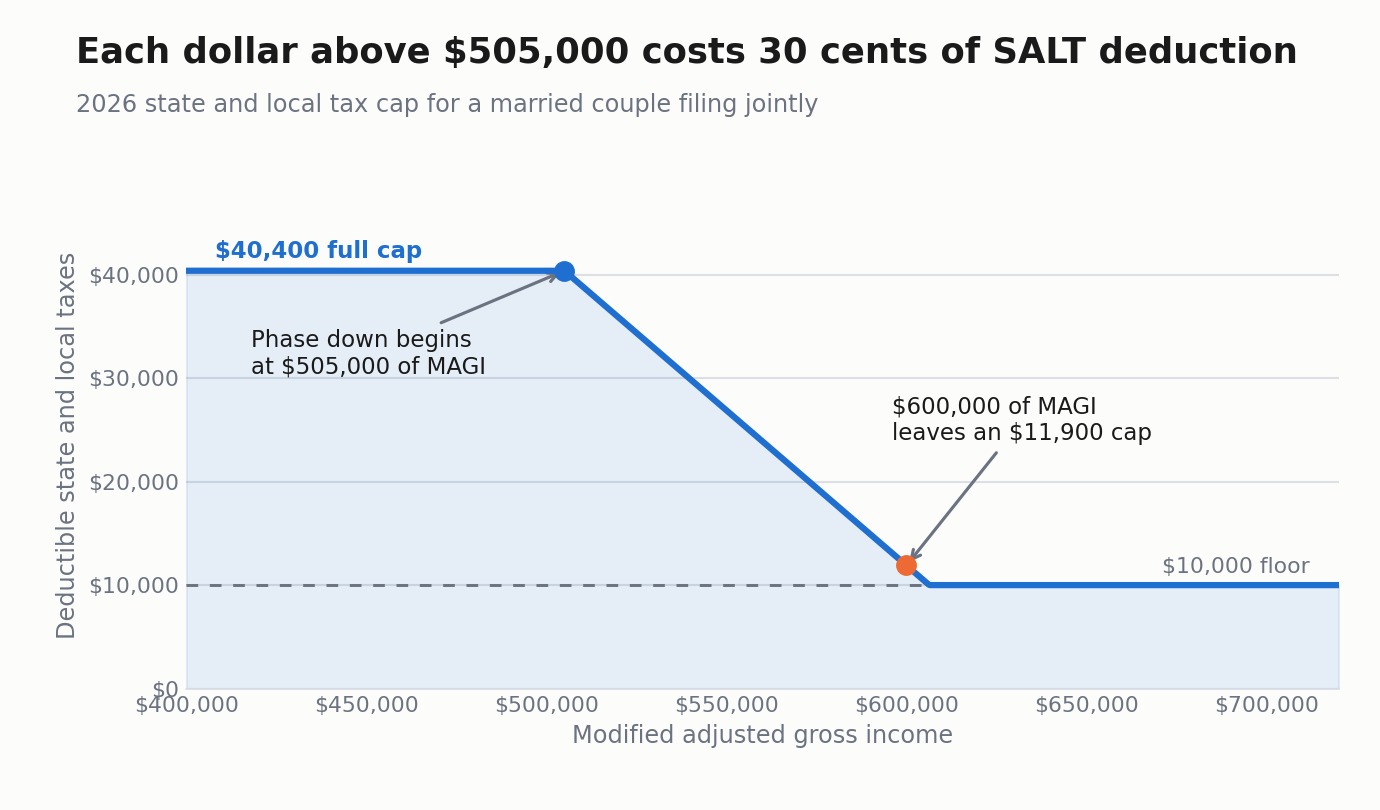
For taxpayers who itemize and remain inside the SALT phase-down range, reducing modified adjusted gross income may also restore part of the available SALT cap. The actual benefit depends on the household’s deductions, tax bracket, alternative minimum tax exposure, and other circumstances.
Business owners, withholding, and your estate
Project your QBI deduction before you commit. For 2026, the QBI threshold is $403,500 for joint filers and $201,750 for most other filers. The phase-in range ends at $553,500 for joint filers and $276,750 for most other filers. Married taxpayers filing separately have a range of $201,775 to $276,775. Above the applicable threshold, wage and property limitations may apply, and income from a specified service trade or business may begin to lose eligibility. A retirement-plan contribution may reduce taxable income and affect the QBI calculation, but the interaction should be modeled for the specific business.
Close your withholding gap. Pay 90 percent of your 2026 liability, or 110 percent of your 2025 liability if prior year adjusted gross income exceeded $150,000, and the underpayment penalty generally disappears. Withholding counts as paid evenly across the year while estimated payments count when you make them, so fixing a shortfall through December withholding beats writing a check in January.
Use the gift exclusion before it resets. The estate and gift exclusion stands at $15 million per person for 2026. The annual exclusion is $19,000 per recipient, it resets every January 1, and it does not carry forward. While you review gifts, confirm your beneficiary designations, since they override your will.
The bottom line
For most calendar-year taxpayers, employee deferrals, Roth conversions, completed charitable gifts, trades that realize gains or losses, required minimum distributions other than an eligible first RMD, and completed annual exclusion gifts generally close on December 31. IRA and health savings account contributions run to April 15, and employer retirement funding follows the business return due date.
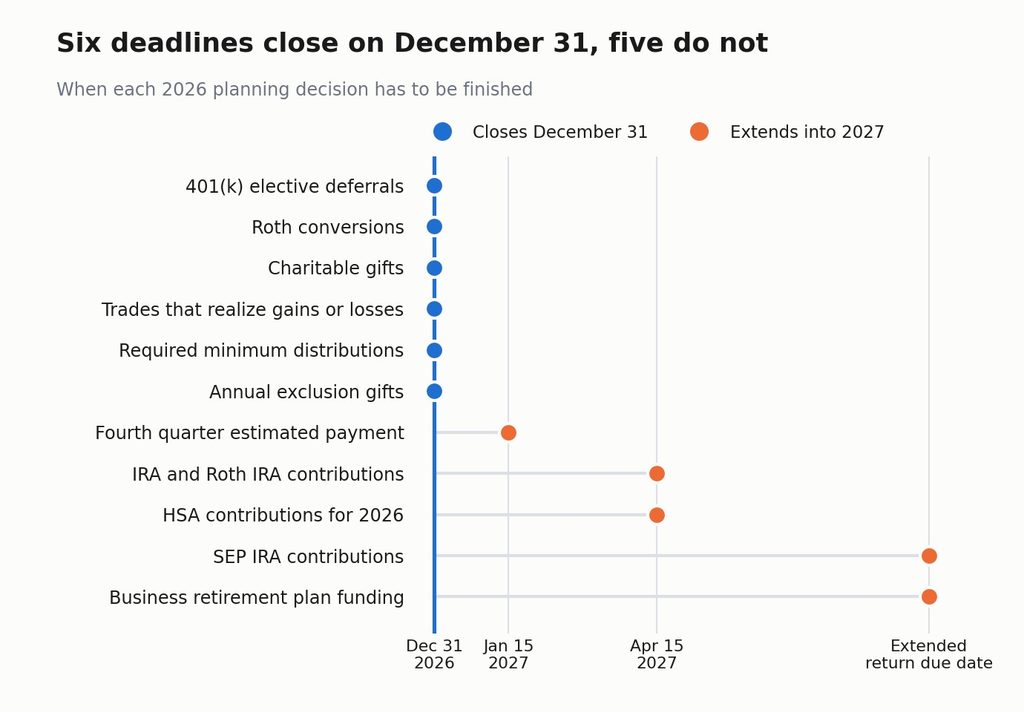
Start with a projection rather than a checklist, and size any conversion last, since it sits on top of every other number. The largest tax move is rarely a single deduction. It is several decisions made together. If you want to coordinate those decisions before the deadlines close, we are happy to review your year-end plan with you.
This article is for educational purposes only and does not constitute tax, legal, or investment advice. Tax rules change, and results depend on individual circumstances. All figures reflect 2026 amounts published by the IRS. Coordinate year end decisions with your CPA, financial advisor, and estate planning attorney.