

For years, $1 million represented the unofficial finish line for retirement. Save a million dollars, pay off the house, retire, and enjoy life.
But after several years of higher home prices, property taxes, healthcare costs, and inflation, a million dollars does not feel as big as it once did. That leads to a question I hear from families around Southlake and the Dallas-Fort Worth area:
Can you actually retire comfortably in DFW with $1 million?
The answer is yes, for some families.
But $1 million by itself tells me surprisingly little about whether someone can retire.
Your Social Security benefits, housing costs, taxes, retirement age, healthcare expenses, spending habits, and investment strategy can matter just as much as the number on your investment statement.
What $1 Million Can Actually Produce in Retirement
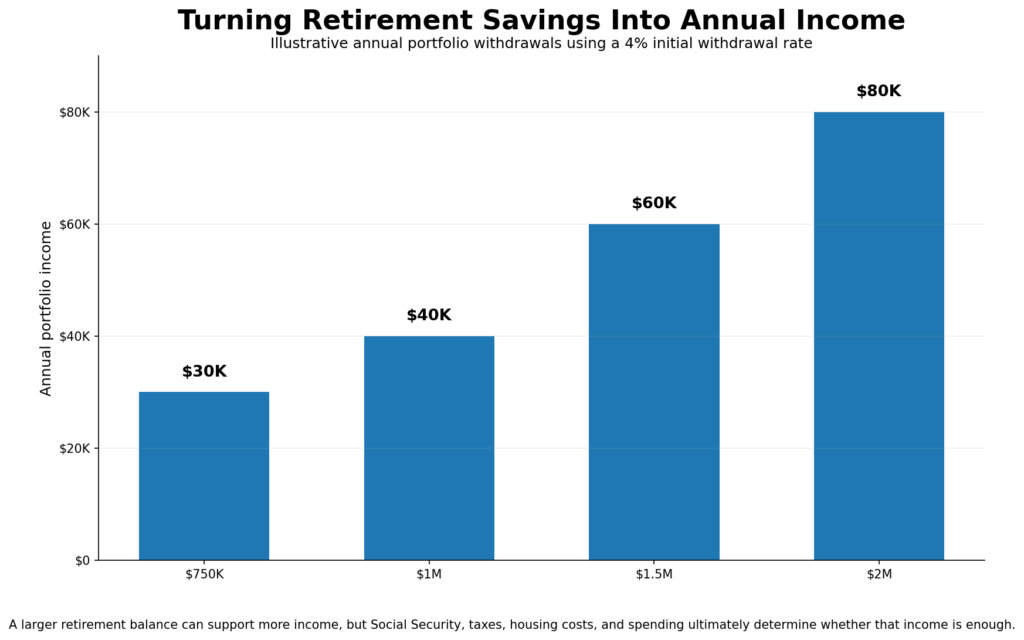
A common starting point for retirement planning is a 4% initial withdrawal rate.
Using that as a simple illustration, a $1 million portfolio could provide approximately:
| Retirement Assets | 4% Initial Withdrawal |
| $750,000 | $30,000 |
| $1,000,000 | $40,000 |
| $1,500,000 | $60,000 |
| $2,000,000 | $80,000 |
That does not mean I automatically recommend withdrawing exactly 4% every year. Retirement income planning should account for taxes, market conditions, inflation, longevity, and changes in spending.
But $40,000 gives us a useful starting point.
Then we add Social Security.
The Social Security Administration estimates that the average retired couple receiving benefits in 2026 collects about $3,208 per month, or approximately $38,500 per year.
Add that to a $40,000 portfolio withdrawal and our hypothetical couple has roughly $78,500 of gross annual income.
Now we have a much better question.
Can a retired couple live comfortably in DFW on roughly $78,500 per year?
For many couples with a paid-off home and reasonable spending, I believe the answer can absolutely be yes.
For another couple, $78,500 may not come close.
The DFW Housing Factor
Housing creates one of the biggest differences between retirement plans.
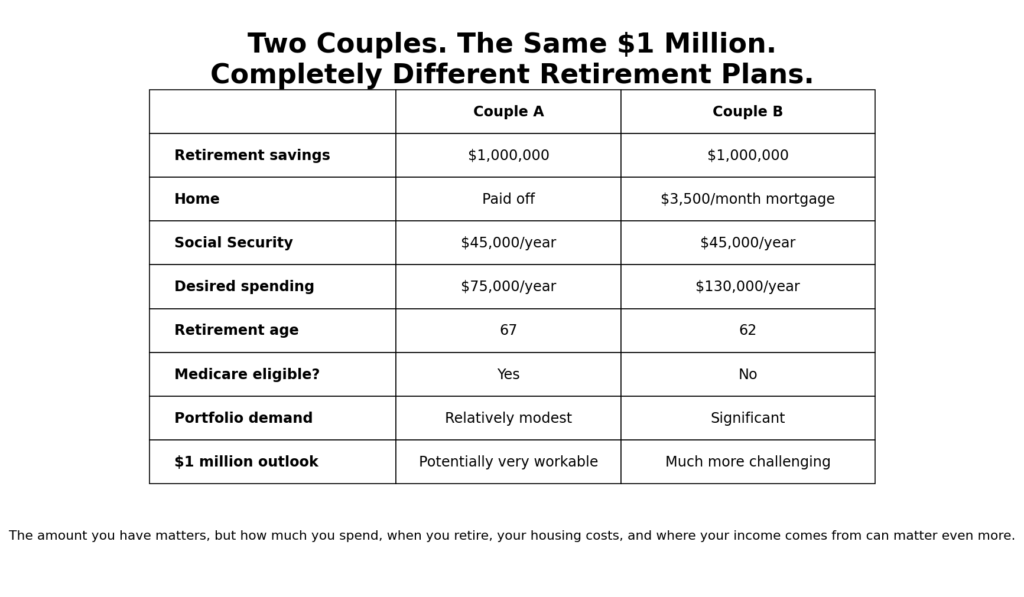
Consider two couples who both have $1 million invested.
Couple A owns a $500,000 home with no mortgage.
Couple B lives in a $1 million home and still has a $3,500 monthly mortgage payment.
Their investment accounts look identical, but their retirement plans look completely different.
Even after you eliminate the mortgage, Texas homeowners still need to budget for property taxes, insurance, utilities, repairs, and maintenance.
That matters around Southlake in particular.
For the 2026 property tax year, Carroll ISD adopted a tax rate of $0.9269 per $100 of taxable value. The City of Southlake’s FY 2026 adopted rate is $0.295 per $100, and homeowners can also face taxes from Tarrant County, Tarrant County College, and JPS Health Network depending on their location.
Fortunately, homeowners may qualify for homestead exemptions and additional benefits after age 65. Texas law also provides a school property tax ceiling for qualifying homeowners age 65 or older.
The point is simple: a paid-off house does not mean free housing.
When we build Lifetime Income Plans for families, property taxes, insurance, maintenance, and future home repairs still belong in the retirement budget.
Texas Gives Retirees One Big Tax Advantage
Texas does have one major retirement advantage.
The state does not impose an individual income tax.
That can make Texas attractive compared with states that tax retirement income at the state level.
But that does not make retirement income tax-free.
Withdrawals from traditional IRAs and 401(k)s can create federal taxable income. Social Security may become partially taxable depending on your other income. Capital gains can also affect your tax bill.
This is why I do not consider $1 million in a traditional IRA equivalent to $1 million sitting in a Roth IRA or taxable brokerage account.
The account structure matters.
Healthcare Can Change the Math Quickly
Healthcare represents another major variable.
For retirees enrolled in Medicare, the standard Medicare Part B premium is $202.90 per month per person in 2026. Higher-income retirees can pay significantly more because of Medicare’s income-related surcharges.
And Part B represents only one piece of healthcare spending.
Retirees may also pay for supplemental coverage, prescription drugs, dental care, vision care, deductibles, and expenses Medicare does not cover.
Retiring before age 65 can make the calculation considerably harder because you also need to bridge the gap until Medicare eligibility.
That is one reason retiring at 62 with $1 million can look dramatically different from retiring at 67 with the same $1 million.
Inflation Still Matters in DFW
A retirement plan also needs to work 10, 20, and potentially 30 years from now.
DFW prices continue to rise. The Bureau of Labor Statistics reported that Dallas-Fort Worth-Arlington consumer prices increased 2.9% during the 12 months ending in July 2026. Food prices increased 3.6%, with food consumed at home up 4.2%.
At 3% inflation, something that costs $70,000 today would cost roughly $94,000 in 10 years and about $126,000 in 20 years.
That is why I would never build a retirement plan around simply dividing $1 million by today’s annual expenses.
The income has to grow.
So, How Much Do You Need to Retire in Texas?
I would not start with a target net worth.
I would start with the lifestyle you want to fund.
Suppose a couple wants to spend $90,000 per year in retirement. Social Security will provide $45,000. Their investments need to fund the remaining $45,000, plus taxes and irregular expenses.
That produces a very different savings target than a couple who wants to spend $150,000 per year.
I would also separate recurring spending from larger one-time expenses.
Replacing a roof, helping children, buying vehicles, traveling extensively during the first decade of retirement, or remodeling a home can easily require another $100,000 to $300,000 over retirement.
A good retirement plan accounts for those expenses before they happen.
My Final Thoughts
So, can you retire comfortably in DFW with $1 million?
Yes, you can.
A couple with $1 million invested, meaningful Social Security income, little or no debt, a manageable property tax bill, and spending around $70,000 to $80,000 per year may have a very workable retirement plan.
But someone with the same $1 million who wants to spend $150,000 per year, carries a large mortgage, retires before Medicare, or depends heavily on portfolio withdrawals may need considerably more.
That is why I would not make $1 million the goal.
The goal is to understand what your life will cost, where your income will come from, how taxes and inflation affect that income, and what could knock the plan off course.
Retiring to a plan is much better than trying to retire to a number.