
If you own a successful business or hold a senior leadership role, you may recognize a strange disconnect.
You make good money. You have saved for years. You probably own several investments, retirement accounts, insurance policies, maybe some real estate, and perhaps an interest in a business worth significantly more than it was a decade ago.
Yet your financial future can still feel surprisingly unclear.
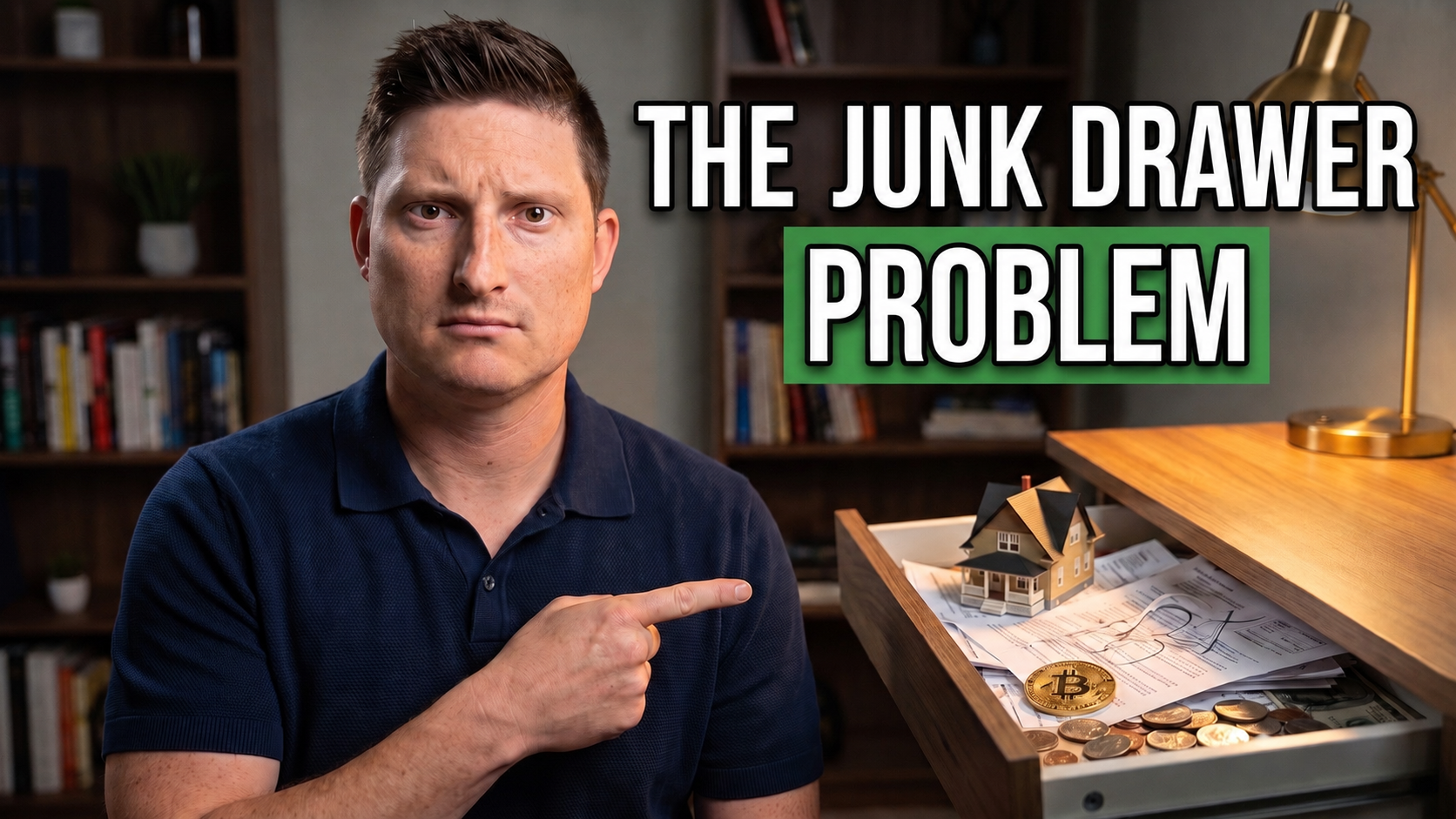
After 14 years as a financial advisor, I have found that many successful families do not have a savings problem. They have what I call a financial junk drawer problem.
Everything inside the drawer may have value. The problem is that nobody has organized it into a system.
A Pile of Money Is Not a Financial Plan
Think about the junk drawer in your kitchen.
There are batteries, keys, scissors, a flashlight, old receipts, a screwdriver, and three chargers that probably belong to devices you no longer own. Most of those things are useful individually.
Together, they are still a junk drawer.
Financial lives often develop the same way.
You enroll in a 401(k) at work. Later, you open an IRA. Someone recommends a brokerage account. You buy some real estate. Maybe you own cryptocurrency or company stock. Your CPA identifies a tax strategy. An insurance agent sets up a policy.
Each decision may have made perfect sense when you made it.
The problem appears when nobody looks at how all those decisions interact.
That is the difference between owning financial products and having a financial plan.
A portfolio tells you what you own. A financial plan should tell you what your money needs to accomplish, where each dollar belongs, what risks you face, what opportunities currently exist, and what needs to change as your life changes.
For business owners in particular, that coordination matters.
Your personal finances, business finances, taxes, retirement strategy, estate plan, insurance, investments, and eventual business exit rarely operate independently.
A decision in one area can change the outcome everywhere else.
The Blind Spots Usually Aren’t Obvious
Most financial mistakes I see do not happen because someone made an obviously bad decision.
They happen because a reasonable decision created consequences nobody modeled.
Consider retirement accounts.
Traditional 401(k) contributions generally reduce current taxable income, while traditional IRA contributions may be deductible depending on income and workplace-plan coverage. Distributions are generally taxable later, except to the extent they represent after-tax contributions. The larger those accounts become, the more important future tax planning becomes.
You know today’s tax deduction. You do not know the tax rate that will apply to every dollar you withdraw decades from now.
That makes tax diversification important.
The same principle applies to business ownership.
How your company is structured today can affect how much you ultimately keep when you sell it. Decisions surrounding entity structure, retirement plans, charitable planning, estate planning, and the timing of a transaction can create dramatically different results.
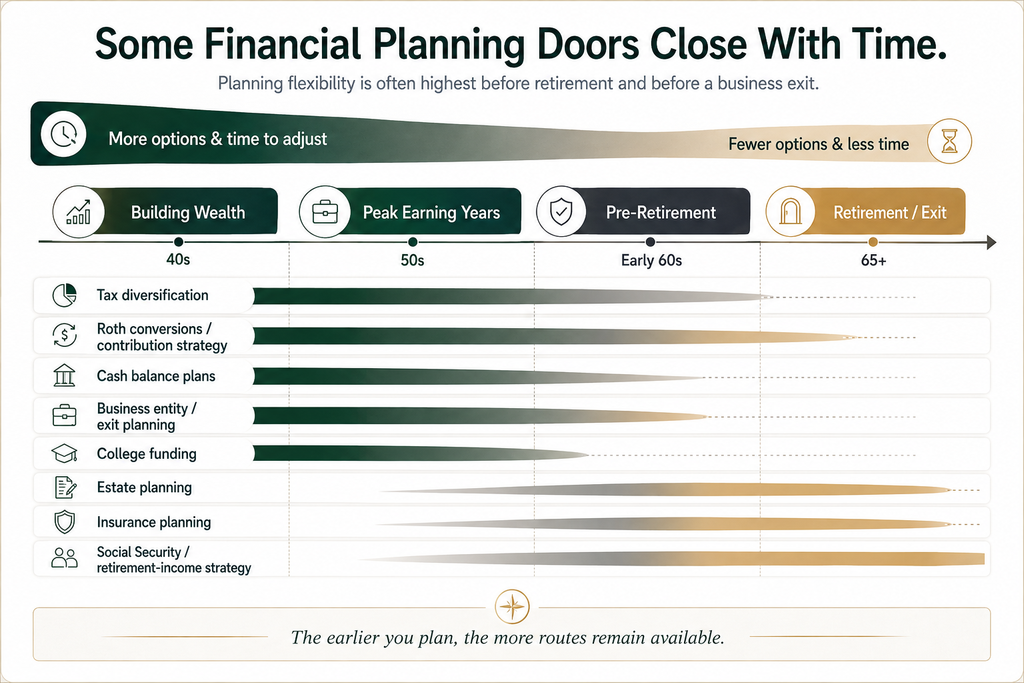
Some planning opportunities also have expiration dates.
College funding changes once the kids reach college. Equity compensation changes as vesting dates arrive. Retirement-plan strategies depend on income, employee demographics, and the life cycle of the business. Certain tax strategies work exceptionally well during a specific period and make little sense afterward.
An opportunity that exists at 45 may not exist at 65.
That does not mean business owners need to spend their evenings learning the tax code.
In many cases, the owner’s time creates far more value inside the business. Good financial planning should allow the owner to focus there while someone else coordinates the financial system surrounding it.
Most Financial Advice Optimizes the First Half of the Decision
The financial industry tends to do a good job solving individual problems.
A 401(k) provider helps you establish the retirement plan.
Your CPA helps identify deductions.
Your investment advisor manages your portfolio.
Your attorney drafts estate documents.
Your insurance professional addresses risk.
None of those things are inherently wrong. The problem is that each professional often works on one section of the financial picture.
Far fewer people model where all those decisions lead.
Someone might recommend maximizing a tax-deferred retirement account every year without modeling what future required distributions and retirement income could look like.
Someone might recommend an investment without considering the concentration you already have inside your business.
Someone might create an estate plan that nobody reviews again after the business triples in value.
Traditional financial planning can suffer from the same problem.
You create a beautiful plan, print it, put it in a binder, and revisit it once a year.
I think there is a better way to approach it.
Financial Planning Should Work More Like Waze
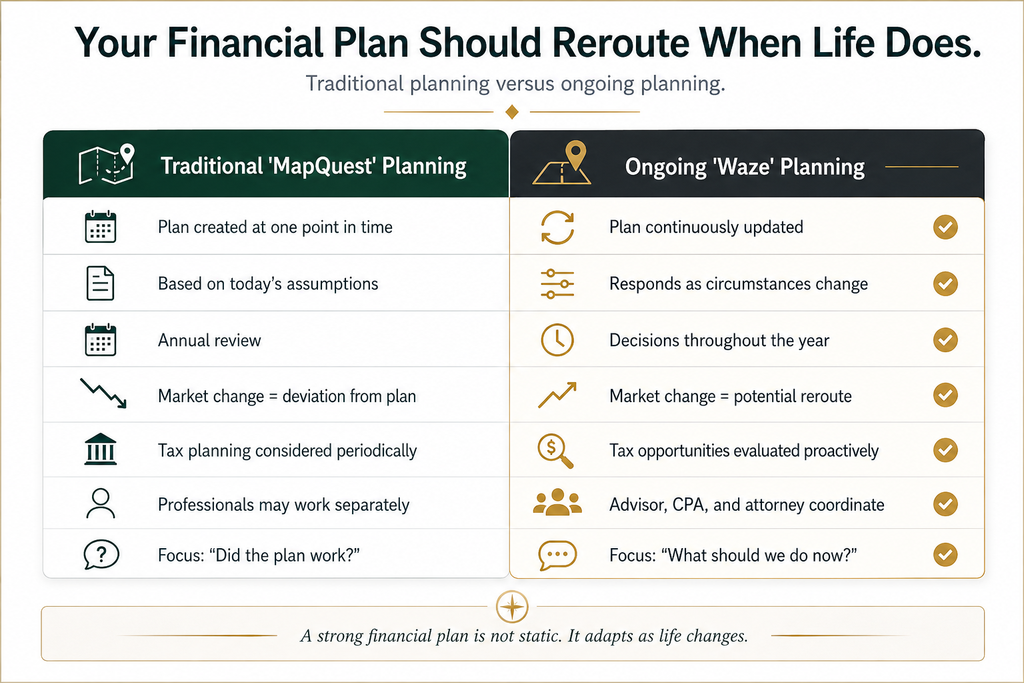
Anyone who remembers MapQuest remembers the routine.
You entered your starting point and destination. MapQuest generated directions. You printed several pages and put them on the passenger seat.
Those directions could be completely accurate when you left the house.
Then reality happened.
There was an accident eleven miles ahead. A highway shut down. Traffic backed up. Construction appeared.
Your perfectly calculated route could not respond.
Modern navigation works differently.
Waze and Google Maps constantly evaluate where you are, where you want to go, and what has changed between those two points.
When something changes, the system reroutes you.
I believe financial planning should work the same way.
Your financial plan should establish a destination and a route, but nobody should expect the original route to remain perfect for the next 25 years.
Markets change.
Tax laws change.
Businesses grow.
Businesses struggle.
People sell companies earlier than expected.
Children go to college.
Parents need help.
Interest rates change.
Income changes.
Retirement goals change.
A good financial plan adapts.
That mindset also removes some of the pressure people feel about investing.
You do not need to correctly predict what the stock market will do next year. I certainly cannot, and neither can the person confidently making predictions on television.
Instead, you build a financial system that can survive being wrong.
A bad quarter becomes information rather than an emergency. A tax-law change becomes a reason to reroute. A new opportunity inside the business becomes something you incorporate into the plan.
You stop trying to get one prediction exactly right and start making better decisions continuously.
Start With a Money Map

When we begin working with a family, we first need to understand what is actually happening.
That means taking the financial junk drawer and putting everything on the table.
We look at retirement accounts, brokerage accounts, bank accounts, tax returns, insurance, debt, business interests, real estate, estate documents, and anything else that affects the family’s financial life.
Then we organize it.
One of the tools we use is what I call a Money Map.
The purpose is not to create a 90-page financial plan that nobody wants to read.
The goal is to answer practical questions.
How much money comes in?
How much actually goes out?
How much should you save?
Where should those savings go?
How much cash should you keep?
Where are you overexposed?
Where are you underprepared?
What decisions deserve attention now?
Cash provides a simple example.
Many successful families hold more cash than they need because nobody has ever given them a target.
They know they should have an emergency reserve, but they do not know whether that means $50,000, $250,000, or $750,000.
A financial plan should give you a number and explain why that number makes sense.
Then excess capital can receive an actual assignment.
Coordination Matters as Much as Investment Management
Once we understand the current picture, we can build an action plan around investments, retirement, taxes, insurance, estate planning, cash flow, and business planning.
Then the ongoing work begins.
That last part matters.
Financial planning should not end after somebody presents the plan.
Throughout the year, decisions continue to appear. Tax projections change. The business has a better year than expected. An acquisition opportunity appears. Markets decline. A child starts college. You begin thinking seriously about selling the company.
Your financial strategy needs to respond.
Coordination between professionals also becomes increasingly important as wealth grows.
Your financial advisor, CPA, and attorney should not operate as three separate islands while you carry messages between them.
You hired professionals so they could help solve problems, not so you could become the project manager responsible for translating one professional’s recommendation to another.
Sometimes the Best Strategy Has a Short Life
Tax planning provides a good example of why active planning matters.
We recently worked with a business owner who had roughly a dozen employees and a unique three-year planning window.
Based on her business, income, employee demographics, and goals, a cash balance retirement plan made sense.
During that window, we helped design a strategy that allowed more than $1 million to go into the plan.
Then the circumstances changed.
So we shut it down when the strategy stopped making sense.
That last part matters just as much as implementing it.
A cash balance plan does not work for every company. Even when it does work, it may not remain the right strategy forever.
Financial planning should not become a collection of strategies that stay in place simply because somebody recommended them ten years ago.
Every strategy has to continue earning its place in the plan.
The Right Advisor Structure Matters Too
Our firm also tries to be clear about how we work.
We are not a fee-only firm.
If insurance represents the appropriate solution, we can help place that insurance and may receive compensation for doing so. Insurance represents a small portion of our overall work, but clients deserve to understand those relationships before they hire us.
I would rather explain that clearly upfront than bury it in disclosures and create frustration later.
Firm structure matters too.
At one end of the spectrum, you have enormous financial institutions where a client can feel like an account number and receive one formal review each year.
At the other end, you have a talented independent advisor trying to handle investments, planning, taxes, technology, service, and operations alone.
We have intentionally tried to build something between those two extremes.
We want the personal relationships of a smaller firm with the planning capabilities of a larger organization.
That includes a team of CFP® professionals and tax expertise inside the firm so financial planning and tax planning can happen together rather than waiting for separate calendars to align.
Decide Whether Managing Everything Yourself Still Makes Sense
I often use three questions when someone is deciding whether they should continue managing their financial life themselves.
- Are you good at it?
- Do you enjoy doing it?
- Do you have enough time to do it properly?
Someone who can confidently answer yes to all three may not need ongoing financial management. They may simply benefit from having another professional review their work periodically.
A no to any one of those questions changes the equation.
For many successful business owners and executives, the issue is not capability.
It is attention.
Every hour spent coordinating investment accounts, modeling retirement income, researching tax strategies, reviewing insurance, updating estate planning, or communicating between professionals competes with something else.
That something else may be running the business, spending time with family, coaching a kid’s baseball team, traveling, or simply enjoying what years of hard work have created.
The purpose of financial planning is not to make money consume more of your life.
It should make your financial life require less of your attention.
My Final Thoughts
Building wealth and building a financial plan are not the same thing.
You can accumulate millions of dollars across retirement accounts, investments, real estate, and a successful business while still lacking a coordinated strategy for what all that wealth should accomplish.
That is the financial junk drawer.
The solution does not start with finding the next great investment.
It starts by pulling everything out, understanding what you actually own, connecting your financial decisions to what matters to you, and creating a system that adapts as circumstances change.
You need a destination. You need a route. Most importantly, you need someone watching the road.
If your financial life has become a collection of good decisions that nobody has ever connected, you can start with a complimentary 15-minute conversation. There is no homework and nothing you need to prepare.
The goal is simply to understand where you are, where you want to go, and whether we can help you build a better route between the two.