
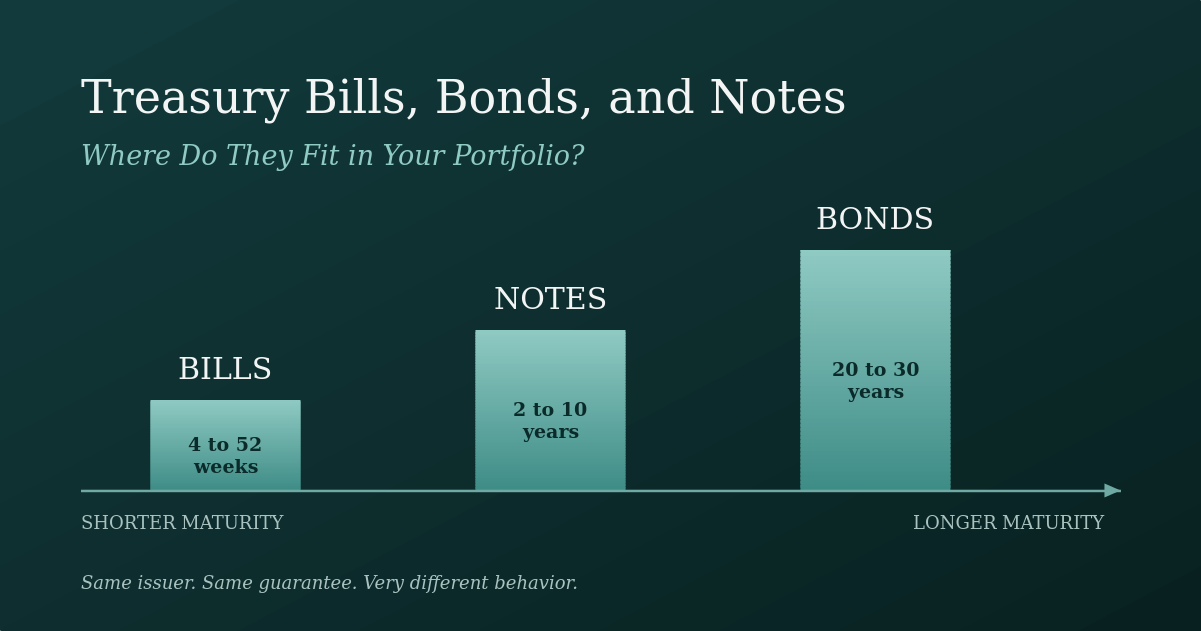
Investors often group every government security under one label and assume they all behave the same way. They do not. A four-week Treasury bill and a thirty-year Treasury bond share the same issuer and the same credit quality, yet they play almost opposite roles in a portfolio. One holds value when markets fall apart. The other can swing more than a stock fund when interest rates move.
Understanding the differences helps you decide what belongs in your emergency reserve, what belongs in your retirement allocation, and what you should simply leave alone.
The Treasury Issues Three Main Securities
The distinction comes down to maturity, meaning how long the government borrows your money before returning the principal.
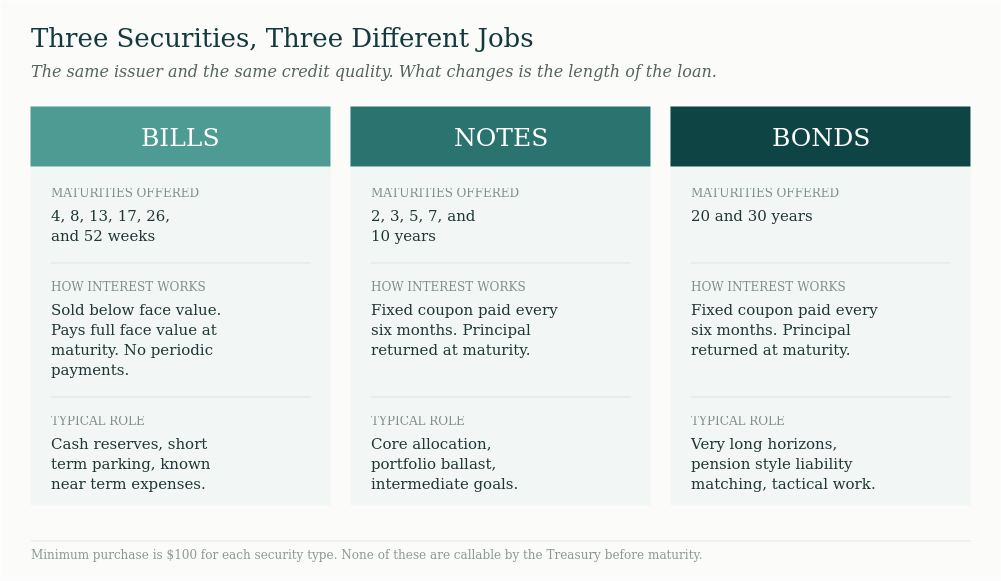
The Treasury also issues two variations worth knowing. Treasury Inflation Protected Securities, commonly called TIPS, adjust principal with the Consumer Price Index and come in five-, ten-, and thirty-year maturities. Floating Rate Notes carry a two-year maturity and reset their interest rate against recent bill auctions. Both solve specific problems rather than serving as general purpose holdings.
The minimum purchase is $100 for any of these, and none of them are callable. The government cannot take a note or bond back early simply because rates fell.
How You Actually Earn the Return
Bills work through discounts. You might pay $9,850 for a bill that pays $10,000 in six months. The $150 difference is your interest, earned all at once when the bill matures. Nothing arrives in between.
Notes and bonds work through coupons. A note with a 4 percent coupon and a $10,000 face value sends you $200 every six months, then returns your $10,000 at maturity. You know both the size and the timing of every payment on the day you buy.
That predictability holds only if you hold to maturity. Sell early and you accept whatever the market pays that day, which may be more or less than what you paid.
You Trade One Risk for Another
Treasury securities carry essentially no credit risk. The government has never failed to pay principal and interest, and that reliability is why Treasuries anchor so many portfolios.
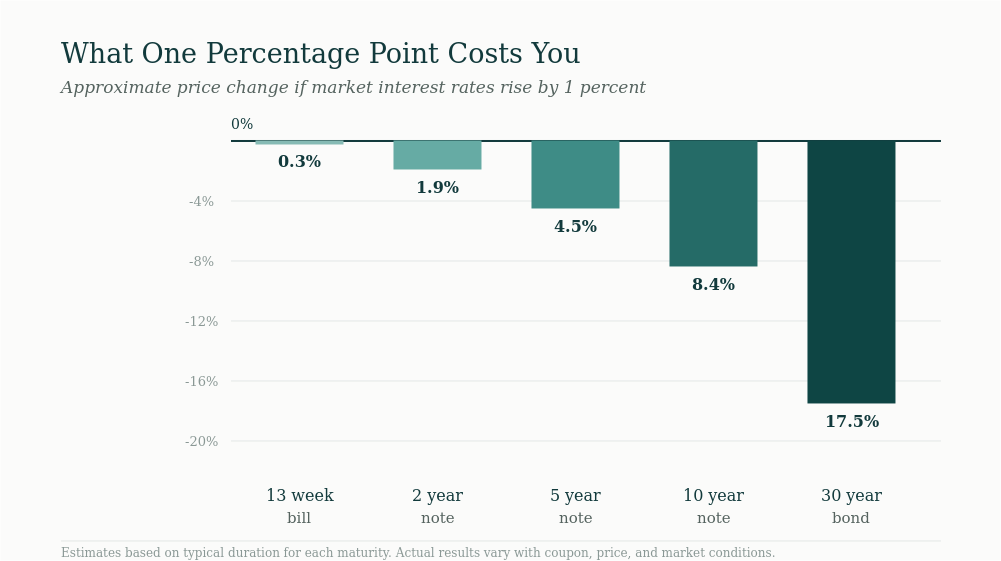
What Treasuries do not remove is interest rate risk, and this is where investors get surprised. When market interest rates rise, existing bonds become less attractive, so their prices fall. The longer the maturity, the sharper the fall.
A thirteen-week bill barely reacts. A two-year note gives up roughly 2 percent for each percentage point rise in rates. A thirty-year bond can lose close to 18 percent under the same conditions. During 2022, long maturity Treasury indexes lost more than 20 percent while short bills posted small gains. Same issuer, same guarantee, completely different experience.
Bills carry the opposite problem, called reinvestment risk. Your 5 percent bill matures in three months and the best available replacement pays 3 percent. You keep your principal and lose your income.
Neither risk is avoidable. You choose which one you would rather live with, based on what the money is for.
Matching Each Security to a Purpose
Bills serve money you will need soon. Emergency reserves, a tax payment due in April, a down payment on a house you plan to close on this year, proceeds from a business sale that you have not yet allocated. Bills give you a known payoff on a known date with almost no price volatility. For clients holding meaningful cash, a bill often pays more than a bank savings account with less credit exposure than a certificate of deposit.
Notes serve as the ballast in a diversified portfolio. The intermediate part of the yield curve, generally five to ten years, is where Treasuries do their most useful diversification work. When equity markets fall on growth fears, investors move toward safety and intermediate Treasuries tend to rise. That relationship is not guaranteed, and 2022 proved it can break when inflation drives the selloff, but over most market cycles notes have offset equity losses more reliably than either bills or long bonds.
Bonds serve a narrower set of situations. A thirty year bond makes sense when you have a genuinely long obligation to fund, when you want to lock in a high yield for decades, or when you are deliberately taking a position on falling rates. For most individual investors, a thirty year commitment introduces volatility that the extra yield does not compensate for. We use long bonds selectively and with a clear reason.
Structure Matters as Much as Selection
Rather than betting on a single maturity, most investors are better served by a structure.
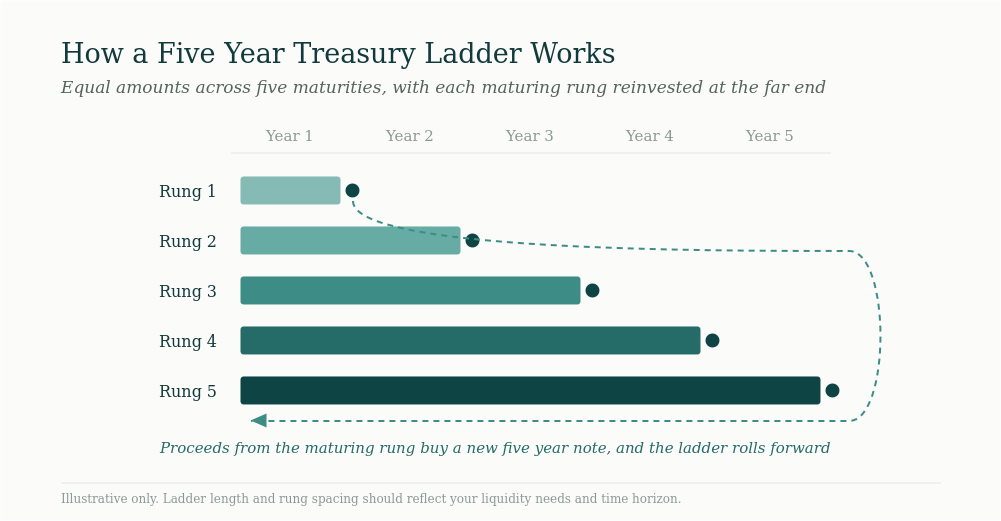
- A ladder divides your money across several maturity dates. You might place equal amounts in one-, two-, three-, four-, and five-year notes. Each year one rung matures and you reinvest at the far end. The ladder averages your yield across rate environments and removes the pressure of timing the market. It also creates predictable annual liquidity, which retirees often value.
- A barbell concentrates holdings at the short and long ends while skipping the middle. It gives you liquidity from the short side and yield from the long side, and it makes sense when the yield curve rewards that shape.
- A bullet clusters maturities around one future date. This works when you have a specific obligation, such as college tuition beginning in a particular year.
Individual securities give you a defined maturity date and the return of par. Bond funds and exchange traded funds give you diversification and easier management, but they never mature, so you always face price risk when you sell. Neither approach is better in the abstract. The right answer depends on the size of the position and what job it is doing.
Taxes Deserve Specific Attention
Treasury interest is fully taxable at the federal level and exempt from state and local income tax. That exemption matters a great deal in California or New York and matters very little in Texas, where there is no state income tax to avoid. Texas investors should compare Treasury yields against certificates of deposit and corporate bonds on a straight federal basis rather than assuming a tax advantage that does not apply locally.
Two additional points come up often:
- Bill income arrives entirely at maturity, which gives you some control over timing. A 52-week bill purchased in November delivers its interest in the following tax year. That can be useful in a year when you are managing a large capital gain or watching a bracket threshold.
- Treasury interest counts toward modified adjusted gross income. It affects Medicare premium surcharges and the taxation of Social Security benefits even though it escapes state tax. Retirees managing income thresholds should account for this.
Because Treasury interest receives no preferential federal rate, holding these securities inside an IRA or another tax deferred account often makes more sense than holding them in a taxable account, particularly for investors in high federal brackets. Asset location decisions like this deserve a full review rather than a rule of thumb.
Where Investors Go Wrong
Four mistakes account for most of the trouble we see:
- Buying long bonds for short goals. A thirty-year bond is not a safe place for money you need in two years, regardless of the government guarantee.
- Assuming the guarantee removes volatility. It removes default risk only. Prices still move.
- Chasing the highest yield on the curve without considering what happens if rates change or if that money is needed early.
- Holding large idle cash balances at bank rates while comparable Treasury bills pay meaningfully more. This is one of the easiest gaps to close.
Bringing It Together
Treasury securities are among the most useful tools available to an individual investor, and they are among the most frequently misapplied. The question is never whether Treasuries are safe. The question is which maturity fits which dollar.
Start with the purpose of the money and the date you need it. The right security follows from there.
If you are holding cash you have not put to work, weighing a bond ladder for retirement income, or trying to decide whether individual Treasuries or a fund fits your situation better, we are glad to work through it with you. Schedule a 15-minute intro call and we’ll help you match the right maturity to each dollar.
This material is for informational purposes and does not constitute investment, tax, or legal advice. Yields and market conditions change. Individual circumstances vary, and you should consult your advisor before acting.