

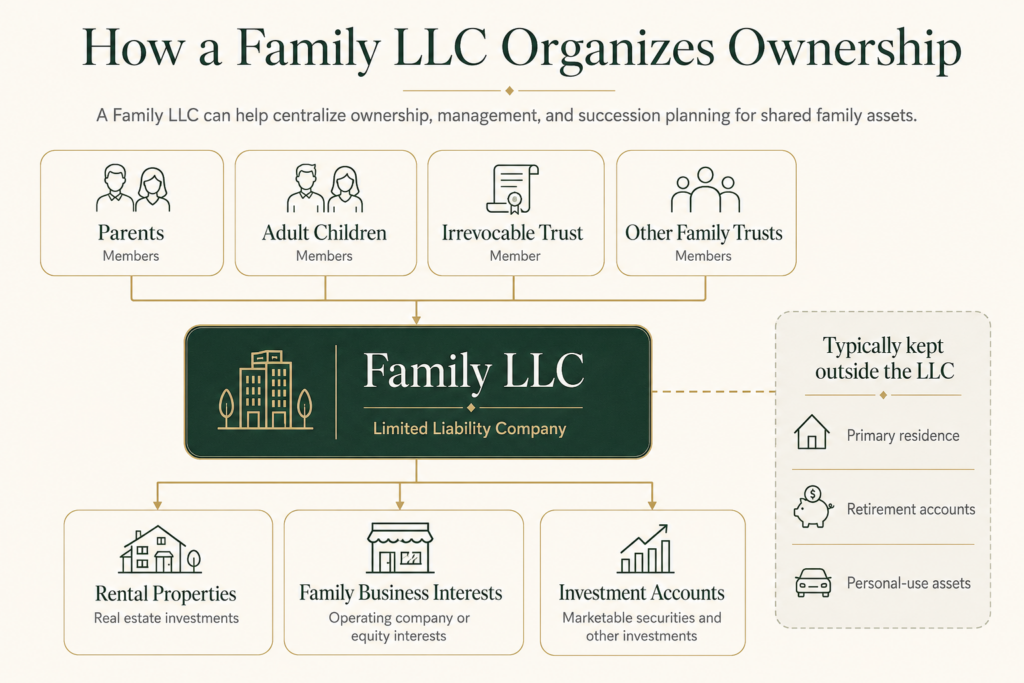
For families who own rental properties, a closely held business, or a growing investment portfolio, a family limited liability company can create a useful layer of organization and liability protection. It can also help parents manage shared assets, establish rules for the next generation, and transfer ownership over time.
A family LLC is not a special type of entity under Texas law. It is a standard Texas limited liability company whose members are related to one another. The family uses the LLC’s company agreement, ownership structure, and asset titling to support its asset protection and estate planning goals.
What a Family LLC Can Accomplish
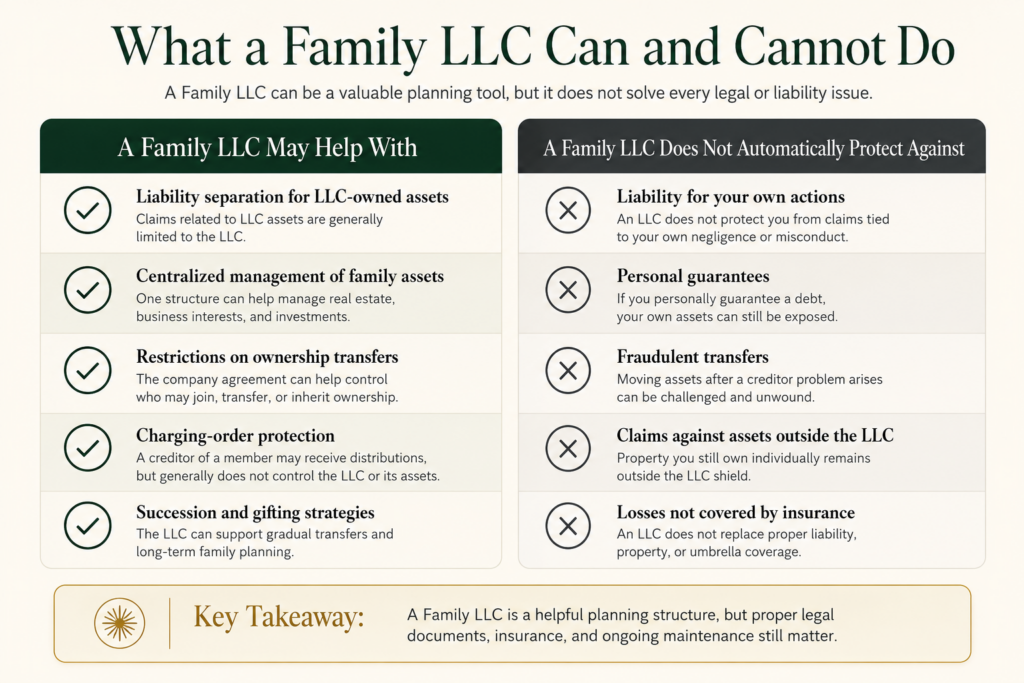
A properly structured family LLC can separate liabilities associated with an LLC-owned asset from the family’s other property. Texas law generally provides that a member or manager is not personally liable for the debts and obligations of the LLC solely because of that role.
For example, if a family LLC owns a rental home, a property-related claimant would generally pursue the LLC and its assets. The family still needs liability and property insurance because an LLC does not replace insurance.
A family LLC can also provide protection when a creditor has a judgment against an individual member. Texas permits a charging order against that member’s interest. The creditor generally receives only distributions that would otherwise go to the debtor-member and does not gain possession of the LLC’s property or control over the company. This rule applies to single-member and multi-member LLCs.
The company agreement can also define who manages the assets, who may receive ownership, how decisions get made, and what happens after a death, disability, divorce, or family dispute. Parents may transfer noncontrolling interests to children or trusts, but those transfers require careful legal, tax, and valuation work.
The Limits of Family LLC Asset Protection
A family LLC cannot protect every asset from every claim.
The LLC generally does not protect someone from liability for that person’s own actions. It also does not erase a personal guarantee, protect assets that remain titled individually, or prevent a creditor from reaching distributions paid to a member.
Families also cannot move assets into an LLC after a lawsuit, creditor claim, or financial crisis appears and assume the assets have become untouchable. Texas law permits creditors to challenge transfers made with actual intent to hinder, delay, or defraud them. The law also addresses certain transfers made without reasonably equivalent value when the debtor becomes insolvent.
Asset protection planning works best when families complete it before a specific threat develops.
How to Set Up a Family LLC in Texas
1. Define the LLC’s Purpose
Start by identifying what the family wants the LLC to accomplish. The goal may involve liability separation, centralized management, succession planning, gifting, or a combination of those objectives.
The purpose should drive the structure. An LLC created to own one rental property may look very different from one that holds several investment properties or a family business interest.
Avoid placing unrelated high-risk and low-risk assets in the same entity. A liability connected to one property could expose every other asset held by that LLC.
2. Assemble the Advisory Team
A family LLC touches business law, estate planning, taxation, risk management, and financial planning. An attorney should draft the legal documents and evaluate transfers. A CPA should review the tax consequences. A financial advisor can coordinate the LLC with the family’s investments, insurance, cash flow, and estate plan.
Correcting a poor structure later can require amended documents, new tax filings, and additional transfers.
3. Choose the Owners and Managers
Texas LLCs can use a member-managed or manager-managed structure. A member-managed LLC allows members to participate in management. A manager-managed LLC assigns authority to one or more designated managers.
Many family LLCs use a manager-managed structure. Parents may retain management authority while gradually transferring nonmanager interests to children or trusts.
The family should decide who owns the interests, who manages the company, which decisions require special approval, whether members can transfer interests, and what happens after death, divorce, disability, bankruptcy, or departure. These rules belong in the company agreement.
4. File the Certificate of Formation
The organizer creates a Texas LLC by filing Form 205, Certificate of Formation, with the Texas Secretary of State. The current filing fee is $300.
Texas requires the LLC to maintain a registered agent and registered office in the state. The registered office must use a physical street address where the agent can receive legal documents during normal business hours. The agent must consent to the appointment.
5. Create a Detailed Company Agreement
Texas commonly refers to an LLC operating agreement as a company agreement. This document provides the rules for ownership, management, distributions, transfers, and succession.
A strong agreement should address contributions, voting, manager authority, distributions, transfer restrictions, buy-sell procedures, valuation, disputes, and the treatment of an interest after death, disability, divorce, or creditor action.
The agreement may also create different classes of interests with different voting or economic rights. Texas law permits an LLC to establish classes or groups of membership interests with different rights, powers, and duties.
A generic template rarely reflects the family’s assets, relationships, or estate plan.
6. Obtain an EIN and Select Tax Treatment
The family may need an Employer Identification Number and must determine the LLC’s federal tax classification.
A domestic LLC with two or more members generally receives partnership tax treatment unless it elects corporate taxation. A single-member LLC generally receives disregarded-entity treatment unless it makes a corporate election.
Tax classification affects reporting, basis, distributions, payroll, and ownership transfers. Families should make this decision with a CPA.
7. Transfer the Assets Into the LLC
The LLC provides little protection for an asset that the family never legally transfers into it.
Real estate requires a properly prepared and recorded deed. Bank and investment accounts require new registrations. Business interests may require assignments, consents, or amendments to existing agreements.
Before transferring real estate, review mortgages, lender restrictions, title coverage, insurance, property taxes, and existing contracts. A transfer of a primary residence deserves particular caution. Texas requires an individual to hold an ownership interest and use the property as a principal residence to qualify for the general residence homestead exemption. Moving a homestead into an LLC can create serious exemption and creditor-protection concerns.
Retirement accounts should not be retitled to an LLC. IRAs and employer plans follow separate ownership and tax rules.
8. Separate the LLC’s Financial Life
Open a dedicated bank account, maintain separate accounting records, and document contributions and distributions.
The LLC should receive its own income and pay its own expenses. Members should not use the company account as a personal checkbook. Leases, contracts, insurance policies, and property records should identify the correct LLC.
Texas law requires LLCs to maintain certain company and financial records. Good records also help demonstrate that the family treats the LLC as a real entity.
9. Coordinate Insurance
An LLC and insurance solve different problems.
The LLC can separate ownership and contain some liabilities. Insurance can fund defense costs, settlements, and covered losses. The named insured, property owner, and policy details should match the legal structure.
10. Maintain the LLC Each Year
A family LLC requires ongoing administration.
Texas imposes franchise tax requirements on taxable entities formed in the state or doing business in Texas. Annual franchise tax filings generally fall due on May 15. For the 2026 and 2027 report years, the no-tax-due threshold is $2.65 million. Entities below the threshold may avoid a tax payment, but they still need to satisfy applicable public information and account-maintenance requirements.
The family should maintain its registered agent, renew insurance, prepare tax filings, update ownership records, document major decisions, and review the agreement after major changes.
Common Family LLC Mistakes
The most common mistake involves treating the filing itself as the asset protection plan. The certificate of formation only creates the entity. The protection depends on thoughtful documents, correct asset transfers, separate records, adequate insurance, and consistent administration.
Other mistakes include mixing personal and LLC expenses, transferring a homestead without legal advice, placing several risky properties into one entity, making undocumented gifts, failing to update insurance, and waiting until a creditor problem already exists.
Families should also avoid using the LLC primarily to manufacture a tax result. The entity should have a legitimate business, investment, management, or succession purpose. Transfers of membership interests can create gift tax returns, appraisal requirements, income tax consequences, and estate inclusion issues.
When a Family LLC May Make Sense
A family LLC may work well for a family that owns rental properties, a family business, valuable nonretirement investments, or assets that several generations will manage together.
It may provide less value for a family with modest assets, no shared investments, and little liability exposure. Legal drafting, tax preparation, bookkeeping, insurance, appraisals, and administration can exceed the value of the structure when the family lacks a clear objective.
The Bottom Line
A family LLC can provide a strong framework for asset protection, family governance, and long-term wealth transfer in Texas. It works best when the family establishes it before problems arise, places the right assets inside it, follows the company agreement, keeps accurate records, and coordinates the structure with insurance and estate planning.
The goal should not be to hide assets or create a legal fortress. The goal should be to organize ownership, isolate appropriate risks, establish clear decision-making rules, and prepare the family’s wealth for the next generation.
Before creating or funding a family LLC, work with a Texas attorney, CPA, insurance professional, and financial advisor. At Mills Wealth Advisors, we coordinate that team so the LLC aligns with your investments, insurance, and estate plan. Schedule a 15-minute intro call to talk through whether a family LLC fits your situation.