
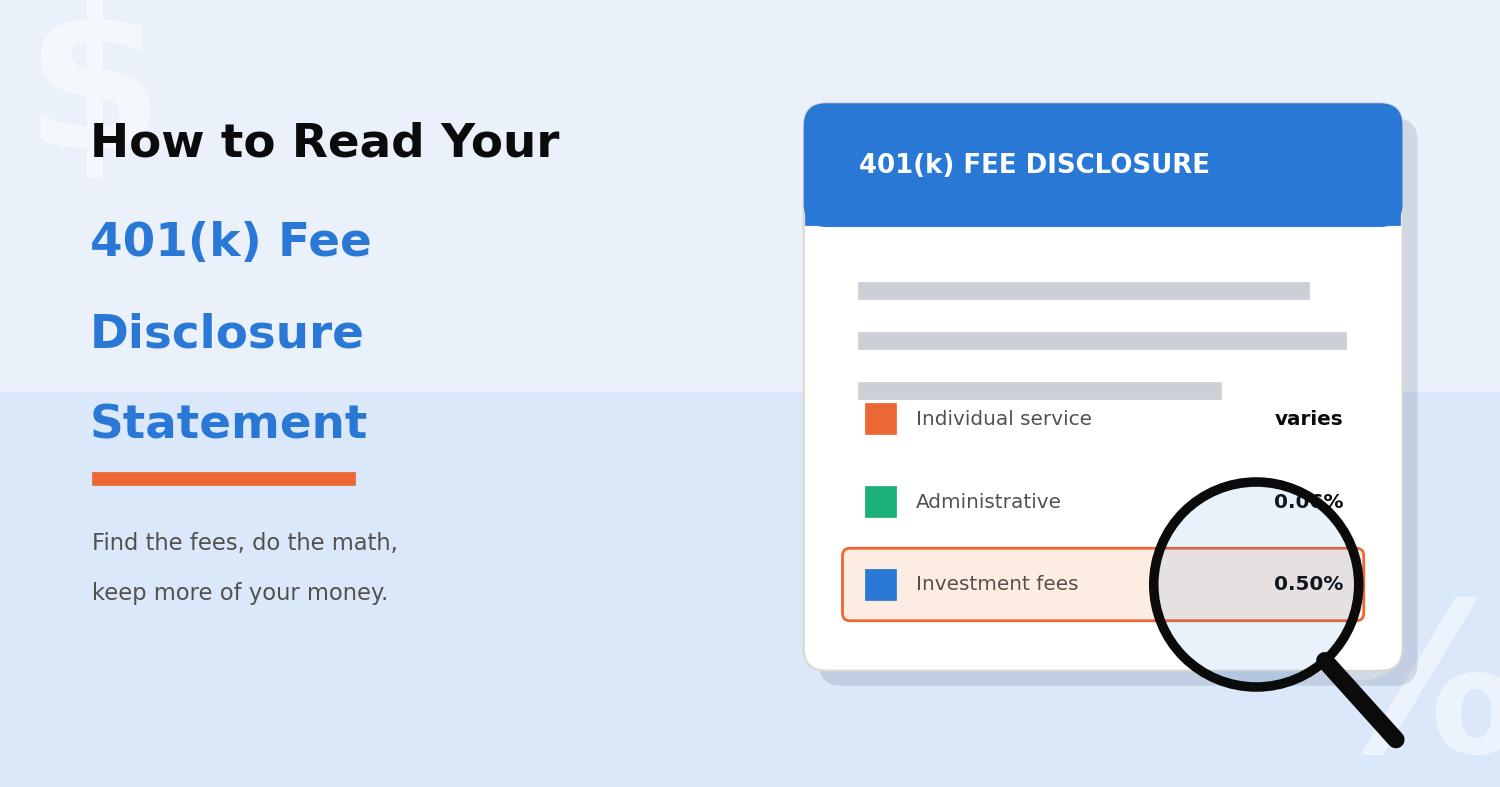
Every year, your retirement plan sends you a document that most people file away without a second look. It carries a dull title, runs several pages, and lists numbers in small type. That document is your 401(k) fee disclosure statement, and it holds one of the most important facts about your retirement: how much you pay to invest, and how much those costs will quietly subtract from your savings over a working lifetime.
Fees rarely feel urgent because your plan never sends you a bill. It simply deducts the money from your account before you ever see it. That invisibility is exactly why the disclosure matters. Once you learn to read it, you can spot expensive funds, question charges that do not earn their keep, and often keep tens of thousands of dollars that would otherwise leak away. This guide walks you through the statement section by section so you can read yours with confidence.
Why the law puts this document in your hands
Since 2012, federal rules under the Employee Retirement Income Security Act have required plan administrators to hand participants a clear, standardized breakdown of plan costs. The rule, known as the 404(a)(5) participant disclosure, exists for one reason: to let you compare your investment choices on an even footing and to show you what you actually pay.
The plan owes you two things on a schedule. First, it gives you a full disclosure at least once a year that explains the plan and lists every fee. Second, it sends you a statement at least once every quarter that shows the actual dollar amounts it pulled from your account during that period. The annual document tells you what the fees are. The quarterly statement tells you what you paid.
The three kinds of fees you are looking for
Almost every charge on your statement falls into one of three buckets. Learn these three, and the rest of the document becomes far easier to follow.
- Investment fees come from the funds themselves and almost always represent your largest cost. Each fund charges an expense ratio, a percentage of your money that pays the fund managers and covers operating costs. The plan skims this amount from the fund’s return before it ever reaches your account.
- Plan administrative fees cover the machinery that keeps the plan running: recordkeeping, accounting, legal work, and the annual audit. Your plan may spread these costs across every account, either as a flat dollar amount per person or as a percentage of your balance.
- Individual service fees apply only when you use a specific feature. If you take a loan from your plan, request a professionally managed account, use a self-directed brokerage window, or trigger a qualified domestic relations order in a divorce, the plan charges you for that service alone.
The chart below shows how these three categories typically stack up for a saver with a $100,000 balance. Investment fees usually dwarf the others, which is why they deserve the closest look.
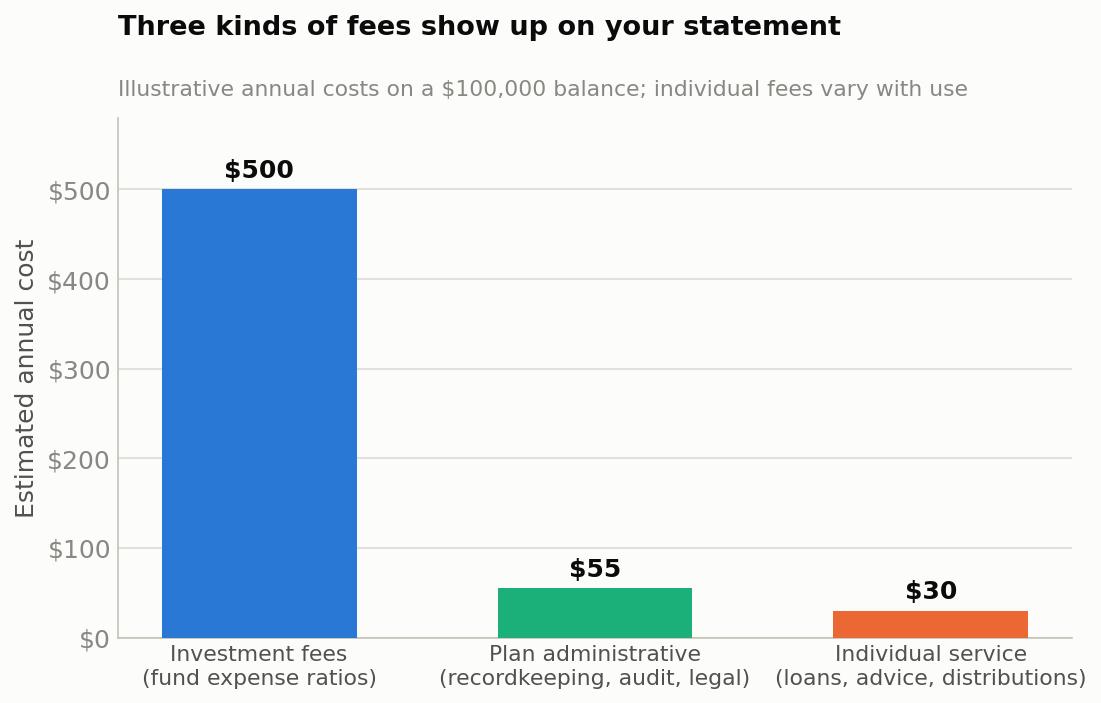
Illustrative annual costs on a $100,000 balance. Individual fees vary with use.
Reading the comparative investment chart
The heart of your annual disclosure is a large table that lines up every investment option side by side. Regulators designed it so you can compare funds without a finance degree. For each option you will find its name and asset category, its past performance, a benchmark to judge that performance against, and its cost.
The cost appears in two forms, and this is the clever part of the rule. The plan must show each fund’s total annual operating expense as a percentage and as a dollar figure for every $1,000 you invest. A 0.50 percent expense ratio, for example, shows up as $5.00 per $1,000. That translation turns an abstract percentage into a number you can feel.
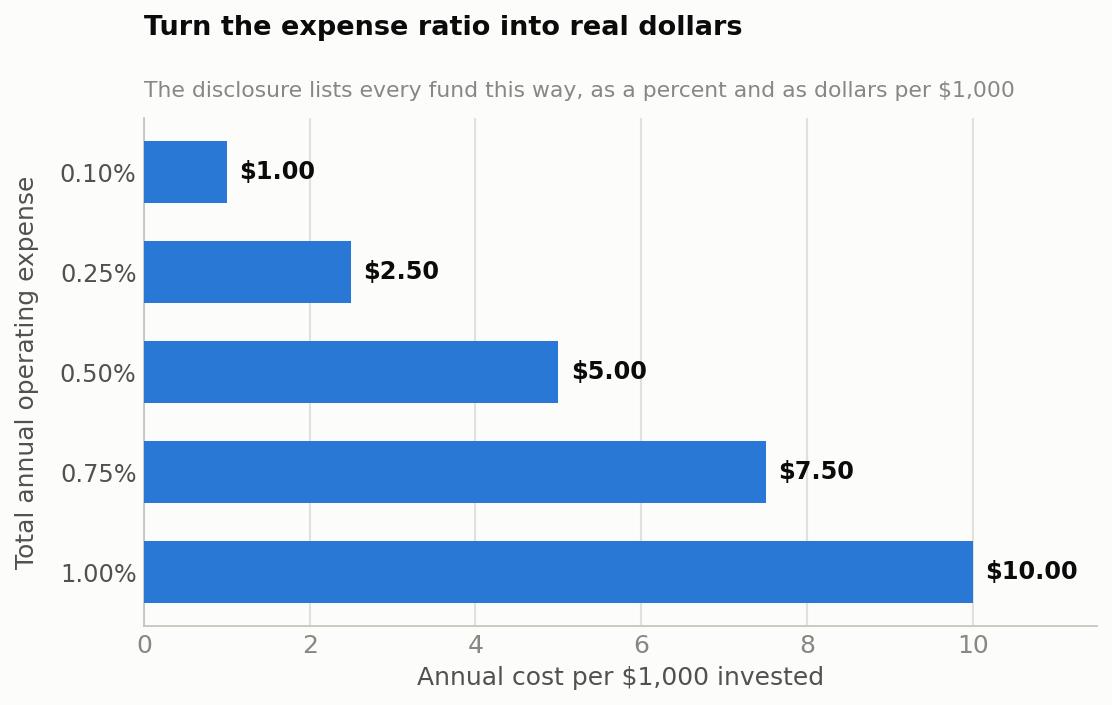
The disclosure lists every fund this way, as a percent and as dollars per $1,000.
Use that dollar column to compare funds directly. A large cap index fund might cost $0.30 to $1.00 per $1,000, while an actively managed fund in the same category might cost $6.00 to $10.00 per $1,000. When two funds hold similar investments, the cheaper one lets you keep more of every dollar of return. The disclosure hands you this comparison on a single page, so use it.
Do not skip the performance and benchmark columns
Cost matters most, but the chart also shows how each fund performed over one, five, and ten years, and it places a benchmark index right beside those numbers. The benchmark is the yardstick. If a fund charges a premium price yet trails its benchmark year after year, you are paying more for less. Index funds that simply track the benchmark tend to charge little and match the market closely, which is why they anchor so many strong plans.
Read performance with a steady hand. One strong year proves little, and past returns never guarantee future ones. Look instead at the longer columns and ask a simple question: does this fund justify its fee?
Why a single percentage point changes everything
Fees look tiny on paper. The difference between 0.50 percent and 1.50 percent sounds trivial, barely worth a conversation. Compounding tells a different story. Because fees come out every year, they do not just cost you the fee itself. They also cost you all the growth that money would have earned for the rest of your career.
The chart below follows a $100,000 balance growing at 7 percent a year for 30 years, with no new contributions, so you can see the fee effect on its own. At 0.50 percent in fees the balance grows to roughly $661,000. At 1.50 percent it reaches only about $498,000. That one percentage point quietly erases around $163,000, roughly a quarter of the account.
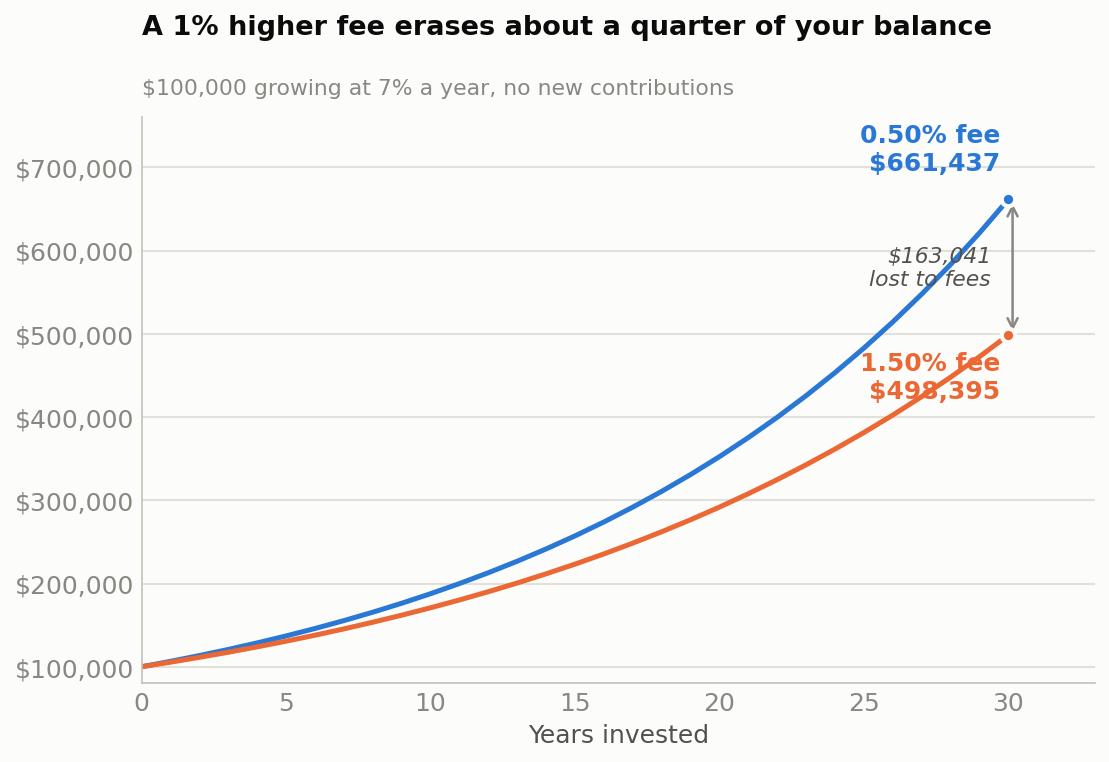
$100,000 growing at 7 percent a year, no new contributions.
The Department of Labor makes the same point with its own example. It calculates that a one percentage point difference in annual fees can shrink your balance at retirement by about 28 percent over a 35 year career. Fees are not a rounding error. Over decades they rival the impact of your contribution rate.
A five-step way to read your statement
- You do not need to study every line. Work through the document in this order and you will capture what matters in a few minutes.
- First, find the quarterly statement and locate the dollar amount the plan deducted from your account. This is the real, out of pocket number, and it grounds everything else.
- Second, turn to the comparative investment chart and read down the cost column for the funds you actually own. Note each expense ratio and its dollar cost per $1,000.
- Third, compare each of your funds with a cheaper option in the same category, usually an index fund, and calculate the yearly difference on your balance.
- Fourth, check the performance and benchmark columns to confirm that any fund charging a premium actually earns it.
- Fifth, read the administrative and individual fee sections so no charge surprises you, especially fees tied to loans or a brokerage window.
If you are close to retirement
The nearer you are to retirement, the more a high fee costs you in absolute dollars, because your balance is at its largest. A half percent on a $1 million account is $5,000 every year, money that no longer compounds for you. As you shift toward more conservative investments, watch the expense ratios on bond funds and stable value options closely, since a rich fee on a low returning fund eats a much larger share of your gain. Reading the disclosure carefully in these final working years often protects more real money than it ever did earlier in your career.
If you own or help run the plan
Business owners and anyone who selects or oversees a plan carry a legal duty to keep fees reasonable for every participant. A separate disclosure, the 408(b)(2) rule, requires service providers to spell out their compensation to you as the plan sponsor. Read it alongside the participant disclosure, benchmark your total plan cost against comparable plans, and document your review. Courts have held plan sponsors responsible when they let excessive fees ride unexamined, so a regular, written fee review protects both your participants and you.
What to do when the fees look high
Finding a high fee does not mean you switch plans overnight. Start inside the menu you already have. Most plans include at least a few low cost index options, and moving your money into them costs nothing and often cuts your investment fee sharply. If the entire menu looks expensive, raise it with your human resources team or plan administrator, since participant pressure has pushed many employers to negotiate better pricing. And if you want a second opinion on whether your funds earn their cost, a fiduciary advisor can review the disclosure with you and model the long term difference on your own balance.
The bottom line
Your 401(k) fee disclosure statement is not busywork from your benefits department. It is a map of every cost standing between you and your retirement, written in a format the law designed for you to understand. Spend a few minutes with it each year. Find your fees, translate them into dollars, compare your funds with cheaper alternatives, and act on what you learn. Small percentages compound into life changing sums, and the money you keep is money that keeps working for your future.
If you’d like a second opinion on whether your funds earn their cost, schedule a 15-minute intro call. We’ll read the disclosure with you and model the long-term difference on your own balance.