

Many people reach tax season, review their retirement savings, and realize they did not fully fund an IRA in a previous year. That often leads to an important question: Can you make an IRA contribution now to replace the amount you missed?
In most cases, no. The IRS does not let you carry unused IRA contribution room from one year to another. Once the applicable deadline passes, the opportunity to contribute for that tax year generally disappears.
However, you do have a limited window to make a prior year IRA contribution. The IRS may also postpone the deadline for taxpayers affected by a federally declared disaster or another qualifying emergency.
What Are IRA Makeup Contributions?
“IRA makeup contributions” is an informal phrase. The tax code does not create a special contribution category that lets you replace every contribution you skipped in earlier years.
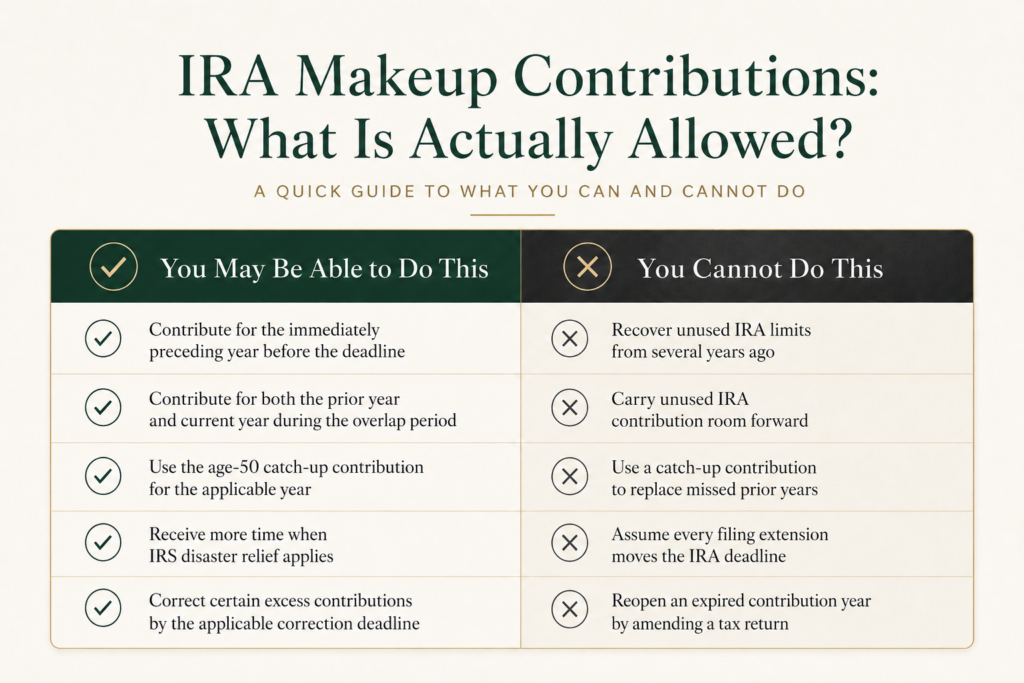
When people search for IRA makeup contributions or IRA make up contributions, they usually mean one of two things. They may mean a contribution for the immediately preceding tax year, or they may mean an age-based catch-up contribution.
A prior year contribution gives you extra time to fund the previous year’s IRA. A catch-up contribution gives eligible savers age 50 or older a higher annual limit. Neither rule lets you recover contribution room from several years ago.
Can You Make a Prior Year IRA Contribution?
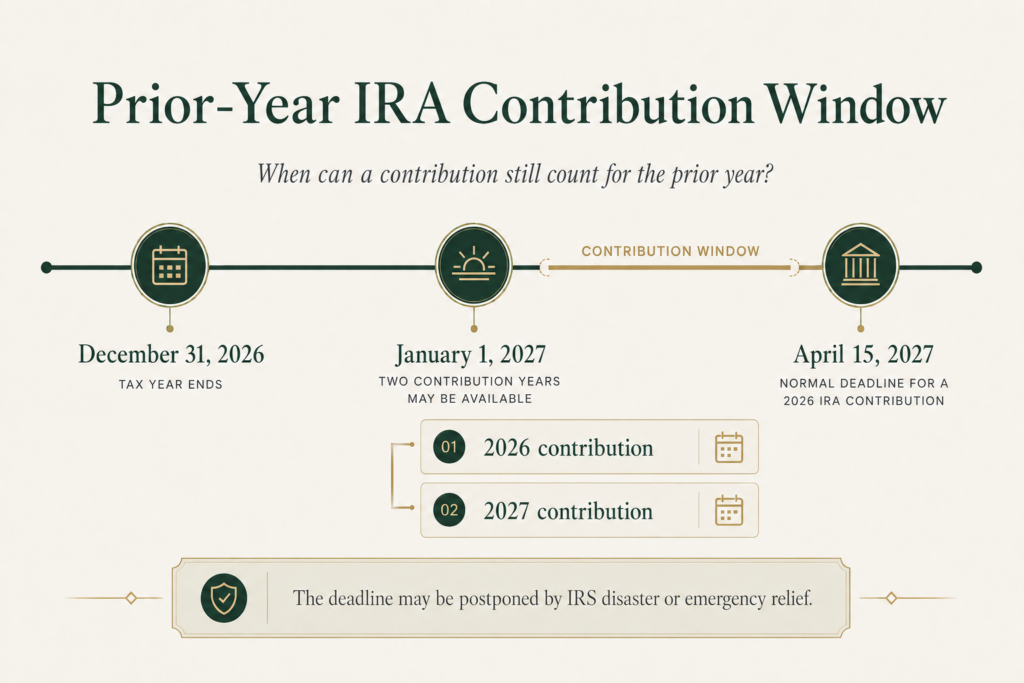
You can generally make a traditional or Roth IRA contribution for the previous tax year until the original due date of your federal income tax return. For most calendar-year taxpayers, that deadline falls in mid-April of the following year.
For example, most taxpayers could make a 2025 IRA contribution through April 15, 2026. Someone who had not reached the 2025 limit could contribute during the first part of 2026 and designate the deposit for 2025.
A tax-filing extension generally does not extend the regular IRA contribution deadline. Filing your return in October does not normally give you until October to fund the prior year’s IRA. The IRS states that IRA contributions generally must be made by the return’s original due date, without extensions.
This creates an overlap at the beginning of each calendar year. From January through the prior year’s deadline, you may be able to contribute for both the previous year and the current year.
For example, a contribution made in February 2027 could potentially count toward either 2026 or 2027. You could also make separate contributions for both years, assuming you qualify.
Emergency and Disaster Relief Can Extend the Deadline
The normal April deadline is not always the final deadline. The IRS can postpone IRA contribution deadlines for taxpayers affected by a federally declared disaster, national emergency, or other qualifying event.
A major example occurred in 2021. The IRS postponed the deadline for making 2020 traditional and Roth IRA contributions from April 15, 2021, to May 17, 2021, as part of nationwide COVID-related tax relief.
The IRS also announces targeted relief after hurricanes, tornadoes, floods, wildfires, severe storms, and other declared disasters. Depending on the announcement, eligible taxpayers may receive additional time to make a prior year IRA contribution.
The relief does not automatically apply to everyone. An announcement may cover only people who live or operate a business in designated areas. In some cases, relief may also apply when a taxpayer’s records or tax professional are located in the affected area.
Always review the specific IRS announcement before assuming that a deadline has moved. The notice will identify who qualifies, which deadlines are covered, and the new due date. The IRS may postpone all or only some of the deadlines associated with a particular disaster.
A postponement extends an existing contribution opportunity. It does not create unlimited makeup rights for unrelated earlier years.
Designate the Correct Contribution Year
A contribution made during the first few months of the year does not automatically count for the prior year. You must tell your IRA custodian which tax year the contribution applies to.
Suppose you deposit $7,500 into an IRA in March 2027. Depending on your eligibility, it could count toward your 2026 limit or your 2027 limit.
Do not assume the institution will choose the year you intended. If the contribution gets coded incorrectly, you may leave prior-year space unused or create an excess contribution for the current year.
Review the transaction confirmation. Verify the contribution amount, account type, and tax year before the deadline passes.
Can You Make Up Contributions From Several Years Ago?
No. You cannot go back several years and fund an IRA for each year you missed.
Assume you contributed nothing to an IRA in 2023, 2024, or 2025. After the 2025 contribution deadline passes, you cannot deposit three years of contributions and assign one deposit to each year.
During the early-year overlap, you may contribute for the immediately preceding year and the current year. Once the prior-year deadline passes, including any applicable IRS postponement, only the current year generally remains available.
The IRS specifically states that if you contribute less than the annual limit, you cannot make up the difference after the contribution deadline or add the unused amount to a later year’s limit.
An amended tax return does not reopen an expired IRA contribution window. You may amend a return to correct the reporting for a contribution made on time, but you cannot use an amended return to create a new contribution after the deadline.
IRA Contribution Limits for 2026
For 2026, the combined contribution limit for traditional and Roth IRAs is $7,500. A person who reaches age 50 or older by the end of 2026 may contribute an additional $1,100, bringing the total potential contribution to $8,600.
The limit applies across all of your traditional and Roth IRAs combined. Opening several IRA accounts does not multiply the amount you can contribute.
For example, a 45-year-old who contributes $4,000 to a traditional IRA for 2026 could generally contribute no more than $3,500 to a Roth IRA for the same year.
Your taxable compensation can also limit your contribution. If your eligible compensation falls below the annual dollar limit, your maximum contribution generally cannot exceed your eligible compensation.
Catch-Up Contributions Do Not Restore Missed Years
The term “catch-up contribution” causes much of the confusion surrounding IRA makeup contributions.
An IRA catch-up contribution does not restore unused room from an earlier year. It simply raises the annual limit for someone who reaches age 50 or older by the end of the applicable tax year.
Someone who turns 50 in 2026 cannot replace missed contributions from 2022 through 2025. That person may contribute up to the applicable 2026 limit, assuming sufficient compensation and eligibility, but cannot add the unused limits from prior years.
Each tax year stands on its own. The catch-up rule gives older savers more room for the current contribution year. It does not rebuild expired contribution space.
Traditional and Roth IRA Eligibility Still Matters
Meeting the deadline does not automatically mean you qualify to contribute or deduct the contribution.
You can generally contribute to a traditional IRA if you have sufficient taxable compensation. However, your income, filing status, and participation in a workplace retirement plan may reduce or eliminate the deduction.
You may still make a nondeductible traditional IRA contribution if you otherwise qualify, but you must track the after-tax basis. Taxpayers generally report nondeductible contributions on Form 8606.
Roth IRA contributions follow separate income limits. Your modified adjusted gross income and filing status determine whether you can make a full direct contribution, a reduced contribution, or no direct contribution.
These rules still apply to a prior year IRA contribution. Making the deposit before the deadline does not override the eligibility requirements for that tax year.
This issue often affects people with variable income. A bonus, business sale, stock compensation, or unexpected capital gain may change Roth IRA eligibility after a contribution has already been made.
What Happens If You Contribute Too Much?
An excess IRA contribution can occur when you exceed the annual limit, lack sufficient compensation, exceed the Roth IRA income limit, or accidentally fund the same tax year twice.
A 6% excise tax generally applies to an excess amount for each year it remains unresolved in the IRA.
You may be able to avoid or limit the penalty by correcting the excess by the applicable deadline. The custodian must process the correction properly, so do not request a normal withdrawal without explaining that you need to correct an excess contribution.
The correction deadline does not always match the deadline for making a prior year contribution. A filing extension generally does not provide more time to make the original contribution, but it may affect the correction period.
A Practical IRA Contribution Strategy
The easiest way to avoid a missed deadline is to contribute throughout the year instead of waiting until tax season.
A person targeting the $7,500 limit in 2026 could automate monthly contributions of $625. Someone eligible for the full $8,600 limit could contribute approximately $716.67 per month and adjust the final deposit.
Automatic contributions spread the cash-flow impact across the year and reduce the risk of forgetting the deadline. People with variable income may instead reserve cash and complete the contribution once their compensation and eligibility become clearer.
Before making a prior year IRA contribution, confirm:
- The tax year for the contribution
- The type of IRA
- The amount already contributed
- Your eligible compensation
- Your expected modified adjusted gross income
- Your Roth IRA eligibility
- Your workplace retirement plan coverage
- Whether IRS emergency or disaster relief changed the deadline
Checking these items before transferring the money can prevent an incorrect contribution from turning into a recurring tax problem.
My Final Thoughts
A prior year IRA contribution can give you additional time to fund retirement savings, but the opportunity does not remain open indefinitely. For most taxpayers, the window closes on the original federal tax filing deadline in the following year.
Emergency and disaster relief can move that deadline. The nationwide extension from April 15 to May 17 in 2021 for 2020 IRA contributions provides a clear example. The IRS may also grant location-specific extensions after federally declared disasters.
Once the applicable deadline passes, including any official postponement, you generally cannot recover the unused space by amending a tax return, increasing a later contribution, or calling a new deposit an IRA makeup contribution.
Treat each annual IRA limit as a use-it-or-lose-it opportunity. Review your retirement savings before year-end, revisit the decision early in the next year, and clearly designate any deposit made during the overlapping contribution period.
A timely and properly reported IRA contribution can strengthen your long-term retirement plan. An ineligible or incorrectly coded contribution can create tax reporting problems and recurring penalties. Coordinate the decision with your broader tax strategy, cash-flow needs, and workplace retirement benefits before moving the money.