
Most people think of an HSA as a simple place to save money for medical expenses. You contribute cash, potentially receive a tax deduction, invest the balance, and eventually withdraw the money tax-free when you use it for qualified medical expenses.
There is another HSA strategy that far fewer people know about.
It is called a qualified HSA funding distribution, and it allows you to move money directly from an IRA into a Health Savings Account without recognizing the transferred amount as taxable income. For the right person, particularly a business owner or someone with substantial pre-tax retirement savings, it can turn money that would eventually face ordinary income taxes into money that can potentially come out tax-free for qualified medical expenses.
The catch is that the IRS generally gives you only one opportunity to use this strategy during your lifetime. The eligibility requirements also leave very little room for error.
How an IRA-to-HSA Transfer Works
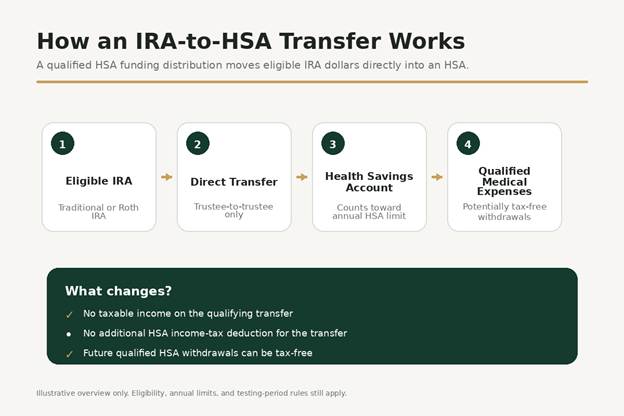
Normally, taking money from a traditional IRA creates taxable income. If you withdraw $5,000 from an IRA, that $5,000 generally becomes part of your taxable income for the year.
A qualified HSA funding distribution works differently. Instead of distributing the money to yourself, your IRA custodian transfers it directly to your HSA custodian.
The amount transferred does not get included in your taxable income, assuming you satisfy the applicable requirements. Once the money reaches the HSA, it can potentially grow tax-free and eventually come out tax-free when used for qualified medical expenses.
That creates an unusual opportunity to move money from a tax-deferred account into a potentially tax-free account without recognizing taxable income during the transfer.
There is an important tradeoff. A normal HSA contribution may provide an income tax deduction. An IRA-to-HSA transfer does not give you an additional deduction.
The primary benefit comes from changing the future tax treatment of the money.
Rule 1: You Generally Get One Opportunity
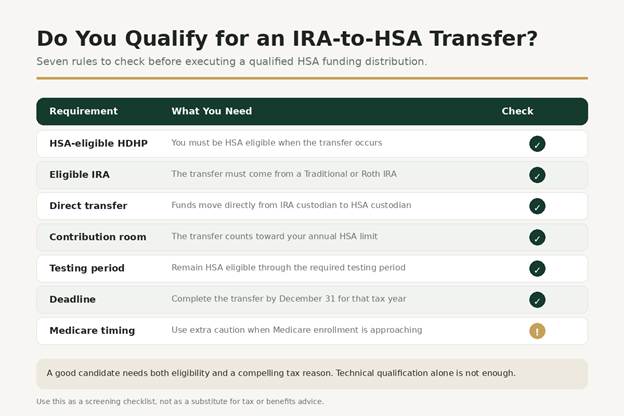
The qualified HSA funding distribution is essentially a once-in-a-lifetime strategy.
That makes timing important. You do not want to use the opportunity simply because you discovered that it exists. You want to use it when the transfer provides a meaningful financial benefit.
There is a narrow exception for someone who completes a transfer while covered by a self-only high-deductible health plan and then moves to qualifying family coverage during the same tax year. In that situation, an additional transfer may be permitted to account for the higher family contribution limit.
For most people, however, the practical assumption should be simple: you get one shot.
Rule 2: The Money Must Come From an Eligible IRA
The transfer must originate from an eligible IRA.
You cannot simply transfer money directly from a 401(k) or 403(b) into an HSA using this strategy. If most of your retirement savings sit inside an employer-sponsored plan, additional planning may be required before a qualified HSA funding distribution becomes available.
The distinction matters because many business owners accumulate retirement savings across several different types of accounts over their careers. Before considering the strategy, identify exactly where the retirement money sits and whether the account qualifies.
Rule 3: The Transfer Must Go Directly to the HSA
You should never take possession of the money yourself.
Your IRA custodian should transfer the funds directly to the HSA custodian. Think of it as moving money from one institution to another without allowing it to pass through your personal bank account.
That trustee-to-trustee process matters because receiving the distribution personally can change its tax treatment.
If your IRA and HSA are held at different financial institutions, coordinate with both custodians before initiating the transaction.
Rule 4: You Must Be HSA Eligible
Moving money from an IRA does not create HSA eligibility.
You still need to be covered by an HSA-eligible high-deductible health plan at the time of the transfer.
For 2026, the transcript’s planning example uses minimum deductibles of $1,700 for self-only coverage and $3,400 for family coverage. It also uses maximum out-of-pocket limits of $8,500 for self-only coverage and $17,000 for family coverage.
If your health insurance does not satisfy the applicable HSA eligibility requirements, you cannot use the strategy.
The Transfer Counts Toward Your Annual HSA Limit
A qualified HSA funding distribution does not sit on top of the normal HSA contribution limit.
It counts toward the same annual limit.
For 2026, the planning figures used here are $4,400 for self-only coverage and $8,750 for family coverage. Someone age 55 or older can also potentially make an additional $1,000 catch-up contribution.
That means a 57-year-old with self-only coverage could have a total 2026 HSA contribution limit of $5,400.
But you also have to account for money already contributed to the HSA.
Suppose your total limit is $9,750 because you have family coverage and qualify for the catch-up contribution. Your employer has already contributed $2,000, and you contributed another $1,000 personally.
You would have $6,750 of remaining contribution capacity.
The IRA-to-HSA transfer could not exceed that remaining amount.
Employer contributions, payroll contributions, personal contributions, and the qualified HSA funding distribution all share the same annual contribution limit.
The Testing Period Can Create a Major Problem
One of the most important rules involves what happens after the transfer.
Once you complete a qualified HSA funding distribution, you generally need to remain HSA eligible throughout the required testing period. The transcript describes that period as extending through the end of the 12th month following the month in which the transfer occurs.
For example, if you completed the transfer on October 8, 2026, the testing period would run through October 31, 2027.
Losing HSA eligibility during that period can create significant tax consequences. The transferred amount can become taxable, and an additional 10% penalty may apply.
That makes this a poor strategy when your health insurance situation is uncertain.
If you expect to change jobs, change health plans, or otherwise lose access to an HSA-eligible plan, the potential benefit may not justify the execution risk.
Watch the December 31 Deadline
Regular HSA contributions can generally continue into the following year through the applicable tax filing deadline.
A qualified HSA funding distribution follows a different timeline.
According to the strategy outlined in the transcript, the transfer must be completed by December 31 of the year you want it to count.
If you want to execute the strategy for 2026, waiting until tax season in 2027 would be too late.
That makes year-end coordination between the IRA custodian, HSA custodian, financial advisor, and tax professional especially important.
Medicare Can Complicate the Strategy
People approaching Medicare need to be particularly careful.
Once you enroll in Medicare, you generally lose the ability to make HSA contributions. Medicare Part A can also create complications because coverage may become retroactive when someone enrolls after age 65.
That retroactive coverage can affect prior HSA contributions.
For someone planning to enroll in Medicare within roughly the next 12 to 18 months, an IRA-to-HSA transfer may create more risk than opportunity because of the HSA testing-period requirements.
This is one of those situations where technically qualifying today does not necessarily mean the strategy makes financial sense.
A $5,400 Example
Consider a hypothetical 57-year-old business owner named David.
David has self-only HSA-eligible high-deductible health coverage. Neither he nor his company has contributed to his HSA during 2026.
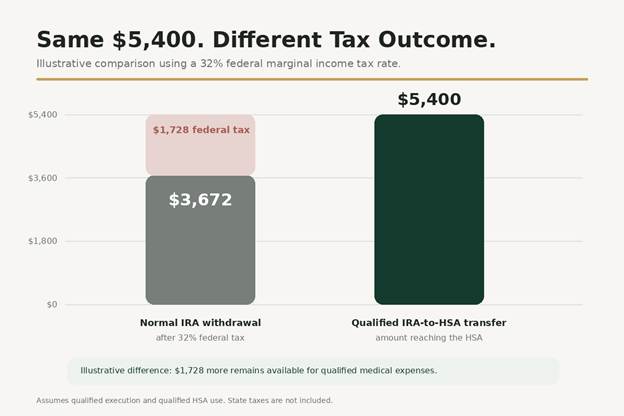
Using the 2026 limits in our example, David can contribute $4,400 plus a $1,000 catch-up contribution because he is over age 55. His total available contribution capacity is $5,400.
David requests a qualified HSA funding distribution from his IRA custodian. The custodian transfers $5,400 directly into his HSA.
He does not receive an additional HSA deduction for the transfer, but he also does not recognize the $5,400 as taxable income from the IRA transfer, assuming he complies with the rules.
Now consider the future use of that money.
If David eventually needed to take $5,400 from his traditional IRA to pay medical expenses, an ordinary IRA distribution could create taxable income. At a hypothetical 32% federal income tax rate, $5,400 of taxable income represents $1,728 of potential federal income tax.
Inside the HSA, those same dollars may eventually be withdrawn tax-free when used for qualified medical expenses.
That is where the strategy becomes interesting.
Who May Benefit Most
Business owners and self-employed individuals can be particularly good candidates because they often accumulate significant traditional IRA balances while also carrying HSA-eligible health insurance.
Someone in a higher ordinary income tax bracket may also find the strategy more valuable. The greater the potential future tax cost of IRA distributions, the more valuable tax-free HSA distributions for qualified medical expenses can become.
People age 55 or older also gain additional flexibility because the $1,000 HSA catch-up contribution increases the amount potentially available for the transfer.
Another possible use involves someone facing significant medical expenses without sufficient cash or HSA savings. Rather than taking a taxable IRA distribution and paying the medical bill directly, a properly executed qualified HSA funding distribution may allow that person to move eligible IRA money into the HSA and then use HSA funds for qualified expenses.
When You Should Probably Leave It Alone
The strategy does not automatically beat a normal HSA contribution.
If you have plenty of cash available, funding the HSA normally may provide a better result because you can potentially receive the current-year HSA deduction while leaving your IRA invested.
The IRA transfer becomes more interesting when liquidity is limited or when shifting pre-tax retirement assets into an HSA meaningfully improves the long-term tax characteristics of your portfolio.
You should also be extremely cautious if you expect your health insurance to change or Medicare enrollment is approaching.
Finally, using Roth IRA money generally makes the strategy less attractive. Roth IRA assets already have the potential to provide tax-free qualified withdrawals without restricting the money to medical expenses.
Giving up that flexibility usually provides little benefit.
My Final Thoughts
Qualified HSA funding distributions sit in a strange corner of the tax code. Most investors will never use one, and many people will never even hear about the strategy.
But obscure does not mean unimportant.
For someone with an HSA-eligible health plan, available HSA contribution capacity, traditional IRA assets, and a strong reason to reposition some of those dollars, the strategy deserves consideration.
The most important word, however, is once.
This is generally a once-in-a-lifetime opportunity. Treat it accordingly. Before moving the money, verify your HSA eligibility, remaining contribution limit, health insurance outlook, Medicare timeline, source account, and transfer procedure.
A qualified HSA funding distribution can be a useful tax-planning tool when all of those pieces line up. When they do not, forcing the strategy can cost more than it saves.
The objective is not to use every tax strategy the IRS allows. The objective is to use the right strategy at the right time for the right financial plan.
If you have an HSA-eligible plan and a traditional IRA, and you’re wondering whether this is your year to use the once-in-a-lifetime transfer, schedule a 15-minute intro call before the December 31 deadline.