
Most business owners are excellent capital allocators inside their companies. They constantly decide where money should go, what projects deserve funding, and which investments will produce the best return. If you ask a founder why they spent $300,000 on equipment or why they hired three new employees, they can usually explain the decision in a few seconds. The capital had a purpose, and the decision was tied to growth, efficiency, or long-term value.
But when we look at that same founder’s personal balance sheet, the discipline often disappears. Money accumulates across different accounts, investments, and opportunities, but there is rarely a clear framework guiding where each dollar should go. Some cash sits in the bank. There might be a brokerage account, a retirement account, maybe a piece of real estate or a private investment that sounded interesting at the time. None of these decisions are necessarily wrong, but they usually weren’t made as part of a larger strategy.
Over time, that lack of structure creates inefficiencies. Capital ends up sitting idle, risk becomes concentrated in unexpected ways, and opportunities to grow wealth are often missed. The founder built an incredible machine inside the business, but outside the business their finances slowly turn into a collection of accounts rather than a coordinated system.
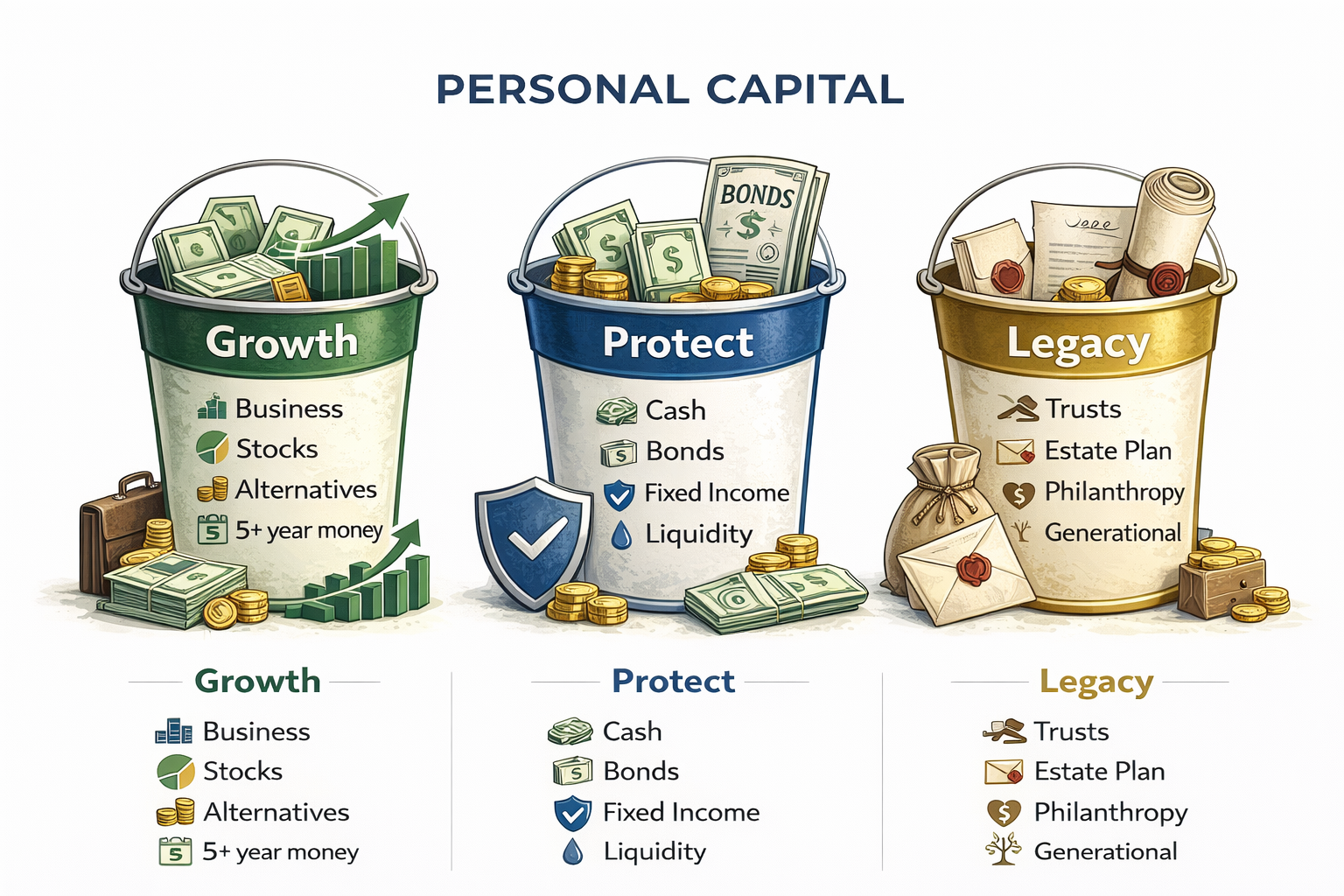
One of the simplest ways to fix this problem is by organizing your wealth into three clear buckets. Every dollar on your personal balance sheet should ultimately belong in one of these buckets: the growth bucket, the protect bucket, or the legacy bucket. Once you start thinking about your money this way, capital allocation becomes far easier to understand and far easier to manage.
Key Takeaways: The 3-Bucket Capital Allocation Strategy
- The Concept: Business owners should organize their personal balance sheet into three distinct categories to ensure every dollar has a defined purpose.
- Growth Bucket (Horizon: 5+ Years): High-growth, volatile assets like business equity, public stocks, and index funds.
- Protect Bucket (Horizon: Immediate to Short-Term): Stable, liquid assets like fixed income, bonds, and intentional cash reserves.
- Legacy Bucket (Horizon: Multi-Generational): Tax-efficient structures, trusts, and estate planning designed to transfer wealth.
The Growth Bucket: Long-Term Wealth Creation and Business Equity
The first bucket is the growth bucket, and this is where your capital goes when the primary objective is long-term growth. These assets are meant to compound over time and produce the highest expected returns, but they also come with volatility. Their value will move up and down along the way, sometimes dramatically, but over long periods of time they tend to grow alongside the broader economy.
For most founders, the largest asset in the growth bucket is their business equity. The company itself is often the engine that creates the majority of their wealth. Years of reinvestment, risk-taking, and operational discipline are designed to build something valuable that can generate profits or eventually be sold for a significant amount of money. Because of this, the business naturally sits at the center of the growth bucket.
But the growth bucket should rarely consist of the business alone. Many founders also allocate capital to public equities, such as stock portfolios or index funds, because those investments participate in the long-term growth of the global economy. Over time, these investments allow wealth to compound beyond the success of a single company.
One of the most important concepts with the growth bucket is time horizon. Money placed in this bucket should generally be capital that you do not expect to use for at least five years. Markets move unpredictably in the short term, and even strong investments can decline temporarily before they recover and grow again. If money that belongs in the growth bucket is treated like short-term capital, investors often panic during downturns and make emotional decisions.
When founders clearly understand which assets belong in the growth bucket, volatility becomes easier to tolerate. They know those investments were never meant to fund next year’s expenses or the next big purchase. They were meant to grow over time, and that growth requires patience.
The Protect Bucket: Stability, Liquidity, and Cash Reserves
The second bucket is the protect bucket, and its role is very different. While the growth bucket focuses on long-term returns, the protect bucket focuses on stability and liquidity. These assets exist to make sure that money is available when it is needed and that a portion of the balance sheet remains resilient even during difficult periods.
When structuring wealth management for business owners in Keller and across DFW, we emphasize this bucket because entrepreneurs already carry a significant amount of risk in their businesses. Their income, reputation, and equity are all tied to the success of the company. Because of that, it often makes sense for part of their personal wealth to serve as a stabilizing force rather than another source of risk.
Assets in the protect bucket might include fixed income investments, bonds, defined risk strategies, or carefully managed cash reserves. These investments typically offer lower expected returns than equities, but they also provide greater stability. Their purpose is not to produce the highest growth possible, but to ensure that funds remain available when they are needed.
Cash itself also belongs in this bucket, but the key is that the amount of cash should be intentional. Many founders accumulate large cash balances simply because they never decided how much they actually want to keep in reserve. Over time, the number grows from $100,000 to $300,000, then to $600,000 or more, simply because the money was never allocated anywhere else.
A better approach is to define a liquidity threshold. In other words, decide exactly how much cash you want available and why. That number might be based on operating expenses, personal expenses, or simply the amount that allows you to sleep well at night. But once that number is reached, additional capital should begin moving into other buckets instead of sitting in the bank indefinitely.
The protect bucket acts as a financial buffer. It allows founders to take intelligent risks inside their businesses and growth investments because they know a portion of their wealth is positioned for stability.
The Legacy Bucket: Generational Wealth and Estate Planning
The third bucket is the legacy bucket, and this is where wealth begins to move beyond the individual founder. While the growth bucket focuses on compounding capital and the protect bucket focuses on stability, the legacy bucket focuses on long-term impact and generational planning.
For many entrepreneurs, building wealth eventually becomes about more than just personal financial success. They want their hard work to create opportunities for their children, their family, or the causes they care about. Without planning, however, wealth can dissipate quickly as it moves from one generation to the next.
The legacy bucket is designed to address that challenge. Assets in this bucket often include estate planning structures like trusts, philanthropic strategies, and long-term tax-efficient investments. These structures allow wealth to transfer more effectively and ensure that it continues to serve a purpose long after the original wealth creator is gone.
One important aspect of the legacy bucket is its time horizon. These investments are often designed to operate over decades rather than years. Instead of focusing on short-term outcomes, the goal is to position assets in a way that supports future generations while minimizing unnecessary taxes and inefficiencies.
When founders intentionally allocate part of their wealth to the legacy bucket, they begin thinking about their finances differently. The focus shifts from simply accumulating assets to designing a financial system that can outlast them.
Why the 3-Bucket Capital Allocation Framework Works
The reason the bucket framework works so well is that it forces clarity. Each dollar has a role, and that role determines how the money should be invested and how long it should remain invested. Instead of viewing the balance sheet as one large pool of capital, it becomes a collection of assets with distinct purposes.
The growth bucket drives long-term wealth creation. The protect bucket provides stability and liquidity. The legacy bucket ensures that wealth can extend beyond a single lifetime. When these buckets are balanced correctly, they work together to create a far more resilient financial structure.
Without this separation, investors often treat every asset the same. That can lead to selling long-term investments when short-term cash is needed, or taking unnecessary risks with money that should have been preserved. The bucket framework helps prevent these mistakes by clearly defining the purpose of each investment.
Tax Sequencing and Asset Location Strategy
Another important component of capital allocation is taxes. Where investments live from a tax perspective can significantly influence long-term outcomes. Certain assets are more efficient inside tax-deferred accounts, while others may be better suited for taxable or tax-free accounts.
Having money spread across taxable accounts, tax-deferred accounts, and tax-free accounts creates flexibility later in life. It allows investors to control how much income they recognize each year and potentially manage their tax brackets more effectively. This flexibility can become extremely valuable during retirement or after the sale of a business.
For founders planning a business sale—a critical component of our exit planning services in Trophy Club—tax sequencing becomes even more important. A business sale often creates a large taxable event, and coordinating other financial decisions around that event can dramatically reduce lifetime taxes. Capital allocation is not just about investment choices; it is also about positioning assets in the most efficient way possible.
Applying Corporate Financial Discipline to Personal Wealth
Most business owners are exceptional operators. They know how to create revenue, manage teams, and grow companies in competitive environments. But wealth is not built by income alone. Over time, wealth is shaped by how intentionally capital is allocated.
If your personal balance sheet does not have a clear structure behind it, you do not really have a wealth strategy. You simply have accumulated assets that happen to exist in different places. Without a framework, those assets may not work together as effectively as they could.
The three bucket approach brings structure to that process. It forces every dollar to answer a simple question: Is this money meant to grow, to protect, or to create a legacy? Once that question is answered, the decisions about where to invest and how to manage those assets become much clearer.
The same discipline that helped you build your company should also apply to your personal capital. Because in the long run, wealth is not just about how much money you make. It is about where that money goes and what role it plays in your life. If you are ready to organize your balance sheet and build a deliberate allocation strategy, contact our advisory team to discuss your specific situation.