
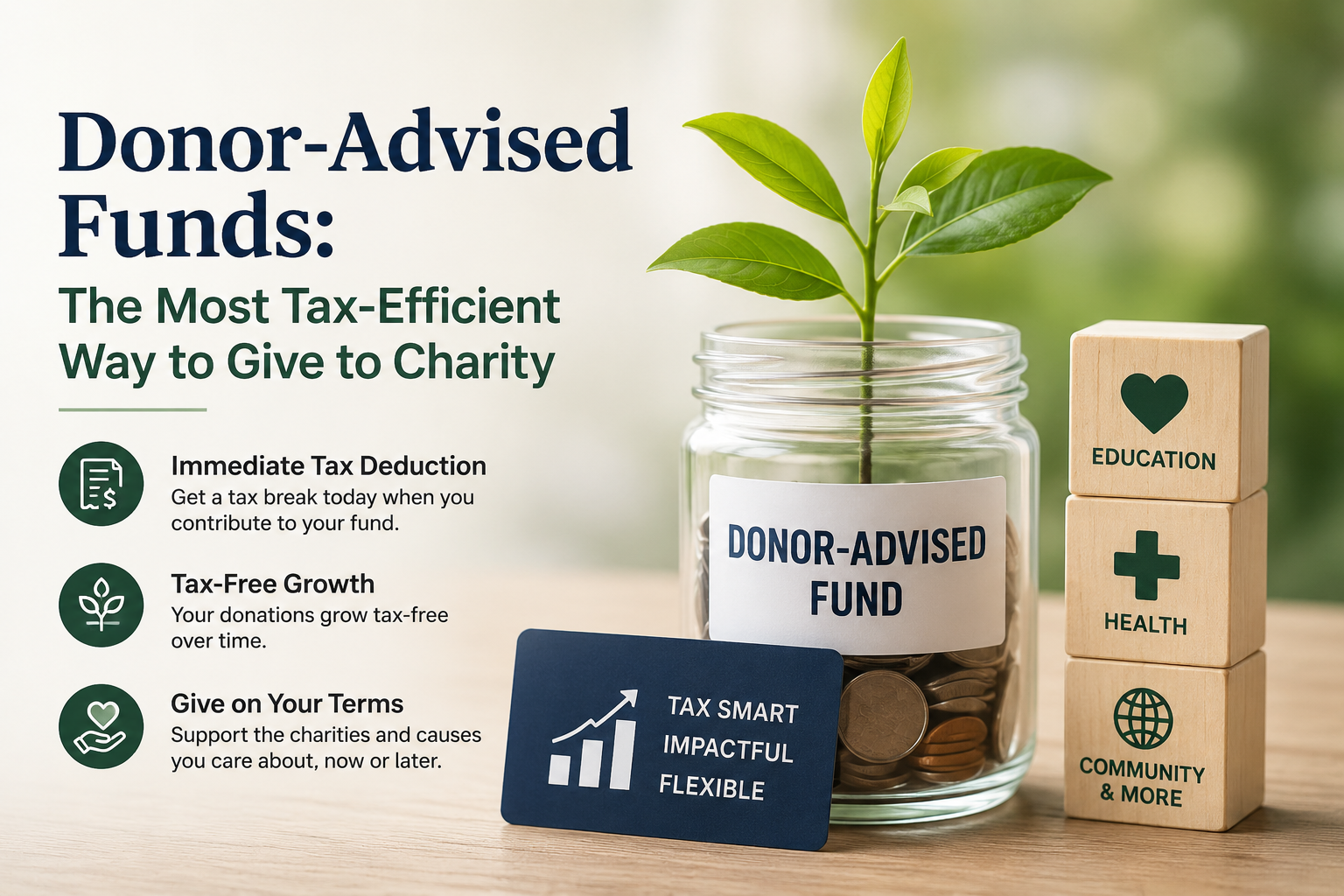
Most people give to charity from their checking account. They write a check, they claim a deduction if they itemize, and they move on. It works, but it leaves money on the table. A donor-advised fund, often shortened to DAF, changes the math. It lets you give the same amount you always planned to give while keeping more of your wealth working toward the causes you care about and less of it heading to the IRS.
A DAF is a charitable investment account. You contribute cash, stock, or other assets, you take the tax deduction in the year you contribute, and then you recommend grants to your favorite charities on whatever timeline suits you. The charity still gets the gift. You simply gain control over the timing and the tax treatment. Here is why that control matters so much.
Donate Appreciated Assets and Skip the Capital Gains Tax
The single biggest advantage of a DAF comes from what you fund it with. When you donate appreciated stock, real estate, or other long-term assets directly, you avoid the capital gains tax you would owe if you sold them first. The charity receives the full value, and you still deduct the full fair market value.
Picture a stock position worth $50,000 that you bought years ago for $10,000. If you sell it to free up cash, you trigger tax on the $40,000 gain. At the top long-term rate of 23.8 percent, that costs you $9,520, and most people round up once state tax enters the picture. Donate the shares straight to your DAF instead, and the entire $50,000 goes to work for charity.
You deduct the full market value, the fund sells the shares without owing tax because it is a charity, and every dollar stays in the charitable pool. This advantage alone often makes the DAF worth opening.
Bunch Several Years of Giving Into One
The 2017 tax law nearly doubled the standard deduction, and that quietly erased the tax benefit of charitable giving for millions of households. If your itemized deductions fall below the standard deduction, your gifts deliver no extra tax savings at all. A DAF solves this through a strategy called bunching.
Instead of giving a steady amount every year and never clearing the standard deduction, you combine several years of planned giving into one large contribution. That single year you itemize and capture a substantial deduction. In the following years you take the standard deduction and recommend grants from the fund you already filled. Your charities receive the same steady support while your tax savings jump.
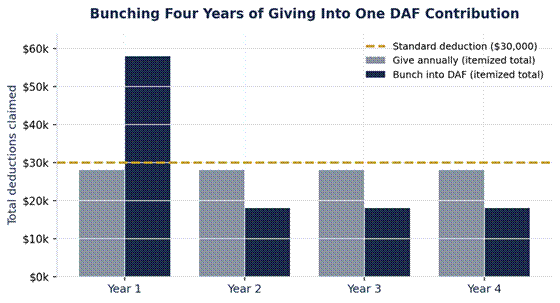
Bunching four years of gifts into one DAF contribution clears the standard deduction and unlocks the itemized benefit.
The chart above shows a household that gives $10,000 a year. Spread out, that giving never beats the standard deduction. Bunched into a single $40,000 DAF contribution, it sails past the threshold and produces real tax savings, all while the family keeps granting $10,000 a year to the same organizations.
For a look at how this plays out for a specific community, see how Westlake families approach charitable giving and tax savings.
Let Your Charitable Dollars Grow Tax-Free
Once your money sits inside the fund, you invest it. Any growth happens tax-free because the assets already belong to charity. That means the gift you make today can fund larger grants tomorrow, and you never owe a dime on the gains.
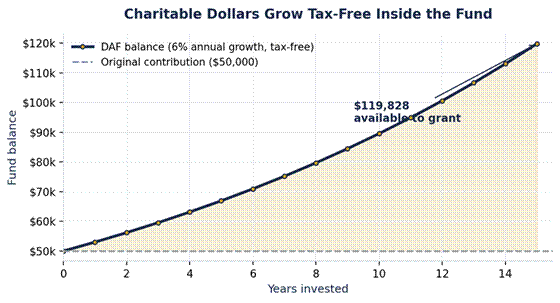
A $50,000 contribution invested at 6 percent grows to roughly $120,000 over fifteen years, with no tax on the gains.
A $50,000 contribution invested at a 6 percent annual return grows to roughly $120,000 over fifteen years. That entire balance remains available to grant. You gave once, claimed the deduction once, and more than doubled the impact without writing another check.
Three More Reasons to Like the Structure
Simpler Recordkeeping
You receive one tax receipt for your contribution to the fund, no matter how many charities you eventually support. That replaces a shoebox of acknowledgment letters with a single document.
Flexible Timing
You can fund the account in a high-income year, perhaps when you sell a business or exercise stock options, and then take your time deciding where the money goes. The deduction lands when you need it; the giving unfolds on your schedule.
A Lasting Family Legacy
You can name successors to your fund and involve your children in grant decisions, turning generosity into a shared family practice that continues across generations.
Is a Donor-Advised Fund Right for You?
DAFs suit people who give meaningful amounts, who hold appreciated assets, or who want to separate the timing of their tax deduction from the timing of their gifts. They cost little to open and even less to maintain. Keep in mind that contributions are irrevocable, so the money must go to charity, and you recommend grants rather than direct them outright, though sponsors approve qualified requests as a matter of course.
If you give regularly and want every dollar to count, a donor-advised fund deserves a serious look. The strategy pairs especially well with a year when your income spikes or when you hold a concentrated stock position you would rather not sell outright.
If you are weighing a donor-advised fund, or you have a high-income year coming, schedule a 15-minute intro call and we can model what it saves you.