

The policy you bought for the kids did its job. You probably bought term coverage in your thirties so a mortgage and two tuition bills would never land on one income. Now the kids have jobs, the mortgage balance shrinks every month, and the premium notice looks like a bill you can stop paying. For many families that conclusion holds up. For others, the biggest risk still sits a few years ahead, when retirement income starts to depend on two people staying alive.
Doing nothing is a decision too. A term policy that runs out at 65 or 70 ends your coverage on its own schedule, not yours. Most term contracts let you convert to permanent coverage without a new medical exam, but only before a deadline written into the policy. Miss that date and you may face fresh underwriting at an age and health that make coverage costly or unavailable. Review the policy while you still hold every option.
What changes after 60
The question shifts from replacing a paycheck to protecting a plan. At 40, life insurance covers the years of earnings your family would lose. At 60, most of those earning years sit behind you, and your savings do more of the work. Coverage now answers narrower questions. Will the survivor keep enough income? Who pays the debts and the taxes? Does the estate hold enough cash to settle cleanly? The federal estate tax reaches only estates above $15 million per person in 2026, and Texas levies no estate or inheritance tax, so estate tax rarely drives the decision. Income, debt, and fairness among heirs usually do.
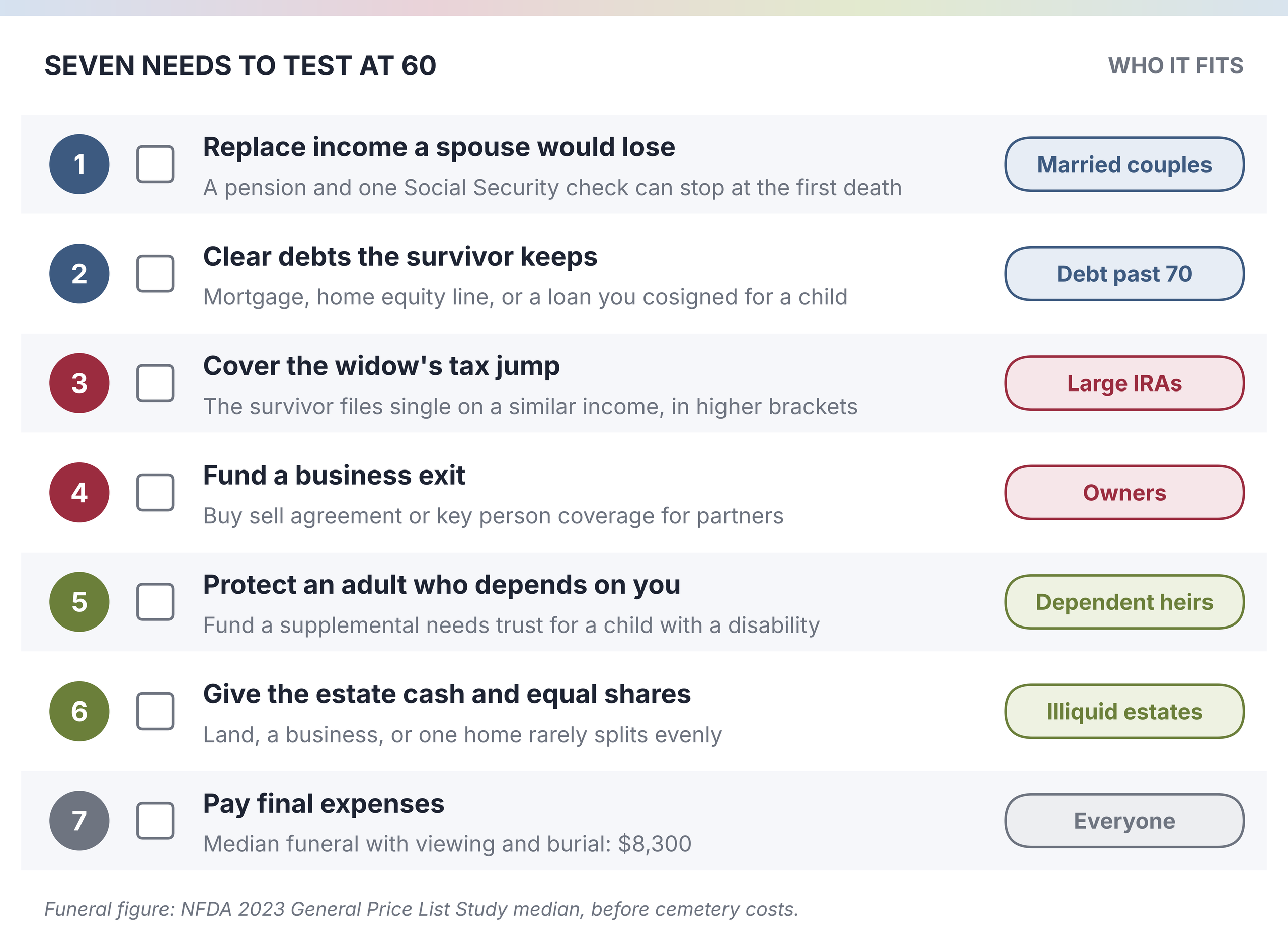
Seven needs to test
Walk through the list below with your spouse. Each need that fits your family earns a check mark. A need that does not fit lets you drop that slice of coverage with confidence.
The survivor income gap
Consider Rick and Donna. Rick draws a $4,000 monthly pension on a single life basis plus $3,400 from Social Security. Donna collects $1,900 from her own record. Together they bring in $9,300 a month against $8,500 of spending. If Rick dies first, Donna keeps his $3,400 check as her survivor benefit and loses everything else. Her spending falls to about $7,000, but her income falls to $3,400.
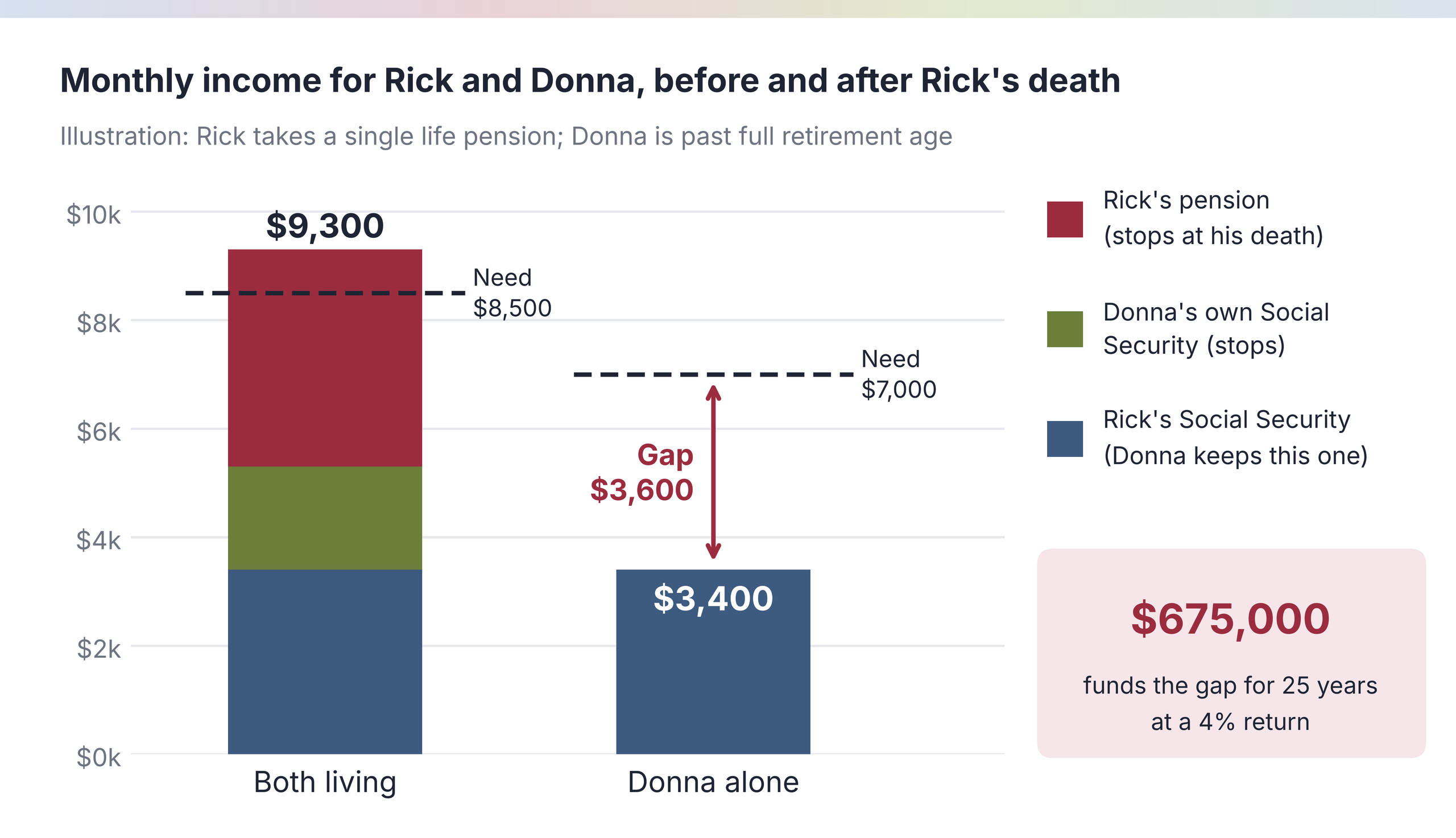
Social Security pays a widow one check, not two. When one spouse dies, the survivor keeps the larger of the two benefits and loses the smaller one. The Social Security Administration puts it plainly: when you qualify for a survivor benefit and another benefit, “the payments won’t be added together.” A pension paid as a single life annuity stops entirely.
A $3,600 monthly gap takes about $675,000 to fill. That figure assumes the money earns 4% and pays out over 25 years. Rick and Donna can close the gap three ways: their own portfolio, a joint and survivor pension election, or a life insurance policy on Rick. In our illustration, the 100% joint and survivor option cuts Rick’s pension to about $3,433 a month for life. That costs the couple roughly $6,800 a year whether or not Donna ever needs the protection. A policy that costs less and lasts as long as Donna would need the income can leave them ahead. The trade works only when Rick qualifies for coverage at a fair price, so price the policy before he signs the pension election.
Debts, taxes, and the estate
Debt follows the survivor. Many couples carry a mortgage into their seventies, and some cosigned a car or student loan for a grown child. A policy sized to the remaining balance lets the survivor keep the house without stretching the budget.
The tax bill can climb even when income does not. Starting the year after a spouse dies, the survivor usually files as a single taxpayer, and single brackets fill at roughly half the income of joint brackets. Required distributions from a large IRA then push the survivor into higher brackets on nearly the same income. Children who inherit a traditional IRA face their own squeeze: most must empty the account within ten years and pay ordinary income tax as they go. Life insurance proceeds generally arrive free of income tax, so a policy can offset either bill.
Some estates hold value nobody can split. A family ranch, a business, or a lake house rarely divides evenly among three children. A policy can pay the child who does not take the business, cover settlement costs, or keep heirs from selling land in a weak market. Business owners should also confirm that the buy sell agreement names its funding source. A partner without cash to buy your share leaves your family holding an interest it cannot sell.
An adult child who depends on you changes the math. If a son or daughter with a disability will need support for life, a policy payable to a supplemental needs trust can provide for them without costing them Medicaid or Supplemental Security Income. Have your attorney draft the trust first, then name the trust as beneficiary.
Final expenses belong on every list, even a short one. The National Funeral Directors Association reported a 2023 median of $8,300 for a funeral with viewing and burial and $6,280 for a funeral with cremation, before cemetery costs. Most families cover that from savings. Make sure the survivor can reach the money quickly.
What to do with the policy you own
When the needs above fall away, you still hold a contract with value. You have four main choices, and each one carries its own tax treatment.
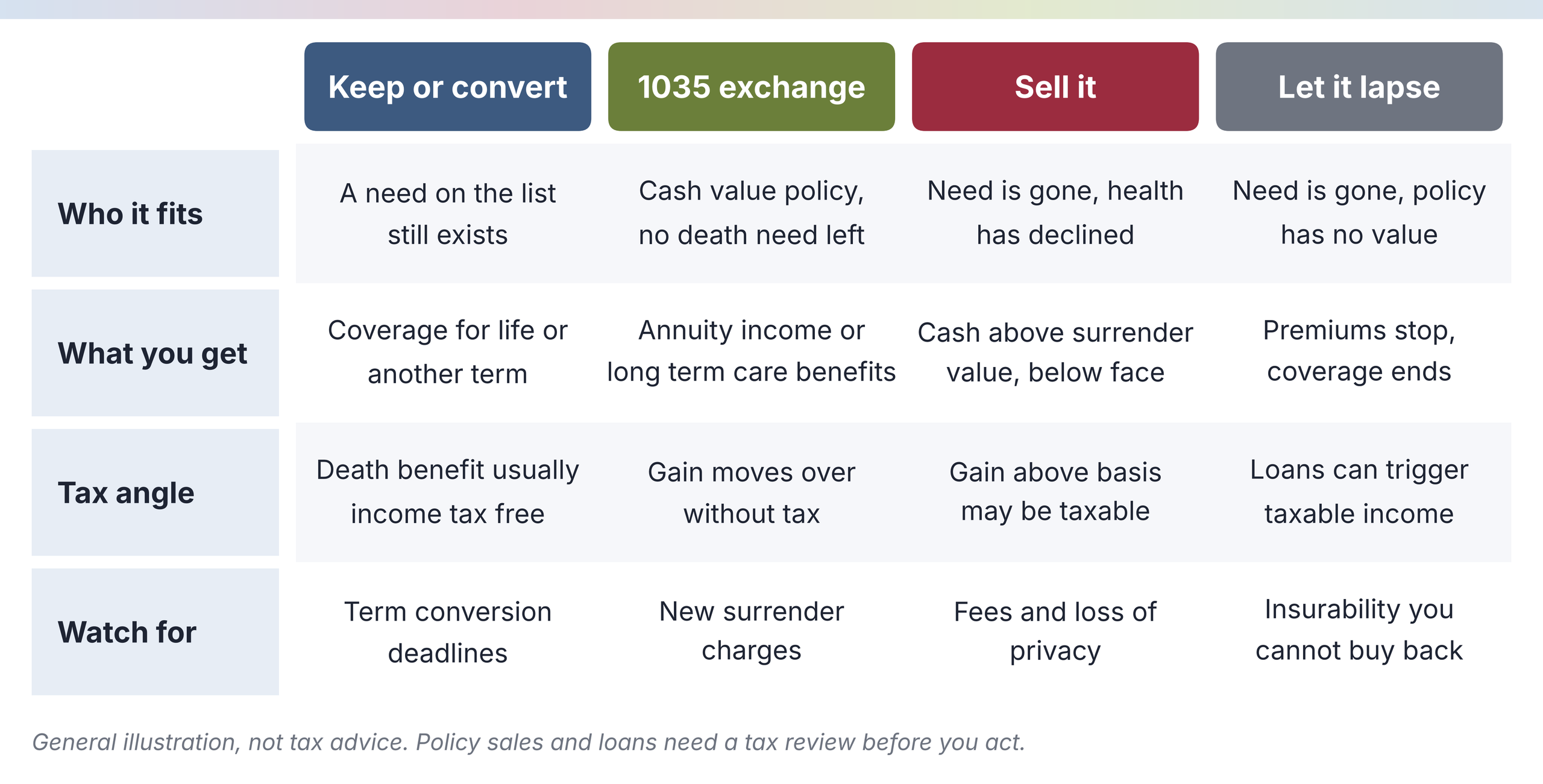
Selling a policy surprises many owners. In a life settlement, an investor buys your policy for more than its cash surrender value, takes over the premiums, and collects the death benefit later. Older owners and owners whose health has changed tend to receive the strongest offers. The Texas Department of Insurance licenses and regulates life settlement providers in this state. Compare at least two offers, ask what the broker earns, and run the tax math before you sign.
A 1035 exchange keeps the gain sheltered. Section 1035 of the tax code lets you move a policy’s cash value into an annuity or a long term care contract without paying tax on the gain. That route suits an owner who no longer needs a death benefit but wants income or care coverage instead.
Three households show how the answer differs. Rick and Donna keep a policy on Rick because his pension ends at his death. Maria, a widow with $1.2 million in savings and no debt, lets her term policy lapse, since her portfolio already covers every need on the list. Tom and Ellen own a cash value policy they bought in their forties and no longer need, so they exchange it into a long term care contract and put the value toward future care costs.
Find the deadline before you decide
Pull every policy you own this month. Note each conversion deadline and premium schedule, and ask the insurer for an in force illustration that shows how the policy performs from here. Bring those pages and your pension election options to your next planning meeting. Coverage is easiest to keep, convert, or sell while you are healthy, and it gets harder every year after.
This article offers general education and does not provide tax or legal advice. Figures for Rick and Donna are an illustration, not a quote from any plan or insurer.