
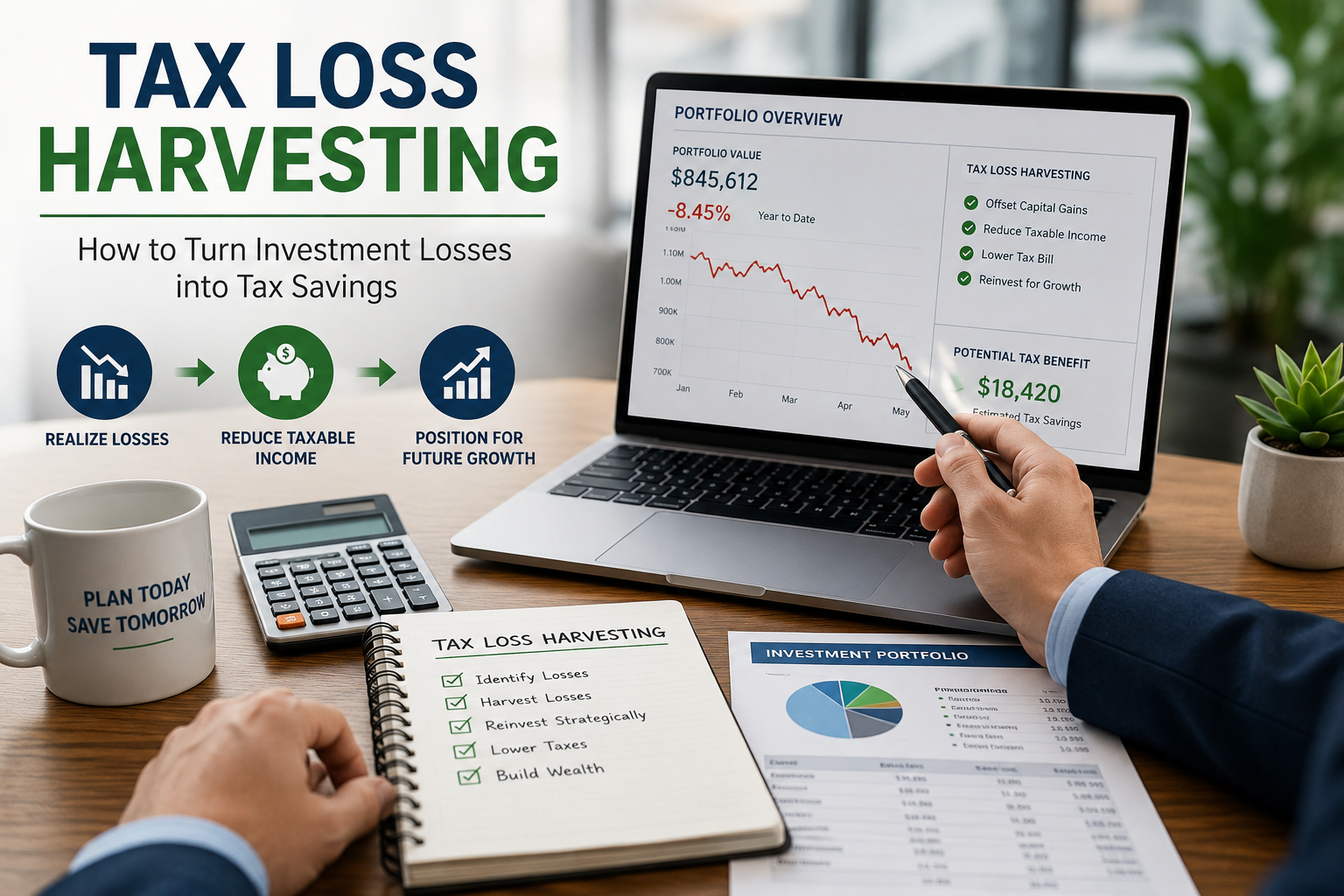
Market volatility is rarely welcome, but for disciplined investors it does present an opportunity that is too often overlooked. Tax loss harvesting—the deliberate practice of realizing investment losses to offset taxable gains—can meaningfully improve after-tax returns without altering the long-term direction of a portfolio. For high-net-worth households, where capital gains exposure and marginal tax rates are typically higher, the cumulative impact over time can be substantial.
This article outlines how tax loss harvesting works, the rules that govern it, and the strategic considerations that distinguish a routine tax exercise from a thoughtful component of wealth planning.
The Core Mechanics
At its simplest, tax loss harvesting involves selling a security that has declined in value, realizing the capital loss, and using that loss to offset capital gains elsewhere in the portfolio. The Internal Revenue Code allows realized losses to offset realized gains on a dollar-for-dollar basis, first within the same category (short-term losses against short-term gains, long-term against long-term) and then across categories.
When realized losses exceed realized gains in a given tax year, up to $3,000 of the excess loss may be deducted against ordinary income. Any remaining loss is carried forward indefinitely and can be applied against gains in future years. For an investor in the highest federal bracket—where long-term capital gains can be taxed at 23.8% after the Net Investment Income Tax, and short-term gains and ordinary income can exceed 37% federally—each harvested dollar of loss carries real, quantifiable value.
The key insight is that loss harvesting does not require exiting the market. After selling the depreciated security, the proceeds are typically reinvested in a similar but not “substantially identical” position, preserving the investor’s market exposure and long-term thesis while capturing the tax benefit.
The Wash-Sale Rule
The single most important constraint is the wash-sale rule. Under IRS Section 1091, if an investor sells a security at a loss and purchases the same or a “substantially identical” security within 30 days before or after the sale, the loss is disallowed for current-year tax purposes. The disallowed loss is added to the cost basis of the replacement security, effectively deferring rather than eliminating the benefit.
The 30-day window applies in both directions, creating a 61-day period that must be navigated carefully. The rule also extends to purchases made in related accounts, including a spouse’s accounts and IRAs. A common and costly mistake is harvesting a loss in a taxable account while a dividend reinvestment plan in an IRA quietly triggers a wash sale.
“Substantially identical” is not precisely defined in the tax code, which is why practitioners typically reinvest proceeds into a security tracking a different index or holding a meaningfully different basket of underlying assets. Two S&P 500 ETFs from different sponsors are generally considered substantially identical; an S&P 500 ETF and a total U.S. market ETF generally are not, though this remains an area of professional judgment.
A client example. Consider an investor who sells $500,000 of a large-cap U.S. equity ETF on November 15 at a $75,000 loss, intending to use the loss against a sizable gain from a business sale earlier in the year. Two weeks later, on November 30, a dividend reinvestment program in her spouse’s IRA quietly purchases shares of the same ETF. The wash-sale rule is triggered. Because the replacement shares sit inside an IRA, current IRS guidance (Rev. Rul. 2008-5) treats the disallowed loss as permanently lost—it is not added to the IRA basis the way it would be in a taxable account. A $75,000 deduction, worth roughly $17,850 at the 23.8% long-term capital gains rate, evaporates because of a routine dividend reinvestment no one thought to coordinate. Cases like this are surprisingly common in households with multiple advisors, custodians, and automated reinvestment settings.
Strategic Considerations for High-Net-Worth Investors
For wealthier households, tax loss harvesting is most powerful when integrated into a broader planning framework rather than executed as a year-end reflex.
Harvest opportunistically, not seasonally. Most investors think of loss harvesting as a December exercise. In practice, the most valuable opportunities tend to appear during intra-year drawdowns, when individual positions or sectors decline sharply even if the broader market is flat or higher. Monitoring portfolios on a continuous basis—monthly, or in some cases daily through systematic platforms—captures losses that may have recovered by year-end.
Prioritize short-term losses. Because short-term gains are taxed at ordinary income rates, short-term losses are more valuable when they offset those gains. Sequencing matters: harvesting short-term losses first preserves long-term losses for offsetting long-term gains or future use.
Consider direct indexing. A diversified ETF often moves as a single position, limiting harvesting opportunities even when underlying holdings have declined. Direct indexing—holding the individual constituents of an index in a separately managed account—provides far more granular harvesting potential. Even in years when the index itself finishes higher, a meaningful share of its components will have traded at a loss at some point, generating harvestable activity.
Mind the asset location. Loss harvesting is only valuable in taxable accounts. Losses generated inside IRAs, 401(k)s, and similar vehicles have no tax effect. Concentrating tax-inefficient assets in tax-advantaged accounts—and tax-efficient, harvestable assets in taxable accounts—amplifies the strategy’s benefit.
Coordinate with concentrated positions and liquidity events. Investors anticipating a significant taxable event—the sale of a business, exercise of equity compensation, or rebalancing of a concentrated stock position—can use accumulated carryforward losses to absorb a meaningful portion of the resulting gain. Building a “loss bank” in the years preceding a known liquidity event is one of the most underappreciated planning techniques available.
A client example. Consider a Caterpillar executive holding 4,000 shares of CAT accumulated over more than a decade through restricted stock vesting and non-qualified stock options, with an average cost basis near $250 per share. Following a strong quarterly earnings release, CAT hits a new all-time high of $930 per share, and the post-earnings Section 16 trading window opens for a narrow ten-business-day period. The position now represents close to 30% of the executive’s liquid net worth, the price spike is an unusually favorable diversification opportunity, and the window will close before any other meaningful catalyst. Selling 2,000 shares to begin diversifying would generate roughly $1.36 million in long-term capital gains—approximately $324,000 in federal tax at the 23.8% rate before state tax. Because we had been opportunistically harvesting losses across his broader portfolio for several years, primarily through a direct-indexed core equity allocation, he entered the window with roughly $300,000 of accumulated carryforward losses. Applied against the CAT sale, those losses absorbed about 22% of the realized gain and reduced the federal tax bill by roughly $72,000—while allowing him to act decisively inside the narrow window his insider trading obligations permitted. Without the pre-built loss bank, the practical choices would have been to sell fewer shares, pay full tax, or wait for a window that might never reopen at a comparable price.
Common Pitfalls
Several mistakes can erode or eliminate the benefit of an otherwise sound strategy. Harvesting losses against gains that would have been taxed at zero percent (for example, by clients in lower brackets in a particular year) wastes the opportunity. Failing to coordinate across spousal and household accounts can trigger inadvertent wash sales. Reinvesting too aggressively into a replacement security that is later judged substantially identical creates audit risk. And in highly appreciated long-term portfolios, harvesting losses lowers cost basis on the replacement security, which simply defers tax to a future sale—worthwhile if rates are stable or declining, less so if the investor expects rates to rise.
A particularly important pitfall for high-net-worth investors involves the interaction between loss harvesting and the step-up in basis at death. Highly appreciated positions held in a taxable account receive a basis adjustment to fair market value when passed to heirs, effectively erasing the embedded capital gain. Aggressively harvesting losses on positions that are likely to be held until death can be counterproductive, because the strategy lowers the cost basis on the replacement security and pulls forward a tax benefit that the estate would have received automatically. For families using a buy-and-hold approach within a broader estate plan, the harvesting calculus is more nuanced than for investors who expect to liquidate during their lifetime—and the analysis should be revisited as net worth, age, and estate strategy evolve.
It is also worth remembering that loss harvesting is a tax strategy, not an investment strategy. The decision to sell should always be filtered through the underlying investment thesis. Realizing a loss on a position you would have sold anyway is pure benefit. Realizing a loss simply because the tax savings appear attractive can lead to portfolios drifting away from their intended allocation.
The Bottom Line
Tax loss harvesting is one of the most reliable, repeatable tools available for improving after-tax returns. Executed well, it can add the equivalent of 50 to 100 basis points or more of annual after-tax return for high-net-worth investors over time—a meaningful tailwind compounded over decades.
The strategy rewards consistency, careful coordination across accounts, and integration with broader tax and estate planning. We work with clients to monitor harvesting opportunities throughout the year, coordinate with CPAs and estate attorneys, and ensure that every realized loss is captured efficiently and put to its highest use. If you would like to review whether your current portfolio is being managed with these opportunities in mind, we welcome the conversation.
This article is for informational purposes only and does not constitute tax, legal, or investment advice. Please consult your tax professional regarding your specific circumstances.