
If your financial plan starts with “max your 401(k),” you probably don’t have a business owner plan.
You have an employee plan.
And that’s the problem.
There are more employees than business owners. So most financial advice is built around steady paychecks, predictable taxes, and simple retirement structures.
Then that same advice gets handed to entrepreneurs.
It doesn’t work.
Because as a business owner, you don’t just have a job.
You have:
- Payroll every two weeks
- Revenue that fluctuates
- Taxes that surprise you
- Clients who can leave
- Multiple entities
- A business that may or may not be sellable
- And a family depending on you
That is a completely different planning environment.
I recently spoke with a business owner who had met with nearly ten financial advisors over the past decade. Every time, he walked away feeling like they didn’t understand him.
They were talking about asset allocation.
He was thinking about:
- What happens if I get hit by a bus?
- What is this business actually worth?
- How do I move money between the business and my personal life?
- Am I even on track?
That disconnect is real.
Comprehensive financial planning for business owners requires a specialized framework that integrates personal and business wealth.
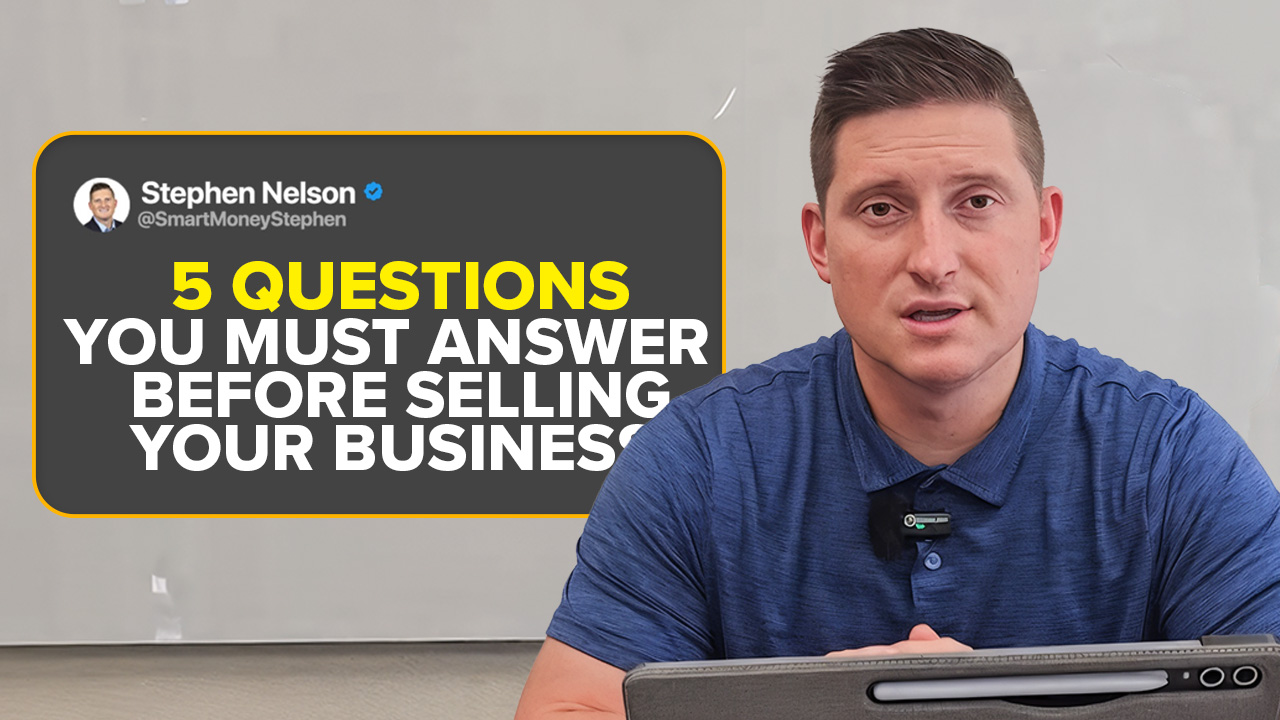
Here are the five questions every serious business owner needs to be able to answer.
The 5 Core Financial Planning Questions for Business Owners:
Valuation: Do you know your business’s value gap and profit gap?If you can answer these clearly, you’ll create clarity, confidence, and connection across everything you own.
Exit Strategy: What does your ideal future look like after leaving the business?
Entity Goals: What is the specific financial and growth goal for each business entity?
Succession Planning: Do you have a documented succession plan if you pass away or become disabled?
Wealth Integration: Are you effectively balancing personal liquidity with business working capital?
1. What Does Your Ideal Future Post-Exit Look Like?
Most business owners have never written this down.
They say:
- “I’ll probably never retire.”
- “I’ll slow down eventually.”
- “I’ll sell when I’m ready.”
That’s not a plan.
Your ideal future determines everything else.
Do you want to:
- Sell everything and never work again?
- Keep one business and drop the rest?
- Move into chairman or board-level involvement?
- Pass the business to your kids?
- Build aggressively to sell in five years?
I worked with a business owner who owned six companies. Out of those six, only one was his passion project. The rest were engines.
That one detail completely changed his plan.
He wasn’t planning for retirement. He was planning for reduction and focus.
You cannot build a strategy until you define the destination.
Action: Write down:
- The age you want optionality
- What your week looks like
- The income you want
- Whether you want to work at all
Clarity here drives everything else.
2. What Is the Financial Goal for Each Business Entity?
Most business owners treat all their entities the same.
They are not the same.
For each business, property, or investment, answer:
- Is this something I want to sell to the highest bidder?
- Is this something I want to pass down?
- Is this a lifestyle asset?
- Is this a growth vehicle?
- Is this something I’ll shut down?
Without clarity, you waste years optimizing something you don’t even want long term.
Create a simple entity map:
- Purpose
- Timeline
- Exit strategy
- Key risk
- Owner dependence level
Now your business owner financial planning becomes intentional instead of reactive, allowing for better tax optimization and asset protection.
3. Do You Have a Documented Business Succession Plan?
This is uncomfortable.
It’s also mandatory.
If an employee dies, the company continues.
If you die and you are the company, what happens?
For each business, ask:
- Does it run without me?
- Is there a successor identified, such as a plan to sell your business to a key employee?
- Is there something in writing?
- Is there funding to execute the transition?
A business succession plan is not just about “who” takes over. It is a vital risk management strategy that details “how.”
How does your spouse get paid?
How does the company stabilize?
How is leadership transitioned?
How is equity transferred?
If you don’t have something documented, you don’t have a succession plan.
You have hope.
Hope is not strategy.
3a. How Does Disability Impact Your Business Operations?
Most business owners dismiss this.
They say:
“I’d still show up.”
“I’d push through.”
That’s not always realistic.
If you are the rainmaker and revenue stops, what happens?
If you are the operator and systems depend on you, what happens?
Ask yourself:
- What are the 3–5 roles I personally perform?
- Who covers those for 90 days?
- Does revenue survive without me?
If the answer is no, you have concentration risk.
This is where leadership depth, systems, and sometimes disability planning matter.
Fragility lowers valuation and increases stress.
Resilience increases both value and peace of mind.
4. Are You Integrating Personal and Business Financial Planning?
You have:
- Personal finances
- Business finances
Most business owners over-focus on one and neglect the other.
Common patterns:
- Obsess over growth, ignore personal liquidity.
- Hoard cash in the business, never diversify.
- Pull too much out, starve working capital.
You need structure.
A disciplined framework:
- Determine true working capital.
- Pay yourself a consistent salary.
- Take quarterly distributions above working capital.
Example:
- Business cash: $100,000
- Required working capital: $50,000
- Quarterly distribution: $50,000
Now you operate with discipline instead of emotion.
On the personal side:
- Know what you spend.
- Build liquidity.
- Invest outside the business.
If your entire net worth is your company, you do not have diversification.
You have exposure.
5. Do You Know Your Business Valuation Gap and Profit Gap?
This is where business-owner planning separates from employee planning.
The Value Gap
Value Gap =
What you need to be work-optional
minus
What your business would realistically sell for
Example:
- Needed to retire: $7 million
- Realistic sale value: $5 million
- Value gap: $2 million
That means you need $2 million outside the business.
Most business owners overestimate what their company is worth when conducting a business valuation.
Buyers care about:
- Clean accounting
- Transferable systems
- Reduced owner dependence
- Predictable profitability
- Leadership depth
Not your emotional attachment.
Be realistic.
The Profit Gap
The profit gap is the improvement opportunity inside your business.
It is the gap between where you are today and where you could be with:
- Better systems
- Stronger profitability
- Reduced owner reliance
- Cleaner operations
Increasing profit and improving structure can raise your multiple.
A $5 million business can become a $6–7 million business through optimization.
That directly reduces your value gap.
Professional exit planning and personal wealth management must work together to ensure you don’t leave money on the table.
The Real Goal: Clarity, Confidence, Connection
When this is done correctly:
Clarity
You know what you own, what it’s worth, and what you need.
Confidence
You know what happens if life hits you — death, disability, downturn.
Connection
Your personal and business finances work together instead of competing.
You stop guessing.
You stop assuming the business will “just work out.”
You operate with intent.
What This Means for You
If you can clearly answer those five questions, you are ahead of most business owners.
If you can’t, that’s not a weakness.
That’s your opportunity.
Most entrepreneurs don’t need more products.
They need integration.
They need structure.
They need someone who understands both the business and personal side — and how they connect.
That’s what we do.
At Mills Wealth, we help business owners:
- Clarify what their business is actually worth
- Identify their value gap and profit gap
- Build disciplined working capital and distribution strategies
- Create real succession plans
- Reduce owner dependence
- Connect business and personal planning into one system
If you want to build clarity, confidence, and connection across everything you own, let’s have a conversation.
No pressure. No generic pitch.
Just a strategic discussion about where you are and where you want to go.
Frequently Asked Questions: Financial Planning for Business Owners
Is my business my retirement plan?
It can be part of it. It should not be all of it.
If 80–100% of your net worth is tied to your business, your future depends on one event: a successful sale at the right time.
That is concentration risk.
Building liquidity outside the business creates optionality.
How much working capital should I keep?
There is no universal number, but you should know:
- Monthly fixed expenses
- Payroll obligations
- Revenue variability
- Debt service
A common starting point is 3–6 months of core operating expenses.
Working capital should be calculated, not emotional.
What determines my valuation multiple?
Multiples increase when businesses are:
- Less reliant on the owner
- Systematized
- Cleanly accounted for
- Predictable
- Led by more than one key person
If your company depends entirely on you, your multiple will reflect that.
Do I need a succession plan if I’m not planning to retire?
Yes.
Succession planning protects against death, disability, and unexpected events.
It protects your family and your employees.
It is risk management, not retirement planning.
What if I never want to sell?
That’s fine.
But you still need:
- Liquidity
- Diversification
- A contingency plan
- A strategy for optionality
Planning is about freedom.
Even if you choose to work forever, you want the ability not to.
If you found this helpful, share it with another business owner.
Most entrepreneurs are building without a coordinated plan.
Clarity compounds.