“When should I take Social Security?” is one of the most common questions we hear from clients in Southlake and across the DFW area. It’s also one of the easiest to oversimplify. Search online and you’ll find dozens of break-even calculators that spit out a single age and call it
You packed the house, found a new doctor and registered the car. The folder holding your will and powers of attorney probably came along in a box, signed years ago under another state’s law. Texas will usually honor those papers. The harder question is whether they will work quickly for
If you own a successful business and start talking with potential buyers, you may assume the biggest negotiation will center on price. Often, it is not. Two deals with the exact same headline purchase price can leave a seller with dramatically different after-tax proceeds depending on how the transaction gets
Most owner-operated businesses choose a retirement plan exactly once. It was just you on payroll, someone reasonably told you a SEP IRA or a Solo 401(k) was the simple answer, and they were right. Then you hired a second person, and a third. The plan is still doing exactly what
Employees at Dallas-Fort Worth’s biggest employers, including Caterpillar, Toyota Motor North America, Charles Schwab, Lockheed Martin, and Texas Instruments, often find that their compensation letter comes with an acronym or two that salary alone never had. RSU. NSO. ISO. ESPP. Four sets of letters, four different tax rulebooks, and one
If you have children under 18, you now have three tax-advantaged places to put money for them, and one of them didn’t exist a year ago. Trump Accounts opened for business on July 4, 2026. For children born between 2025 and 2028, the Treasury will put $1,000 into one —
For years, grandparents were often told to be careful about using a 529 plan to pay for a grandchild’s college education. The problem was not the 529 itself; it was how the FAFSA treated distributions from a grandparent-owned account. Under the old FAFSA rules, a grandparent could save diligently for
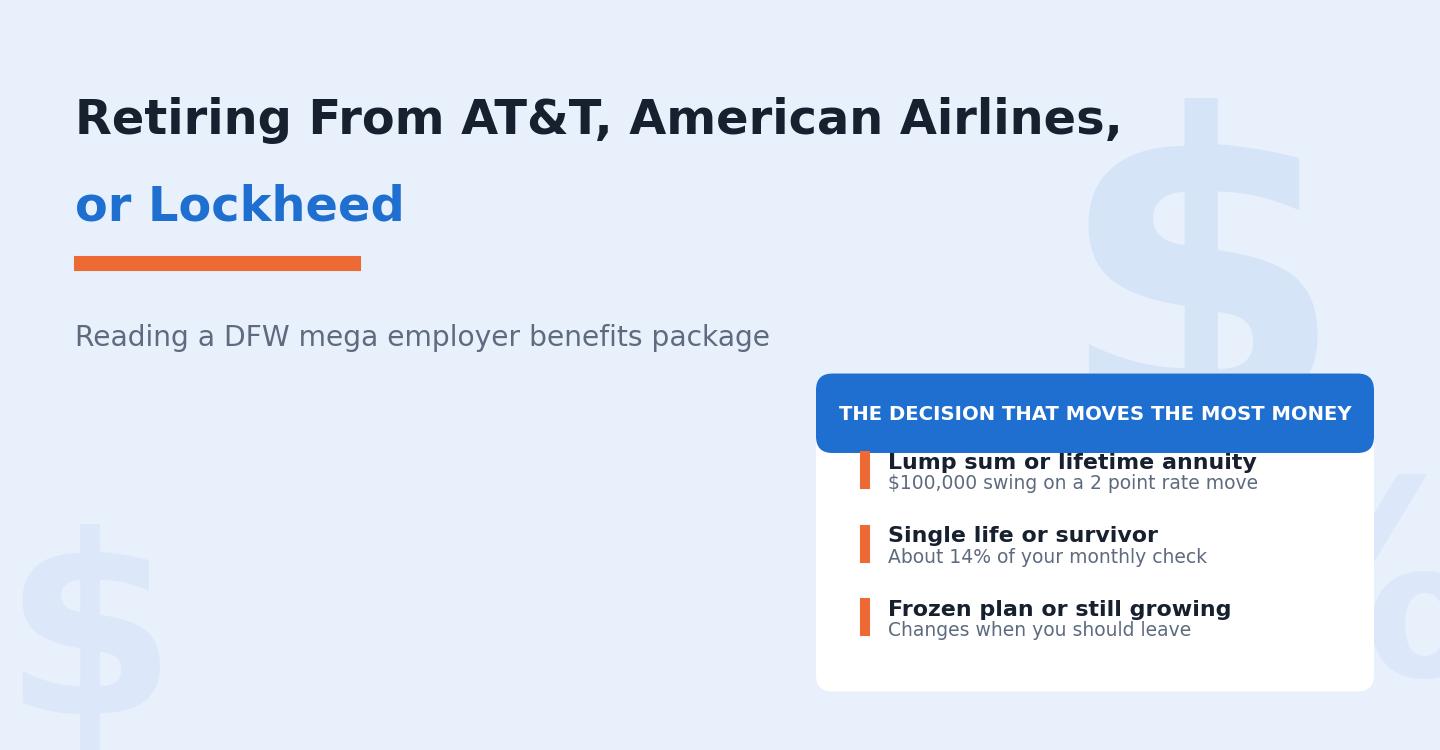
You spend thirty years earning a pension and about six weeks deciding what to do with it. The packet lands, it names a deadline, and it buries the one number that changes your retirement by six figures. Here is how to read it. Name the plan you actually have Confirm
Health Savings Accounts can be incredibly valuable, especially for people who have spent years building a balance and are approaching retirement. But the rules around an HSA and Medicare create one particular trap that catches people off guard. It often affects successful business owners and executives who keep working past
Real estate can be one of the most effective ways for business owners and investors to build long-term wealth. You can collect income, benefit from appreciation, use leverage, and deduct depreciation along the way. The problem often shows up when it is time to sell. An investor may look at