

A direct-indexing proposal usually arrives with an impressive number attached. “We harvested 5% in losses last year.” “This strategy can add 1% to 2% in after-tax return.” For a seven-figure taxable account, that is hard to ignore.
But a harvested loss is not a return, and a tax deduction today is not always a tax saved forever. So when clients ask us “is direct indexing worth it,” we reframe the question: after the extra fees, the fading harvest, and the taxes you may owe on the way out, will you end up with more money than you would in a low-cost index ETF?
For some investors, the answer is clearly yes. For many others, the math is a lot closer than the pitch suggests.
How Direct Indexing Works (and Why It Sounds So Good)
Instead of buying one fund that tracks an index, you own a few hundred of the individual stocks in a separately managed account, chosen so the portfolio behaves like the index.
That matters because an ETF cannot pass its internal losses through to you. When you own the stocks directly and one falls below what you paid, it can be sold to capture the loss and replaced with a similar stock to keep the portfolio on track. And there are always losers, even in great years.
Those losses offset capital gains first, then up to $3,000 of ordinary income per year, with any excess carried forward to future years. On paper, it is a compelling story.
Four Numbers That Often Get Blurred Together
When we review a direct-indexing proposal, we pull apart four ideas that marketing materials tend to blend:
- Harvested losses: the paper losses realized. This is not money in your pocket.
- Tax savings: the losses multiplied by the tax rate on whatever they offset.
- Deferral versus elimination: harvesting lowers your cost basis, so much of that tax can come back when you sell.
- Change in after-tax wealth: what is left after every fee and every tax. This is the only number that ultimately matters.
The third point is the one most often glossed over. If your tax rate stays the same and you eventually sell, harvesting mostly just pushes the tax bill down the road. Think of it as an interest-free loan from the IRS: useful, but not free money. The savings only become permanent when losses offset income taxed at a higher rate than you will pay later, or when the shares are donated or left to heirs.
The Math: Does the Tax Benefit Outrun the Fee?
A fair comparison is not direct indexing versus a clunky, tax-inefficient mutual fund. It is direct indexing versus a low-cost, broad-market ETF, which is already quite tax efficient on its own. Direct-indexing fees typically run 0.30% to 0.40%, compared with about 0.20% on average for ETFs and mutual funds (Schwab, 2025), and retail direct-indexing services have been measured at roughly 0.35% more per year than the cheapest ETFs (Morningstar, 2023).
Let’s put that in dollars. Picture a hypothetical $1 million taxable account paying 0.30% more per year than an ETF, or $30,000 over 10 years. Assume the strategy harvests $150,000 of losses over that decade, most of it early.
Figure 1. The Break-Even Math
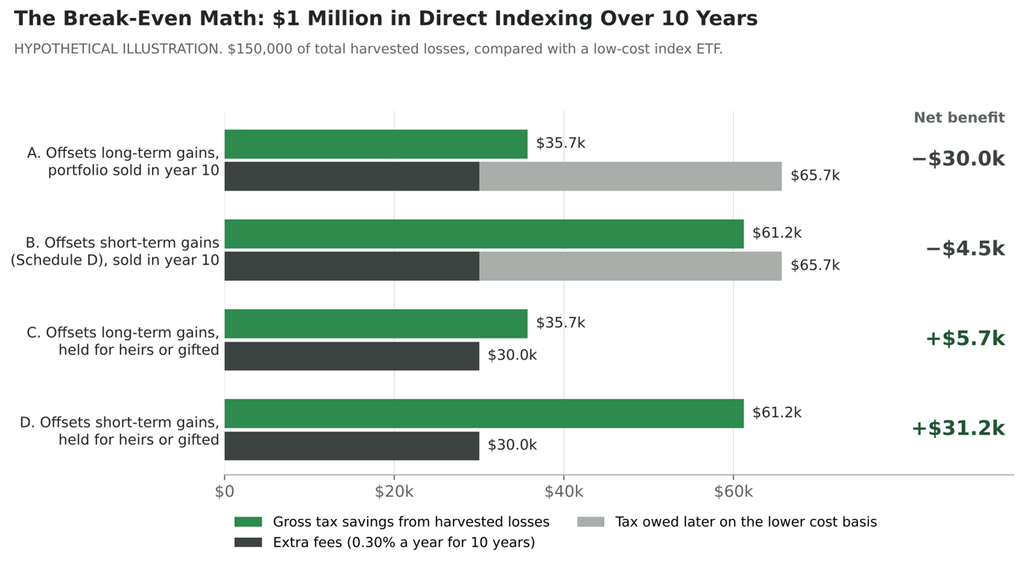
Hypothetical illustration only, not a projection of any strategy. Assumes a $1 million taxable account, $150,000 of total harvested losses over 10 years, and an incremental cost of 0.30% per year versus a low-cost index ETF, calculated on a constant $1 million balance for simplicity. Uses top federal rates of 23.8% (long-term) and 40.8% (short-term) and no state income tax. Excludes investment growth on deferred taxes and on fees, trading costs, and tracking differences. Fee assumption based on industry ranges reported by Schwab (2025) and Morningstar (2023).
Why such different outcomes? If the losses offset long-term gains at the top 23.8% federal rate (Morningstar, 2023), the investor saves $35,700 along the way but owes roughly the same $35,700 back when the lower-basis portfolio is eventually sold. After fees, that is a $30,000 hole, and the deferral would need to earn back that much just to break even.
If the losses instead offset short-term gains taxed at up to 40.8% (Morningstar, 2023), the investor locks in a permanent 17-point rate difference, which brings the result close to break even. And if the portfolio is never sold, the picture improves considerably. Inherited shares generally receive a new basis equal to their value at death, so the deferred tax may never be paid.
The pattern is what matters. Direct indexing tends to earn its keep for top-bracket investors with frequent short-term gains, and for families who plan to give or pass down appreciated shares. For a typical investor who will eventually sell and spend the money, the tax benefit can be largely eaten up by the fee. One more nuance: short-term gains paid out by mutual funds are taxed as ordinary dividends, so harvested losses generally cannot offset them beyond the $3,000 limit.
There is also a Texas wrinkle. With no state income tax here, our clients do not get the extra boost that investors in high-tax states do, so the federal math has to carry the case on its own.
Harvesting Decay: Why the Benefit Fades
Stocks generally rise over time, which is the whole reason you own them. But as more positions climb above their purchase price, there is less left to harvest. Investors commonly run out of meaningful losses within five to 10 years.
Figure 3. Harvesting Decay Over Time
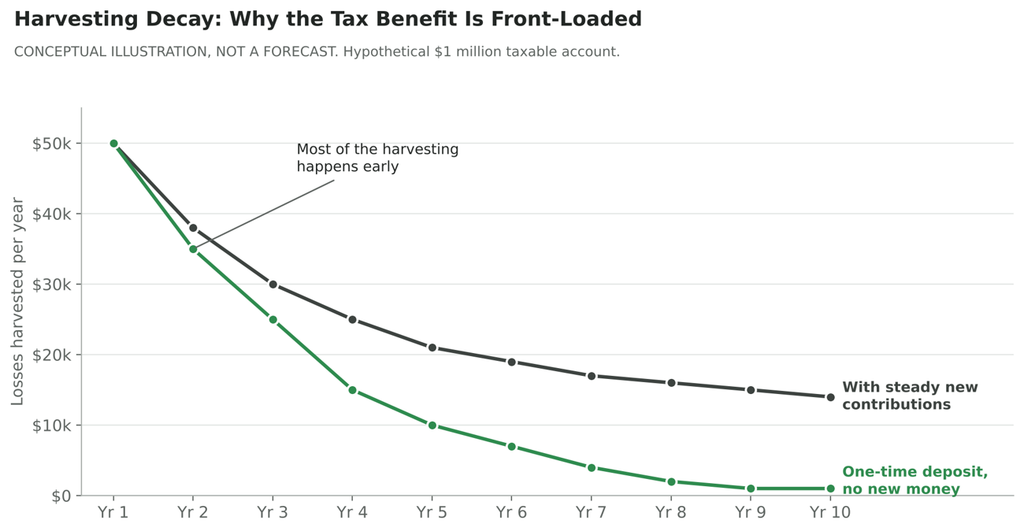
Conceptual illustration with hypothetical values; not modeled, back-tested, or forecast. The one-time deposit line totals the $150,000 used in Figure 1. It shows how harvesting opportunities tend to shrink as unrealized gains build, while new contributions create fresh tax lots.
Volatility and new contributions can refresh the opportunity. During the April 2025 sell-off, some tax-managed accounts harvested about 1.6% to 1.7% of assets in a single month (Dimensional, 2025). That is real, but remember that those are harvested losses, not returns. And if you are adding money regularly, ETF purchases made at different times create their own tax lots that can be harvested too, without owning hundreds of stocks.
The Exit Problem Nobody Puts in the Brochure
Fast-forward a decade. You may own 300 individual stocks, most with built-in gains. Moving to an ETF or a new manager means realizing those gains. Staying put can leave you holding what is essentially an index fund, at a higher price.
There are release valves. Appreciated shares can be given to charity or a donor-advised fund, which can sidestep the capital gain entirely, and shares held until death may receive a new basis. But those work best when they are part of the plan from day one. Add wash-sale tracking across every account you own (including your IRA) and pages of tax reporting each year, and the complexity is a real cost even when it does not show up as a fee.
So, Is Direct Indexing Worth It for You?
Figure 2. Who Benefits From Direct Indexing?
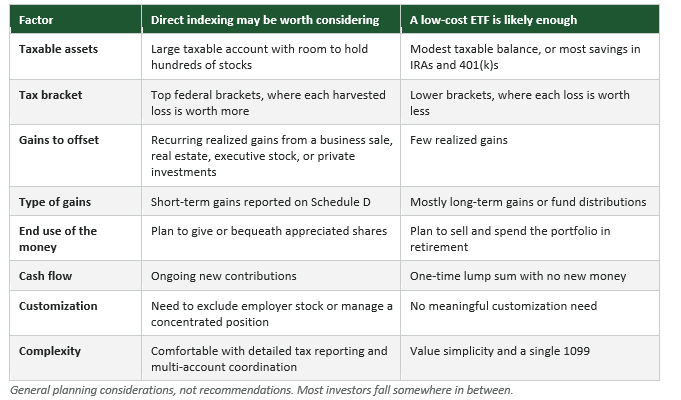
General planning considerations, not recommendations. Most investors fall somewhere in between.
There is one benefit an ETF cannot easily replicate: customization. For a DFW executive or business owner with a concentrated stock position, direct indexing can exclude that company’s stock and use harvested losses to diversify gradually. In those cases, the value goes beyond the tax math.
How We Think About It at Mills Wealth Advisors
Good tax management does not require direct indexing. Asset location, tax-aware rebalancing, harvesting at the ETF level, gifting appreciated shares, and timing gains around a business sale or retirement can all improve after-tax results. In our view, tax decisions work best when they are woven into the investment and planning decisions, not chased as a standalone scorecard of harvested losses.
As an independent fiduciary, we start with a measurable question: does this improve your after-tax wealth once every cost is counted? You can learn more about how we build and rebalance portfolios on our Investment Process page, and our upcoming November article on tax-loss harvesting digs into the mechanics.
Our takeaway: direct indexing tends to earn its fee when you have large taxable assets, recurring gains to offset, and a plan to give or pass down appreciated shares. Without those ingredients, a low-cost ETF paired with thoughtful tax planning will often deliver most of the benefit with far less complexity.
If you have received a direct-indexing proposal, we would be glad to compare it against a low-cost ETF alternative using your actual tax situation.
Frequently Asked Questions
Is a harvested loss the same as investment return?
No. Its value depends on your tax rate, what it offsets, and whether the tax comes back when you sell.
Can I harvest losses with ETFs instead of direct indexing?
Yes. You can sell an ETF at a loss and buy a similar, but not substantially identical, fund. Just be careful about the wash-sale rule: buying a substantially identical investment within 30 days before or after the sale, including inside your IRA, disallows the loss.
What should I ask before starting direct indexing?
Ask for the all-in cost compared with an ETF, where the gains you will offset are coming from, how wash sales are coordinated across your accounts, and what the exit plan is once the portfolio is full of gains.
This article is for educational purposes only and is not individualized tax, legal, or investment advice. Examples are hypothetical and do not represent any specific investment or guarantee any outcome. Tax rules can change; consult your tax professional about your situation.
Sources for Figures Cited
Dimensional Fund Advisors. (2025, May 15). A Silver Lining of Volatility? Dimensional UMAs at Work.
Morningstar. (2023, April 3). When Direct Indexing Truly Pays.
Morningstar. (2025, March 7). Ask Your Advisor These Questions Before Direct Indexing for Tax Management.
Charles Schwab. (2025, March 7). Tax Advantages and Risks of Direct Indexing.